
Johannesburg | Africa is becoming one of the most important growth markets for digital signage - young, fast-growing and increasingly attractive for international brands. But across many markets, unreliable power supply turns installation, operation and service into a discipline that requires local expertise.

South Africa: Digital Signage’s Gateway to Africa
Africa is one of the world’s most dynamic growth regions. The continent’s demographic momentum is reshaping global markets: according to the IMF, Africa’s population is projected to reach around 2.5 billion by 2050, while its working-age population will grow faster than any other age group. For retail, telecoms, banking and consumer brands, this creates enormous long-term potential – and with it, a growing demand for professional digital enterprise services and digital signage.
South Africa plays a special role in this development. It remains the continent’s most established business hub and, for many international companies, the operational gateway to Africa. Global brands often manage their African business from Johannesburg or Cape Town, while South African corporations such as MTN and Vodacom have built strong positions across the continent. For digital signage integrators, that makes South Africa both a market in its own right and a launchpad for projects far beyond its borders.
The Special Challenge: Power Supply
At first glance, digital signage in Africa is not fundamentally different from the rest of the world. Customers focus on Capex, digital concepts are still too often planned separately from architecture, and measurable objectives are frequently missing. So far, so familiar. But in large parts of Sub-Saharan Africa, one critical factor changes everything: reliable electricity cannot be taken for granted.
Power outages affect every layer of a digital signage network: availability, hardware stability, connectivity, service and maintenance. According to the International Energy Agency, around 600 million people in Sub-Saharan Africa still lacked access to electricity in 2023. Even where grid access exists, reliability can vary significantly from country to country, city to city and site to site.
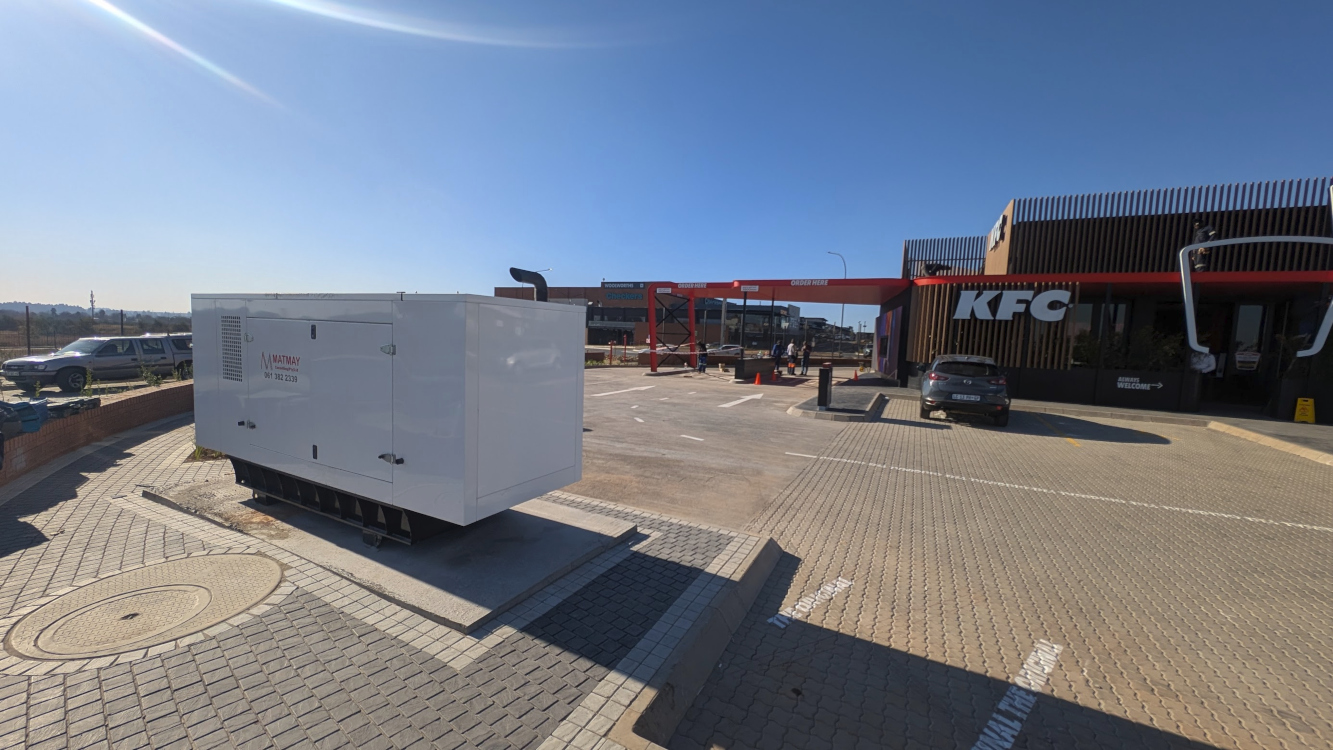
Telecom operators illustrate the scale of the challenge. In Nigeria, diesel generators at mobile towers are often essential to keep networks running during outages. Battery-based backup concepts have not always proved practical either: in some markets, batteries became so attractive on the black market that they were stolen from sites. The result is a return to diesel – expensive, maintenance-heavy and environmentally problematic.
South Africa and Load Shedding
South Africa has long struggled with load shedding – scheduled power cuts designed to prevent a full collapse of the national grid. Although the situation has improved compared with the severe crisis years, the underlying issue remains highly relevant for enterprises: energy security is still a planning parameter, not a given.
For retailers, banks, airports, quick-service restaurants and public spaces, this changes the business case for digital touchpoints. A black screen is more than a temporary failure; it undermines customer experience, advertising value and operational trust. In retail media networks, every hour offline can also mean lost campaign delivery.
Digital Signage Looking for Power
The expectations of retailers and service providers in Southern Africa are hardly lower than in Europe or North America. They want digital experiences, data-driven signage concepts and, increasingly, retail media monetization. But digital signage networks that are unexpectedly — or even predictably — disconnected from power for hours create operational complexity that many international concepts do not fully anticipate.
The quick fix is often to install a UPS. In practice, this helps devices, especially routers and media players, shut down cleanly. But affordable UPS systems are not designed to bridge several hours without electricity. For most deployments, they buy minutes rather than resilience.
Restart behavior after an outage therefore becomes critical. Fewer devices can be an advantage — for example, system-on-chip displays instead of external media players. Other integrators still prefer external players because they are easier to manage remotely. Either way, remote management is not a nice-to-have in Southern Africa; it is a core operating requirement.
Tools such as Teamviewer, Radix and other device management platforms are widely used to keep networks under control. For LED installations, advanced video controllers with remote device management functions can add another layer of resilience by enabling monitoring down to individual modules. The more distributed the network, the more valuable these capabilities become. Black screens are still seen more often than anyone would like. As in other markets, local ownership on site is often limited: frozen playlists, failed LED modules or broken media players are not always reported immediately.
Frequent outages also affect installation and maintenance. Technicians may travel long distances to install or service screens. If the power fails when they arrive, commissioning or repair simply has to wait — sometimes for an hour, sometimes for much longer. Without electricity, there is no service.
Local know-how Is mandatory
For global brands and international roll-outs, experienced local integrators are essential. They understand how to adapt digital signage concepts to local market realities and how to deliver installation and service on the ground. South African integrators are particularly well positioned: they combine regional experience, English-language business culture, a reliable legal environment, a European-friendly time zone and comparatively lower personnel costs.
That combination makes South Africa more than a domestic digital signage market. It is a gateway to Africa – and increasingly, a source of expertise for projects beyond the continent. For anyone planning signage networks in emerging markets, it is worth looking south. More than ever.
- QSR: Subway Unveils Digital-First Restaurant Concept for EMEA
- AV Monitoring: Axion Tests its Radar Maintenance Platform
- Nowsignage Interview: Retail, QSR and Global Growth
- Deep Dive for Retailers: The Big Retail Media Questions
- With Ocean Projections: Moment Factory Transforms National Geographic Museum