
Johannesburg | At Mediatech Africa, invidis’ first digital signage programme in Africa delivered a clear message: South Africa’s DS market is defined by pragmatism, resilience, and structural constraints. Integrators highlighted how power challenges, Capex-driven models, and content limitations continue to shape a stable yet still maturing market.
DSS Mediatech Africa: Pragmatism Shapes South Africa’s DS Market
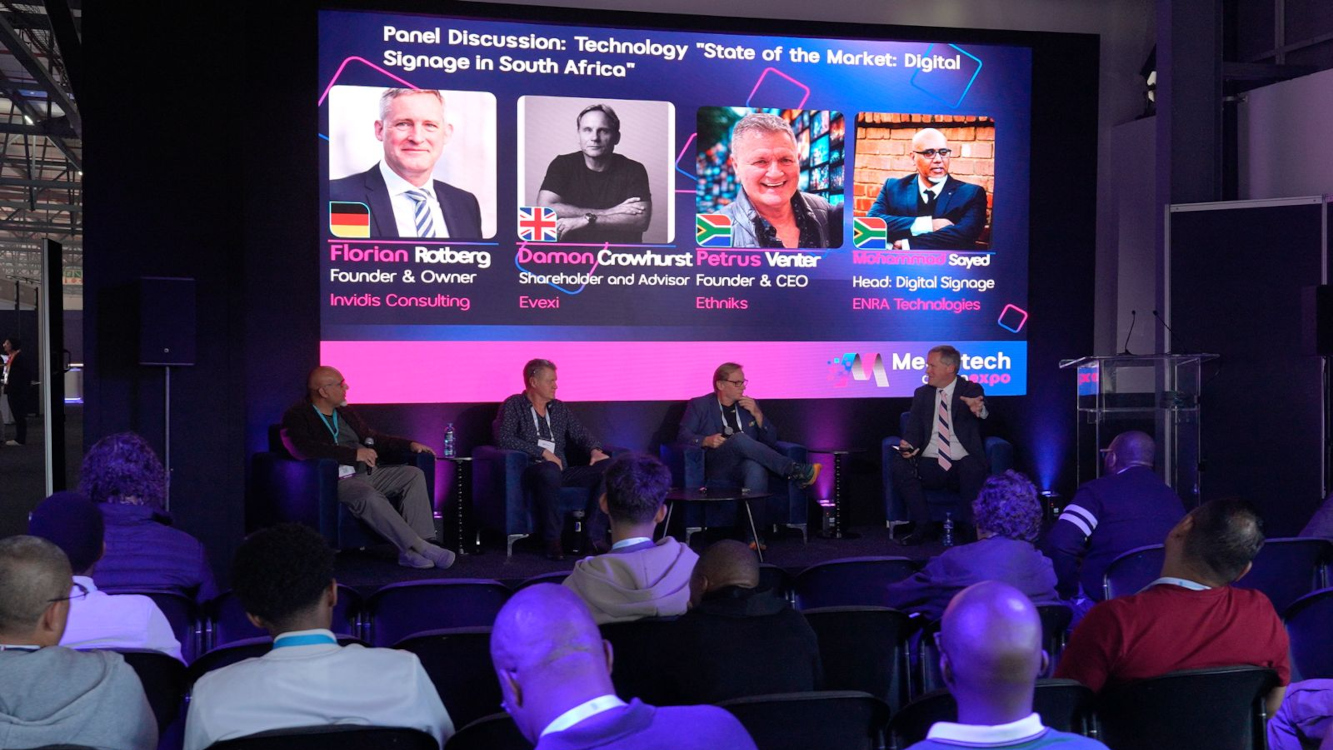
At Mediatech Africa 2026, invidis for the first time hosted a dedicated digital signage programme on the continent, including an integrator panel featuring three experienced industry specialists: Petrus Venter (Ethniks), Mohammad Bilal Sayed (Enra), and Damon Crowhurst (Evexi).
The discussion offered a pragmatic and unvarnished view of South Africa’s digital signage market – defined by practical deployments, structural constraints, and a cautious yet steady path toward maturity.
A recurring theme was resilience in the face of infrastructure challenges, particularly energy instability. While load shedding has historically shaped deployment strategies, panellists noted periods of relative stability, citing over 400 days without outages across South Africa. Nevertheless, the legacy of power uncertainty has driven innovation, including the use of ultra-low-power e-paper displays as a viable solution for critical communication during outages. Unfortunately e-paper displays are still too expensive to be deployed at larger scale. This reflects a broader tendency toward practical, fit-for-purpose technology choices rather than experimental or high-risk concepts.
Despite such innovations, the market remains firmly Capex-driven. Integrators agreed that digital signage projects in South Africa are still predominantly treated as capital investments rather than service-based Opex models. This financing reality constrains scalability and slows adoption of more advanced, data-driven or content-heavy applications.
Content itself continues to be a bottleneck. While hardware and system integration capabilities are well established, many end customers struggle to justify or sustain ongoing content investment. As a result, use cases are predominantly playlist driven information signage, and less data-driven with focus on transactional rather than experience. This is particularly evident in sectors like banking and telecommunications, where deployments focus on queue management, promotions, and information display rather than immersive or experiential engagement.
Retail – especially supermarkets – emerged as a notable exception. Here, digital signage networks are more advanced and integrated, benefiting from clearer ROI cases and established shopper marketing frameworks. However, even in this segment, innovation is often incremental rather than transformative.
Another defining characteristic of the local market is the growing involvement of IT integrators in digital signage projects. This convergence reflects the importance of network infrastructure, yet less so cybersecurity, but it also shifts the competitive landscape, with traditional AV integrators sharing ground with IT service providers.
Finally, the panel touched on broader systemic challenges, including corruption, which continues to impact procurement processes and project execution. Combined with economic pressures, this reinforces a cautious approach among clients and suppliers alike.
Overall, the session painted a picture of a market that is stable but not yet fully mature – one where practical constraints shape innovation, and where growth will likely depend on evolving business models, stronger content strategies, and continued collaboration across the ecosystem. But despite many challenges, South Africa is the continents most advanced digital signage market.
- Three Appointments: USSI Global Reshuffles Executive Leadership
- US OoH Industry: OAAA Launches Technical Council, Names New Chairman
- Haynes Column: Pixel Science and Pints – Jumping Over to Dublin to Understand Where Display Tech May Be Going
- Hospitality Displays: Samsung’s The Frame Hospitality TV Now Available In The US
- India: Kramer Creates Flexible Meeting Spaces for Sailpoint