
After DSS and before Infocomm, Dave Haynes primes Sixteen:Nine readers for what's to come – including his key takeaways from the Munich event, the trends he believes matter most, and his perspective on the recent Scala sale.
Haynes Column: Retired-ish – Notes from Munich, Scala’s Sale and AI Talk at DSS
I don’t know many times I got needled last week in Munich about the feeble job I was doing in being retired, but lots and lots.
Oh well …
I believe I said a year ago, when I stepped back from editing Sixteen:Nine, that I was only kinda sorta retiring. I still wanted to keep my hand in things, and see both the stuff and the people – just not nearly as much.
I went to the annual Digital Signage Summit Europe in Munich for a few reasons.
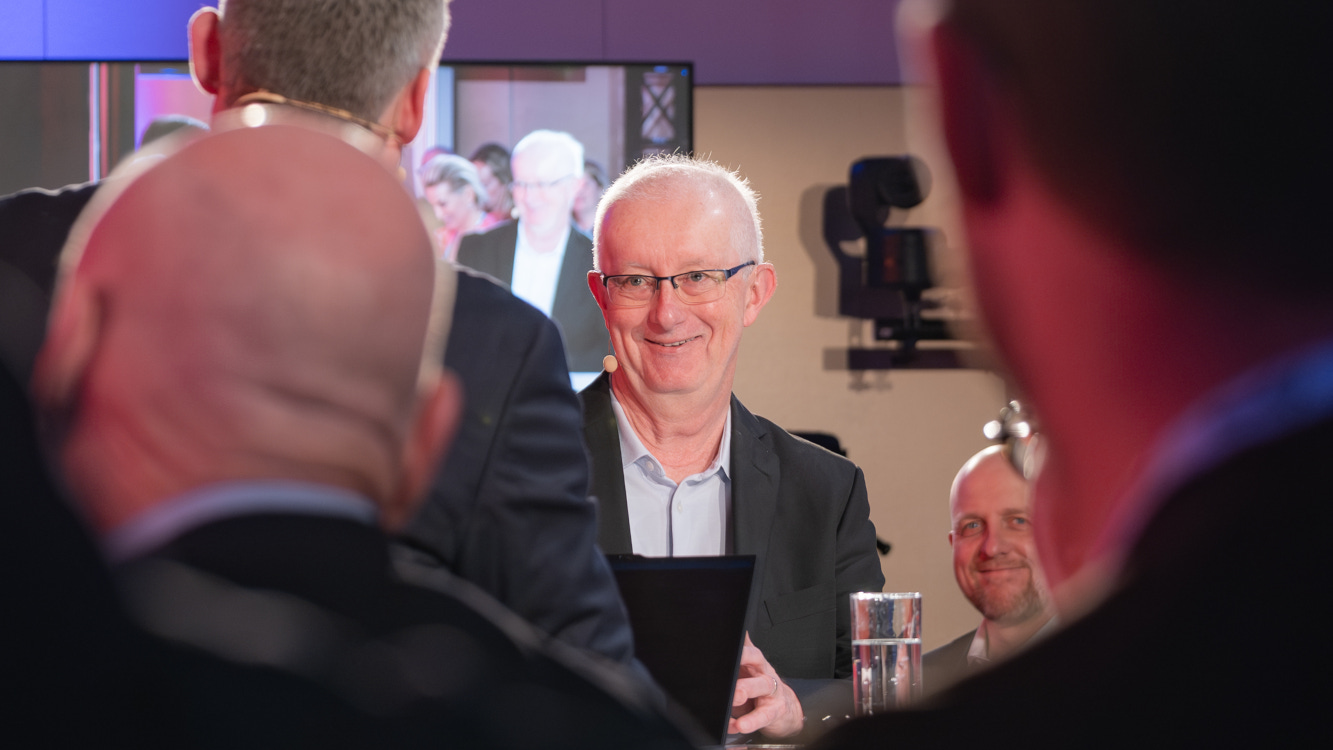
First, I was one of the moderators, steering five sessions on a variety of topics like retail media and cybersecurity. I also had a morning chat on the big boy stage with the hosts, Florian Rotberg and Stefan Schieker.
Second, I wanted to catch up a little on trends and emerging topics.
Third, I wanted to see some people. ISE in Barcelona has soooo many people and so many demands on time that a quality conversation at the venue is one that lasts beyond 30 seconds. At the Munich event, people have time.
I caught up with no end of very senior people from numerous big EU-based companies. At ISE, it would have been something like “Hey, nice to see you. Sorry, I have to run. Bye!”
Last week, we sat and had a coffee. Or weiss bier.
I learned about the big news of the week – Sweden’s Vertiseit buying Scala – while hanging out at the Airport Hilton lobby bar, and then the next morning, ended up chatting about the deal over breakfast with Vertiseit CEO Johan Lind.
He was pretty pleased, especially since he started his time in digital signage years back as a Scala reseller.
Several people asked me what I thought of the deal, and my general feelings are:
- sadness that Stratache has found itself in a position that it has to have what looks like a fire sale to keep the lights on;
- surprise that it is happening, given the smarts and seeming inexhaustible work ethic of founder-CEO Chris Riegel. I’ve asked insiders, who describe it as a perfectly bad storm of variables like tariffs and supply chain shortages, compounded by bad timing;
- curiosity about how Scala will be folded into a Vertiseit offer that already has three retail-centric technology offers in Dise, Grassfish and Visual Art.
The first time I went to Infocomm in 2007, when it was not yet cycling back and forth between only Las Vegas and Orlando. It was in Anaheim (LA) that year, and what struck me was how dominant Scala was at the show. It was a BIG dog in visual presence around the venue, in a way that’s much more familiar with the major display hardware guys.
That obviously changed, with a lot of industry observers suggesting the decision to start selling direct, downplaying the reseller channel, was what put Scala into a slide and allowed a lot of other retail options to get noticed and used. That slide led to Stratacache gobbling it up a decade ago, and for several years building its brand awareness back up.
Lind told me, and the DSS crowd more generally, that Scala will go back to its roots as a channel option. It’s been a long time now, but there would still be a lot of pro AV and retail solutions companies that have familiarity with (or at least top of mind awareness for) the Scala brand.
Will it be easy? Nope. All kinds of dynamics come into play when people and companies that used to compete are put in the same room and asked to collaborate and make nice.
Lind says the goal is to gradually harmonize and unify the in-store software offer, perhaps in two years or so.
As you might imagine, there were numerous discussion sessions at DSSE about AI – both how it is now being used and the implications that it has for the still-way-too-many companies with SaaS content management systems.
Certainly, the level of sophistication being applied has gone up, in tandem with the rising capabilities of AI services. But there is also raised sophistication because the CTOs and product owners in a bunch of companies are at least now on the learning curve, and realizing AI capabilities have to be much broader than enabling quick and dirty visuals.
The term orchestration was used several times at DSSE sessions, and it is very appropriate in describing how putting together relevant and impactful on-screen content has evolved from pre-determined playlists and schedules. Now, on-screen presentations are being pulled together, shaped and triggered by an array of variables fed by available data, with agentic AI conducting this orchestration.
It is a super-nerdy term, but I’d encourage anyone thinking about product and solutions in this sector to at least get familiar with something called Model Context Protocol, or MCP. It is the bridge that interconnects everything from external tools and databases to software stacks and information systems.
There was also a lot of discussion about where CMS software fits going forward, and if AI is an existential threat to these kinds of platforms.
Not sure I agree, but there seemed to be a consensus that AI would change things, though not rendering platforms irrelevant. I think if a vendor has a narrow purpose platform – let’s say menu boards, meeting rooms or queue management – it is definitely at risk of being marginalized or supplanted by agentic AI applications built in-house and tuned very specifically to a need and workflow preferences.
That might not be the case for more robust, many-featured platforms that would need an array or agents and much more of a nod to security, scalability and remote management. But I do think the days are numbered for medium to enterprise-sized customers operating a CMS as a separate login, application and workflow.
As was suggested in moderated panels and main stage chats and presentations, digital signage is moving towards being an application in a larger toolset. A good example of this already in play: Appspace’s digital signage application is natively integrated in Microsoft Teams Rooms.
If people work all day in one toolset, do you really want to login to a separate application to do something related with networked screens?
Another way of thinking about it is the shift by the people who run AV and IT networks to “single pane of glass” applications that act as business operations dashboards that ingest, use and surface data from other platforms and connected endpoints.
I have no idea of attendance size at what was the 20th edition of this annual event, but it looked very busy to me – standing room only for the opening keynote, and packed social events.
For years and years, I’ve been saying the industry needs and benefits from getting together for a couple of days to efficiently meet, share ideas and generally hang out. That works very well with this event – in part because it is an airport hotel far from the distractions and attractions of a big, fun city.
The now-dead DSE was on an inexorable slide as a trade show, with floor space steadily shrinking. But it pulled a lot of people year to year, despite that, because the North American industry wanted a gathering. A shift to education and networking – influenced by what is done in Munich – went over well in San Diego, but I am guessing it was very hard for a show owner whose DNA is selling exhibit space to instead do something where that was very much the secondary purpose.
Now the annual gathering point is Infocomm, by default. It’s a show that is probably 80% (total guess) people who have no ties to digital signage, but still has a sizeable chunk of people who do wake up thinking about that stuff.
There are a couple of networking events at the show in June – an XUSC party organized by Bryan Meszaros and a Sixteen:Nine Mixer driven by the SignageOS guys (don’t hit me up for tickets, I have zero involvement). The Snap-Velasea guys are again doing a golf outing, which is always interesting when it is 110F.
I’ve not been traveling into the US – at all – since the 51st state nonsense came up (research using mobile signal data suggests overall Canadian travel to US is off 42%, so I’m among MANY).
But I am now going to Las Vegas for the show in mid-June. I’m still doing a little side-work here and there, and that sees me making the trip. I have zero issue with Canadians going south for business and job reasons.
It will be great to see a bunch of American friends who don’t get to ISE or DSS, and there will be some tech to look at, as well.
If we bump into each other: Yeah, I know. I’m doing a crap job of being retired.