
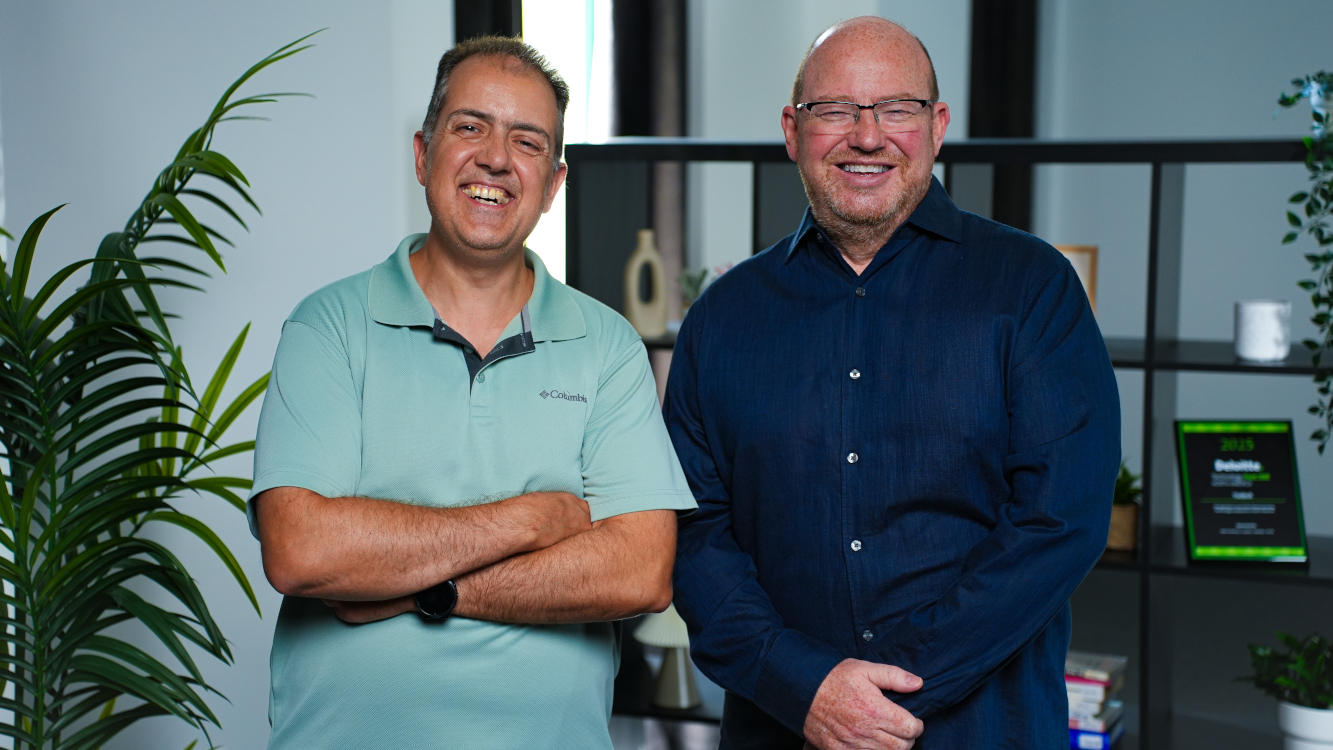
Athens | Yodeck is one of digital signage's best-kept success stories, growing rapidly by focusing on what many competitors overlook: simplicity. In an exclusive interview in Athens, CEO Vangelis Mihalopoulos and CMO James Robins explain how the company plans to scale from 350,000 touchpoints to more than one million active licences.
Yodeck: Simplicity Sells
Yodeck is one of the hidden champions of the digital signage industry. The market thinks it knows what the US-based provider with Greek roots is all about, yet surprisingly little is actually known. invidis travelled to Athens for an exclusive background interview with CEO Vangelis and CMO James.
From Athens to North America
Summer may be drawing to a close, but temperatures in the Greek capital still reach 37 degrees Celsius in the shade. While tourists endure the blazing sun on the Acropolis, invidis enjoys the air-conditioned headquarters of Flipnode in downtown Athens, gaining deep insights into both the parent company and its flagship product, Yodeck. It quickly becomes apparent that Yodeck truly understands digital signage. There is no need to carry owls to Athens.
The long-tail digital signage software provider has been on the market since 2015 and has been remarkably successful. Over the past three years, the company, which now employs around 200 people primarily in Athens, has grown by 40 to 60% annually. For three consecutive years, Flipnode has been recognised in Deloitte’s Technology Fast 500 ranking for North America, which honours the region’s fastest-growing technology companies.
Today, more than 65,000 customers use Yodeck across over 350,000 touchpoints.. The Raspberry Pi-based external media player is a cornerstone of Yodeck’s success story, which revolves around simplicity. Customers simply connect the pre-configured box to a screen and the internet, and the solution is ready to go.
Simplicity as a Growth Engine
The simplicity of the user interface, built on a modern ISO 27001-certified technology stack, is another key ingredient of Yodeck’s success. Every month, the company adds more than 1,000 new customers. Half of them are first-time digital signage users, while the other half are experienced users migrating from competing platforms. Project sizes are also growing steadily. While smaller projects remain the dominant customer segment, the largest deployments already exceed 4,000 licences. Simplicity sells, not only to small family-run businesses but increasingly to enterprise customers as well.
According to CEO Vangelis Mihalopoulos, Yodeck’s success is rooted in its strong product-market fit. “Yodeck is extremely sticky. Customers and users love the simplicity.”
A majority run on Yodeck’s own media player, customer surveys reveal that one of the most important purchasing criteria is its multi-platform support. The Greek-American digital signage solution runs on Samsung Tizen, Android, Sony Google TV, Amazon Fire OS, and others. The partnership with Amazon in particular is developing “very promisingly.” North America was where Yodeck acquired its very first customer, and today the region accounts for 55% of total revenue.
Enterprise Without Complexity
“Simplicity is key, even for multinational clients.”
This philosophy also applies to Yodeck’s enterprise customers, many of whom operate in manufacturing and industrial environments. Screens are often used for far more than traditional signage, with dashboard applications particularly popular. However, each site tends to have its own requirements. At one industrial customer, around 300 content managers are responsible for CMS operations. On the surface, it appears to be a large enterprise deployment, but because of the highly decentralised requirements, it actually behaves more like 300 individual SMB networks. Local ownership favours simplicity.
Yet Yodeck remains firmly focused on being a straightforward product. “We are not a complex digital signage platform.”
The Partner and Platform Strategy
Together with strategic partners, the company also offers vertical-market solutions for sectors such as QSR and retail. In these cases, partners take responsibility for industry-specific customisation while Yodeck supplies the CMS as a white-label platform.
Even without a headless architecture, Yodeck supports popular content creation tools. Canva, which is particularly popular among younger users, can be used as a digital signage editor within the Yodeck ecosystem. Additional applications can be integrated through open APIs and MCP-based connections.
For Vangelis Mihalopoulos, James Robins, and the broader team, the company’s success comes down to a clearly defined go-to-market strategy: a highly scalable digital signage solution without unnecessary complexity. Even first-level customer support is handled in-house, keeping the company close to customers and providing a direct feedback loop into product development.
Cybersecurity is a particular passion for software engineer-turned-CEO Vangelis Mihalopoulos. By controlling both hardware and software through its own Raspberry Pi-based player platform, Yodeck maintains end-to-end oversight. Core applications are updated every six weeks, with Chromium browser updates deployed whenever required. ISO 27001 certification has become standard practice, and a SOC 2 certification, particularly relevant for the US market, is next on the roadmap.
Betting Big on AI
Yodeck is also deeply committed to AI. Within just six weeks last year, the entire organisation completed AI training, introducing AI capabilities across departments and updating business processes accordingly. The company also benefits from the expertise of its Silicon Valley private equity minority investor, with best practices regularly shared across portfolio companies.
Over the past few years, Yodeck has evolved from an SMB-focused vendor into a mid-market specialist. The segment between SMB and Tier-1 enterprise customers now accounts for 45% of total revenue. The company’s ambitions are equally impressive. Within four years, it aims to manage more than one million active licences, entirely through organic growth.
Since day one, Yodeck has remained cashflow positive. Having founded the company during the financial crisis, Vangelis Mihalopoulos continues to lead with a conservative financial mindset. The experience of suddenly facing financial hardship while supporting a young family continues to shape his approach to business today.
This philosophy is also reflected in the company’s unusually generous employee benefits. Yodeck supports family planning by covering up to three IVF treatments and contributes towards childcare expenses. These are exceptional benefits, even for one of Greece’s leading SaaS companies.
Expanding Across Europe and the Americas
All signs point to continued rapid growth. To replicate its North American success across Europe, Yodeck is expanding multilingual support capabilities, including German and French-speaking teams.
At the same time, the company remains focused on further expanding its presence in the United States. Not only is the formal corporate headquarters located there, but the country also generates more than half of Yodeck’s revenue. To support future growth, the company is building a multilingual sales and support team on the US East Coast to serve customers throughout North and Latin America.
The Road to USD 100 Million ARR
As evening falls over Athens and the illuminated Acropolis dominates the skyline, we find ourselves surrounded by weary tourists. CMO James Robins, however, shows no sign of fatigue. The focus is clear, and the roadmap is defined.
Yodeck already surpassed direct-to-market competitor ScreenCloud in annual recurring revenue at the beginning of 2025. Before the end of the decade, the company aims to break through the symbolic USD100 million ARR barrier.
A European success story in the making. Despite all the scepticism often directed at the continent’s technology sector, Yodeck demonstrates that simplicity remains a highly attractive proposition.
- Retail Media: Spar Integrates In-Store Channels with Footprints AI
- Three Appointments: USSI Global Reshuffles Executive Leadership
- US OoH Industry: OAAA Launches Technical Council, Names New Chairman
- Haynes Column: Pixel Science and Pints – Jumping Over to Dublin to Understand Where Display Tech May Be Going
- Hospitality Displays: Samsung’s The Frame Hospitality TV Now Available In The US