
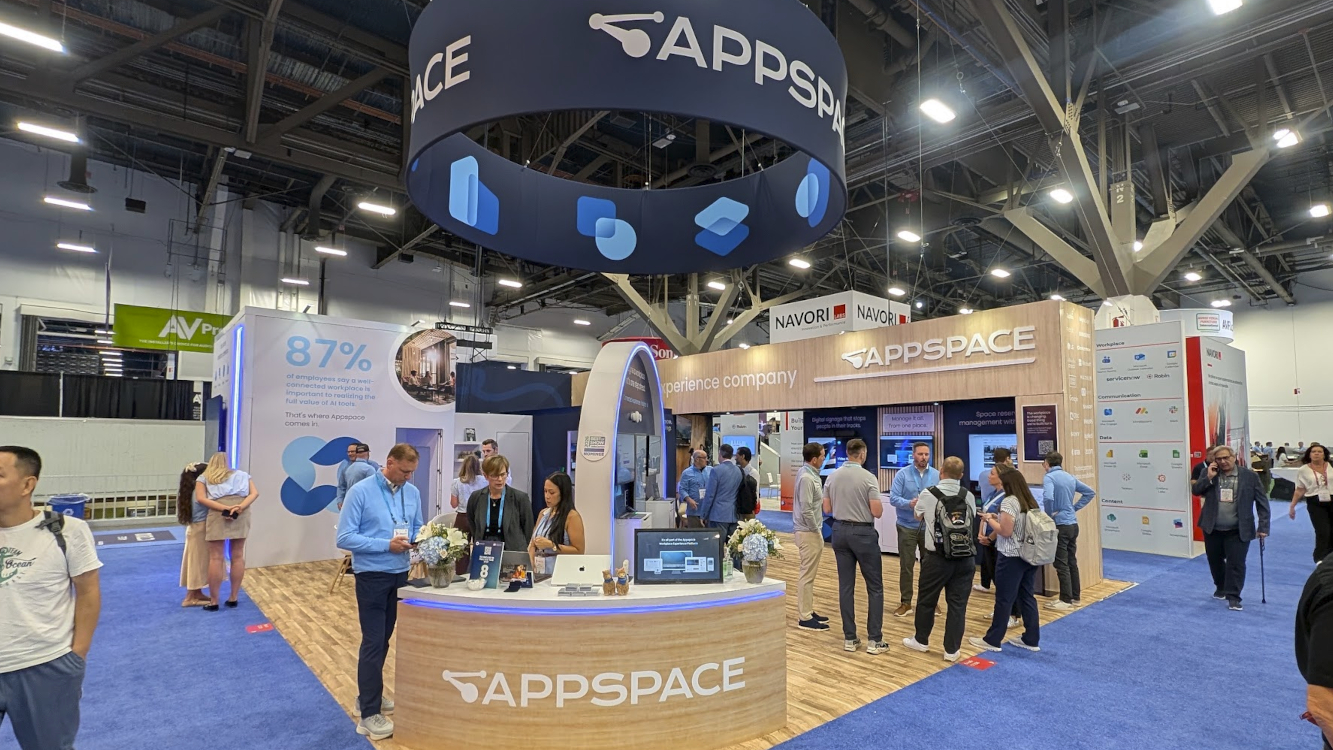
At WOW26 in Scottsdale, Appspace unveiled "Appspace Context", a platform vision designed to make workplace experiences more responsive, personalized, and situationally aware. At the center of the announcement is Situational Signage, a concept that could unlock one of digital signage's most underutilized capabilities: context.
Context: Appspace Unveils Situational Signage
At its annual WOW conference, Appspace presented a vision for a workplace that not only relies on AI and automation, but also understands what is happening around employees in real time. The workplace experience specialist introduced Appspace Context, a framework spanning intranet, visitor management, room booking, communications, and digital signage.
For the signage industry, the standout announcement was Situational Signage.
From static screens to situational awareness
Digital signage has evolved from simple playlists to data-driven content delivery. Yet most workplace screens still operate on predefined rules based on location, screen groups, and schedules.
Appspace believes the next step is contextual awareness. Instead of focusing solely on where a screen is installed, Situational Signage considers what is happening around it. Occupancy levels, visitor activity, room bookings, and workplace events can all influence the content displayed.
A lobby screen, for example, could automatically prioritize visitor information when guests arrive, while floor displays could adapt to changing meeting schedules or occupancy levels without manual intervention.
The approach shifts digital signage from a static communications channel toward a responsive workplace tool.
Connecting workplace data
According to Appspace, the required context already exists within most organizations but remains fragmented across separate systems.
Appspace Context aims to bring together communications, spaces, visitors, signage, workplace activity, and third-party platforms into a common framework. The goal is a workplace experience that continuously adapts to changing conditions rather than relying on predefined scenarios.
In controlled office environments, where occupancy, reservations, and employee activity are already digitally tracked, contextual experiences are considerably easier to implement than in public-facing environments.
Organic UI adapts to the user
Alongside Situational Signage, Appspace introduced Organic UI, an adaptive interface concept that dynamically changes based on a user’s role, location, and immediate needs.
Rather than presenting fixed menus and workflows, Organic UI surfaces the most relevant information, tools, and actions while moving less relevant elements into the background. The concept reflects a broader AI-driven trend toward interfaces that adapt to users instead of requiring users to navigate software structures.
A glimpse of the future
Appspace’s announcement highlights a broader industry trend: as AI makes content creation easier, context becomes increasingly important. The challenge is no longer generating information, but delivering the right information to the right person at the right moment.
Whether Appspace can scale its vision remains to be seen. But the announcement demonstrates that workplace experience platforms are moving beyond content management toward systems that react to real-world conditions.