Singapore | Chinese AI providers are launching a price offensive that could reshape the global AI market. With Western enterprise customers reporting savings of up to 90% and digital signage vendors increasingly embedding AI into their platforms, low-cost Chinese models are becoming impossible to ignore.

Opinion: China Models Could Slash AI Costs by 90%
After a week of intensive meetings across Asia, it is time to take stock. One topic ran like a common thread through almost every conversation: artificial intelligence – and the rapidly escalating costs that come with offering AI-powered features to customers at scale.
For software vendors, a new category of operating expenses has emerged in the form of token-based AI usage fees, costs that are difficult to predict and are not covered by traditional per-screen licensing models. The key question is therefore: Will usage-based AI fees become a standard addition to screen licenses in the future? Or could significantly cheaper Chinese AI models offer a way out of the cost trap? Some thoughts on the future of AI in digital signage – and China’s growing role in the global AI race.
The global AI market is dominated by US companies such as OpenAI, Anthropic, Google and Microsoft. But a new challenge is emerging from China, where AI developers are benefiting from strong government support, abundant investment capital and significantly lower operating costs.
One of China’s biggest advantages is energy. AI data centers consume enormous amounts of electricity, making power costs a critical factor in the economics of large language models. In China, energy remains comparatively inexpensive, helping local AI providers operate at far lower cost levels than many of their Western competitors.
Combined with subsidized infrastructure and aggressive investment strategies, Chinese AI companies are now using pricing as a strategic weapon.
AI performance at a fraction of the cost
The cost difference is becoming increasingly difficult for enterprises to ignore.
According to data from AI benchmarking platforms, performing a standardized intelligence task with Deepseek can cost as little as USD 0.02, compared to approximately USD 2.75 for the same task using Anthropic’s Claude. While actual enterprise deployments vary significantly, many large customers report savings of up to 90% when integrating Chinese AI models into their workflows.
For procurement departments facing growing AI budgets, these numbers are hard to overlook. The result is a growing willingness among Western enterprises to evaluate Chinese alternatives, particularly for less data and cyber security sensitive queries.
Open source disruption
The competitive threat extends beyond pricing.
Many Chinese AI developers have embraced open-source strategies, enabling organizations to deploy models on their own infrastructure or through third-party cloud providers. This approach reduces vendor lock-in and further lowers costs.
For western AI-companies such as OpenAI and Anthropic, the challenge is significant. Their business models depend on premium AI services and consume-based usage fees. If increasingly capable Chinese models are available at a fraction of the price, profit margins and international growth prospects may come under pressure.
The risk is particularly pronounced in overseas markets where enterprises are largely focused on performance-to-cost ratios rather than geopolitical considerations.
Enterprise buyers are mixing models
Rather than choosing a single AI provider, many Western enterprises are adopting a multi-model strategy.
AI aggregation platforms such as Perplexity and other model-routing services allow users to access multiple AI engines through a single interface. Organizations can then select the most cost-effective model for each task, balancing performance, compliance requirements and budget considerations.
This model arbitrage is becoming increasingly common. High-value tasks may still be routed to leading US models, while routine workloads are directed to lower-cost Chinese alternatives.
As a result, competition is shifting from model quality alone to a combination of quality, availability and price.
Implications for digital signage
For the digital signage industry, lower-cost AI models could become a major catalyst for large-scale AI adoption. Network operators, retailers and DooH media owners are increasingly relying on AI-generated content, automated campaign creation, audience analytics and real-time content adaptation. Some of the task like content creation maybe outsourced to Chinese AI models, while audience analytics and coding will remain for cyber security reasons on Western models.
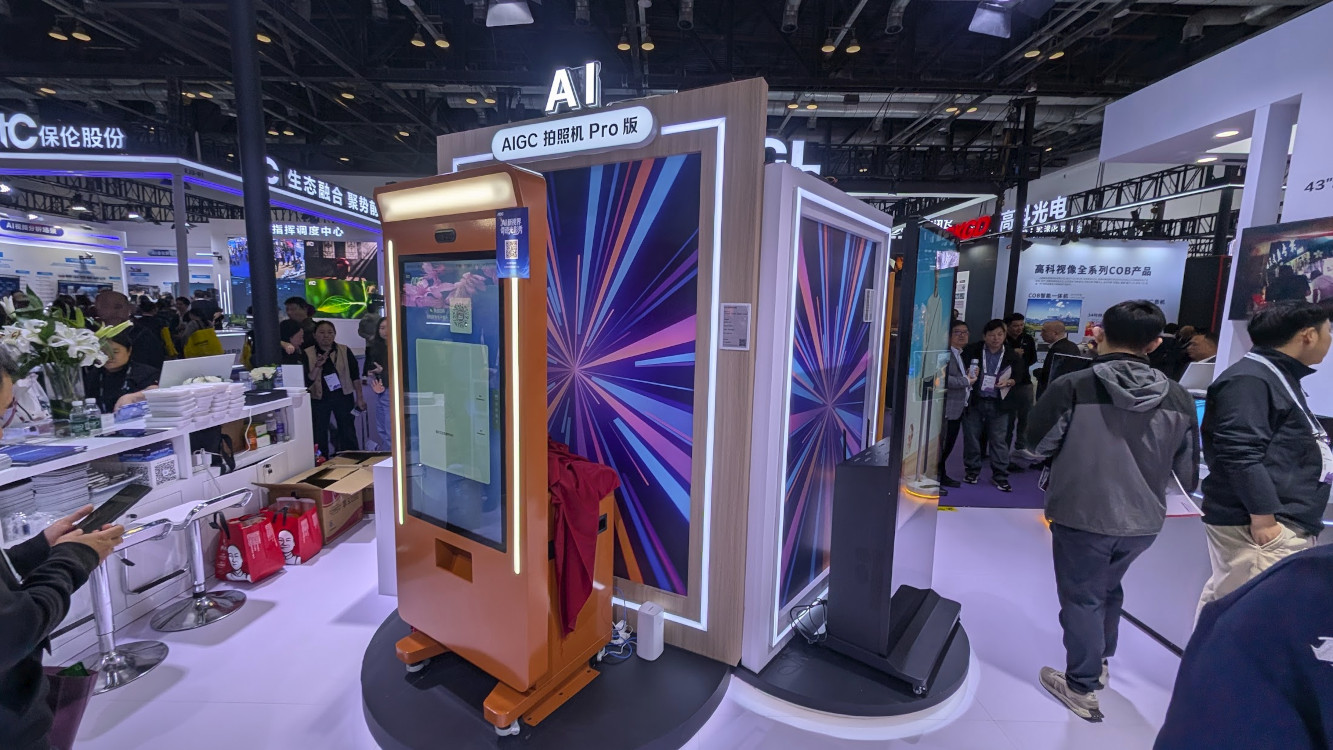
Chinese AI models with dramatically lower operating costs could make AI-powered signage applications economically viable. In April at Infocomm China vendors presented already ready to use AI-edge server with open-source Chinese AI-models for digital signage companies. invidis talked to a few albeit Middle East, Africa and Latam based ISVs and integrators praising the low cost and high performance,
A new phase of the AI race
The first phase of the AI boom was defined by technological breakthroughs. The next phase may be decided by economics.
Chinese AI providers are entering the market with a cost structure that many Western rivals struggle to match. Backed by government support, private capital and inexpensive energy, they are positioning themselves to expand globally while undercutting established US vendors.
For OpenAI, Anthropic and other Silicon Valley leaders, the challenge is no longer just building the most powerful model. It is demonstrating why customers should continue paying a premium when increasingly capable alternatives are available for a fraction of the cost.
Western digital signage providers are understandably hesitant to use Chinese AI models. However, not all AI tasks raise privacy concerns; the industry should at least consider the available options.
- Events: DPAA Summit To Explore Sports Marketing And Fan Engagement
- OoH Campaigns: Land O’Lakes Brings Rural America To Times Square
- Clear Channel: Final Regulatory Hurdle Cleared
- Korbyt Connect 2026: Korbyt Launches Customer And Partner Event At Dallas-Area HQ
- Distribution: Evexi Names Thorvin Electronics Exclusive Canadian Distributor