
Brightsign is expanding its platform with Control Plus, a new premium tier designed to bring greater visibility and control to large-scale signage networks. As device management becomes mission-critical, the company is sharpening its software strategy to stay ahead in an increasingly competitive market.
Infocomm 2026: Brightsign Steps Up Network Control
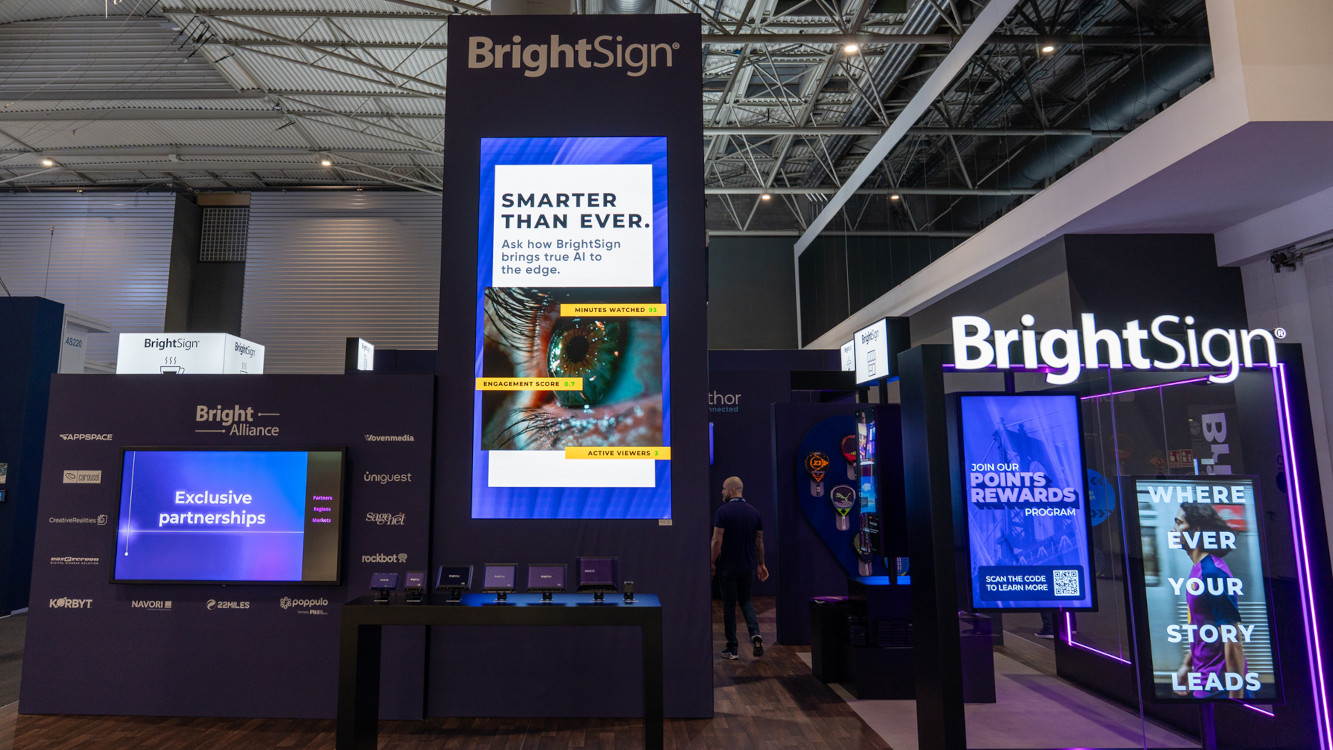
At Infocomm 2026, Brightsign is doubling down on device management. The self-declared global leader in digital signage media players has introduced Brightsign Control Plus, a new premium tier within its remote device management offering – now streamlined under the name Brightsign Control.
The move reflects a broader shift in the industry: as digital signage networks become increasingly business-critical, expectations around monitoring, uptime, and operational control are rising fast.
More control for enterprise-scale networks
Brightsign Control Plus is a paid-for premium cloud-based solution designed to give integrators and end users deeper visibility into distributed signage networks. From a central dashboard, users can configure, monitor, update, and schedule actions across fleets of Brightsign OS-powered players.
The premium tier targets IT managers, system integrators, and multi-site operators who require real-time oversight and scalable management capabilities. In particular, Brightsign is responding to growing demand for tools that ensure consistent performance across large, geographically dispersed deployments.
The standard version of Brightsign Control – formerly known as bsn.Control – remains free with every Brightsign player and is already used across hundreds of thousands of deployed devices worldwide.
Portfolio consolidation under the Brightsign brand
Alongside the launch, Brightsign has reorganized and unified its software portfolio under a single naming architecture:
- bsn.Control → Brightsign Control
- brightAuthor:connected → Brightsign Author
- bsn.Content → Brightsign Author Plus
The rebranding signals a push for clearer positioning and tighter integration across Brightsign’s ecosystem, particularly as software and services become central to its value proposition.
RDM becomes standard across the industry
The introduction of Control Plus highlights a wider market trend: remote device management (RDM) has become a baseline requirement rather than a differentiator.
Display manufacturers are increasingly embedding their own platforms – Samsung continues to promote its proprietary remote management environment, while vendors such as TCL and Sharp ship displays with third-party RDM solutions like Radix pre-installed. At the same time, vendor-agnostic platforms like SignageOS are gaining traction by offering cross-hardware management layers.
Against this backdrop, Brightsign is strengthening its vertically integrated stack, combining hardware, OS, and now an expanded management layer.
Brightsign Built-In ecosystem expands with Sharp
Hardware partnerships remain a core growth driver for the manufacturer of the famous purple media-players. At Infocomm, Brightsign is showcasing the latest additions to its Brightsign Built-In (BSBI) program, with Sharp joining as a new partner.
The collaboration includes the Sharp SDM player with Brightsign Built-In, which is being presented publicly for the first time. The BSBI initiative allows display manufacturers to directly embed Brightsign’s OS and media player capabilities into screens, reducing the need for external hardware. An increasingly attractive offering since memory prices have five-folded and CPU doubled in the past 12 months – making external media-players much more costly.
AI moves to the edge
Another focus at the booth: AI at the edge. Brightsign continues to integrate AI capabilities directly into its players via a built-in Neural Processing Unit (NPU).
Use cases demonstrated at Infocomm include automated monitoring of content playback, such as detecting incorrect aspect ratios or blank screens. These AI-driven diagnostics aim to reduce downtime and speed up issue resolution – an increasingly relevant capability for large-scale, business-critical networks.
- 55” Signage Display: Amazon Goes All-In on Digital Signage
- Qompose: Navori Launches AI-First Unified CMS Platform
- Integrated Communications: Uniguest Launches Community Hub For Senior Living Communities
- Virtual Production: Brompton Powers New Virtual Production Studio In Germany
- Research: Office DooH Screens Generate 3.4 Times More Attention