
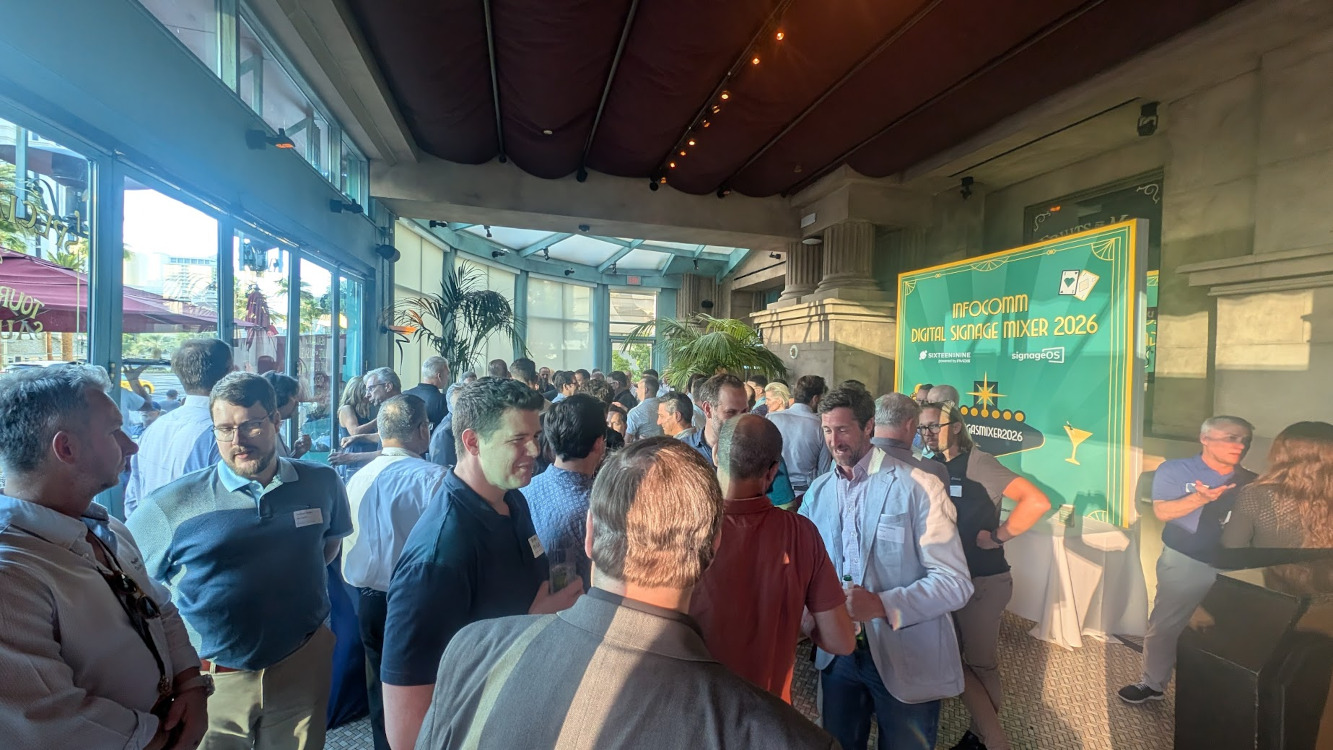
Las Vegas | More than 120 C‑level executives gathered in Las Vegas for the exclusive Sixteen:Nine/SignageOS mixer, setting a confident and forward-looking tone ahead of Infocomm 2026. Against a backdrop of market shifts, rising costs and AI disruption, the evening highlighted both the resilience and the competitive intensity of the North American digital signage industry.
Sixteen-Nine Mixer: Setting The Tone for Infocomm 2026
On the eve of Infocomm 2026, more than 120 C-level executives from across the North American digital signage ecosystem gathered for the traditional Sixteen:Nine mixer – a key industry get-together hosted by invidis and SignageOS. Held at the foot of the Eiffel Tower replica in Paris Las Vegas, the networking event once again proved to be one of the most sought-after pre-show rendezvous. With outside temperatures climbing to a scorching 44°C (111°F), the air-conditioned venue offered a welcome retreat – especially for participants coming straight from the endurance test that is the Infocomm digital signage golf scramble, which lasted an impressive nine hours.
Building on the new C‑suite–only mixer concept first introduced at ISE, the invite-only format proved highly successful. The sharper focus on senior executives also enabled exclusive co-branding and sponsorship with SignageOS – creating a truly high-level networking environment on the eve of Infocomm.
Optimism defines market sentiment
Despite ongoing structural challenges, the overall mood among North American executives could hardly be more positive. Industry leaders see themselves in a strong position within an increasingly competitive market – and many conversations reflected a quiet confidence about continued growth.
The North American digital signage market remains the largest globally and continues to attract investment and innovation. For many in attendance, the evening confirmed that demand fundamentals remain intact, even as competitive intensity rises.
Stratacache in focus
One of the most discussed topics of the evening was Stratacache and the shifting dynamics around the long-time market leader. Executives exchanged views on the company’s current challenges and the broader implications for market share redistribution.
In particular, the industry showed strong interest in Dise CEO Sebastian Kryh, who became one of the most sought-after voices of the evening. He faced repeated questions regarding the Vertiseit group’s acquisition of Scala and its strategic direction moving forward. The discussion underscored how closely the industry is watching consolidation moves and leadership transitions.
Display market disruption
Beyond software and integration, the display segment is undergoing its own transformation – another major talking point at the mixer.
The absence of market leader Samsung from the Infocomm show floor this year, combined with Sharp’s first-time absence, sparked considerable debate. Industry insiders are closely observing how the traditional Korean giants will position themselves against increasingly aggressive Chinese competitors.
At the same time, new market constellations are emerging. The recently formed TCL/Sony joint venture is raising questions about future go-to-market strategies, while smaller and specialized display providers such as Bluefin could find opportunities in the shifting landscape.
Cost pressures move center stage
While previous years’ conversations were dominated by tariffs and trade uncertainties, 2026 discussions have clearly shifted. Rising costs for memory, CPUs and storage are now top of mind.
These cost increases are forcing the industry to rethink established architectures. Many executives are evaluating alternatives to external media players and discussing how to maintain affordability in large-scale deployments. The underlying question: how to balance performance, scalability and cost in an environment where hardware pricing is becoming increasingly volatile.
AI reshaping business models
Particularly for independent software vendors (ISVs) and system integrators, questions around AI integration dominated many conversations. Executives are exploring how to incorporate frontier AI models into their platforms – and, crucially, who will absorb the associated costs.
There is growing consensus that traditional screen-based licensing approaches will need to evolve. New hybrid models combining licensing and consumption-based billing are emerging as the likely solution, especially given the token-based cost structures of many AI services.
Yearbook premiere for the Americas
The evening also served as a platform to preview a major invidis milestone: the first North American edition of the invidis Yearbook.
Set to be officially launched during Infocomm, the invidis Yearbook Americas introduces, for the first time, comprehensive digital signage rankings for the USA and Canada, alongside a dedicated overview of the Latin American market. The publication aims to provide greater transparency and data-driven insights across the region.
A strong start to Infocomm week
As conversations continued late into the evening, the Las Vegas Sixteen:Nine/SignageOS mixer once again demonstrated its role as a barometer for the digital signage industry. Amid shifting competitive dynamics, rising cost pressures and transformative technologies like AI, one thing became clear: the North American market remains highly resilient – and full of opportunity.