
Jeep’s latest DooH campaign in Brazil turns bus shelters into real-time, AI-powered touchpoints that recognise passing Renegade models and trigger dynamic content. Behind the eye-catching execution lies a complex setup of computer vision, edge processing, and extensive manual training – offering rare insight into the true effort behind real-time DooH.
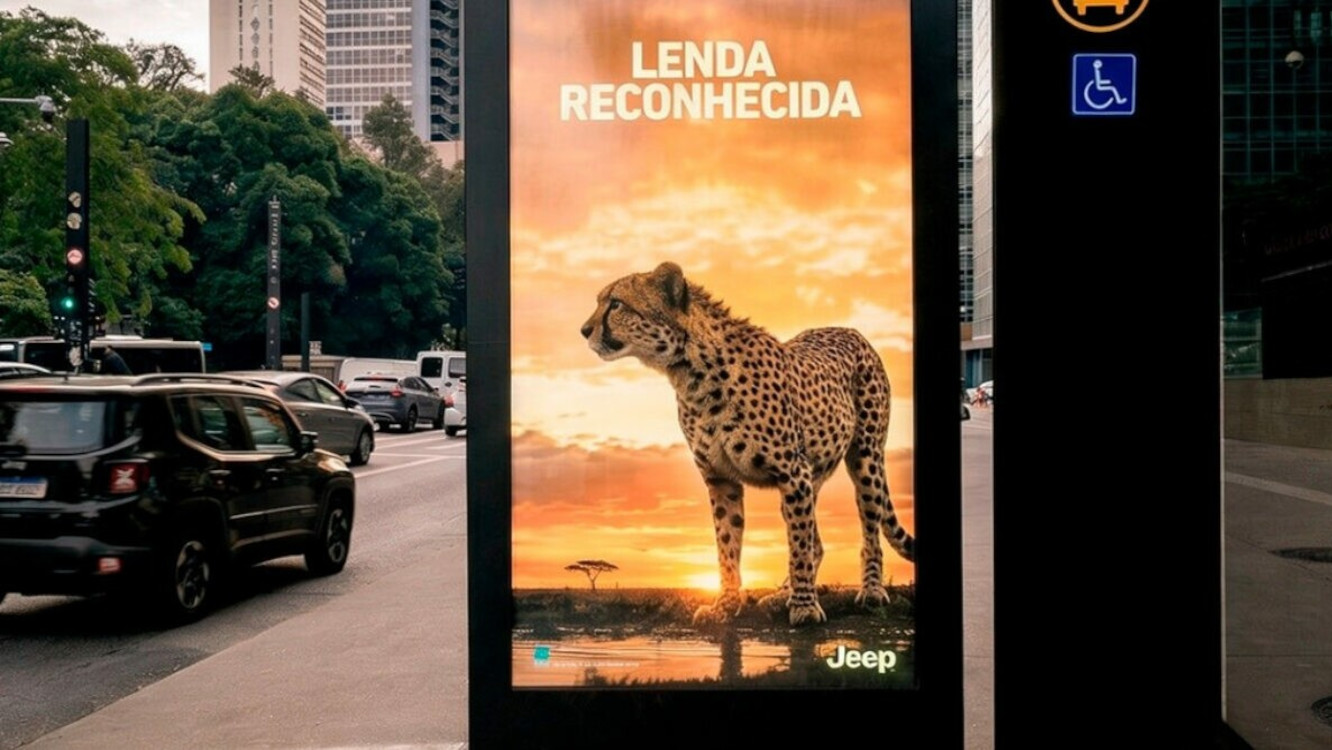
DooH: Jeep Real-time Vehicle Recognition
Real-time DooH campaigns remain relatively rare, largely due to the significant manual effort and operational complexity involved. The new Jeep Renegade campaign in Brazil – developed by agency Leo Burnett in partnership with the country’s largest DooH media owner, Eletromidia (43.729 screens) – is no exception.
While the results are compelling, the execution required substantial groundwork. Agencies and media owners rarely disclose the level of effort behind such activations. In this case, however, Jeep and Eletromidia CEO Alexandre Guerrero have shared valuable insights with Brazilian communications magazine Meio & Mensagem and on Linkedin, offering a closer look at the technical, creative, and operational investment required to bring a real-time AI-enabled DooH concept to life.
Automotive brand Jeep has launched an interactive DooH campaign in Brasil for its Renegade model, combining computer vision, edge processing and contextual storytelling across Eletromidia’s urban DooH screen network. The campaign turns digital bus shelters into responsive touchpoints that recognise passing vehicles in real time.
At selected locations, digital screens trigger dynamic animations whenever a Jeep Renegade is detected in traffic. Animals appear on screen reacting to the vehicle, accompanied by the campaign tagline: “Legend Recognized.” The activation translates Jeep’s broader brand communication into the public space – adding a layer of contextual interactivity rarely seen at scale in street furniture environments.
Computer vision trained specifically for the Jeep Renegade
At the core of the campaign is a custom-trained computer vision model, designed specifically to identify the Renegade in live traffic conditions. According to Eletromidia, the system was trained using around 50,000 images.
To build the dataset, cameras were installed at each selected bus shelter, capturing around 15 hours of video per location. The footage was then manually reviewed and tagged frame by frame over a three-week period – a labour-intensive process required to achieve reliable recognition accuracy in complex urban environments.
The system was not only trained to identify the Renegade, but was also fed with images of similar Jeep models such as the Compass to prevent misclassification. This approach ensures that vehicles with comparable design language can be reliably distinguished.
Following data preparation, model training itself required approximately 60 hours of processing, highlighting the growing accessibility of advanced AI workflows for DooH applications.
Edge-based architecture ensures privacy compliance
A key differentiator of the deployment is its fully local computing architecture. Rather than transmitting video data to the cloud, all image recognition is performed directly within the bus shelter.
Each unit is equipped with a dedicated edge server, capable of analysing video streams in real time. Once a Jeep Renegade is identified, the system triggers the corresponding creative – and immediately discards the captured image.
The shelter processes the image locally, verifies the presence of a Renegade, and deletes the frame instantly, no footage captured on the street is stored or transmitted.
This approach addresses one of the main barriers to computer vision in public spaces: data privacy and regulatory compliance. By avoiding storage and external data transfer, the campaign aligns with tightening privacy expectations while maintaining real-time responsiveness. Data privacy regulations in Brazil are similar tight as the EU’s GDPR regulation framework.
Location-specific calibration as success factor
The campaign runs across five selected bus shelters in São Paulo, located on high-traffic routes. Each site was carefully chosen based on vehicle density and visibility conditions.
A notable technical requirement was that each installation had to be individually calibrated. The AI model was trained using footage captured from the exact camera angle and positioning of each shelter.
As a result, each shelter operates as an independent recognition unit, with its own camera and locally optimised model. This decentralised approach improves detection accuracy but also increases deployment complexity – a trade-off typical for high-precision DooH activations.
The interactive OoH execution is closely aligned with Jeep’s broader campaign strategy developed by Leo. The slogan “A legend is always recognized” has been adapted to the DooH environment, where it becomes a literal, real-time experience.
Invidis analysis: DooH moves towards real-world responsiveness
The Jeep/Eletromidia campaign illustrates a key evolution in DooH: the shift from time- and location-based targeting to real-world object recognition.
While audience measurement and programmatic buying continue to dominate industry discussions, this deployment highlights the growing relevance of sensor-driven, context-aware experiences. By linking content directly to physical triggers – in this case, the presence of a specific vehicle model – brands can create highly personalised yet privacy-compliant interactions in public space.
At the same time, the project underscores the operational complexity behind such activations. Manual data labelling, site-specific calibration and hardware integration remain resource-intensive – limiting scalability for now.
- QSR: Subway Unveils Digital-First Restaurant Concept for EMEA
- AV Monitoring: Axion Tests its Radar Maintenance Platform
- Nowsignage Interview: Retail, QSR and Global Growth
- Deep Dive for Retailers: The Big Retail Media Questions
- With Ocean Projections: Moment Factory Transforms National Geographic Museum