
For years, the digital signage CMS market was dominated by specialist software vendors competing on features, scalability, and ecosystem capabilities. Today, a new class of competitors is entering the arena: vertical software providers embedding digital signage functionality directly into their existing platforms.
Zoom & Co: The New Breed of CMS Providers
The trend is yet another sign that digital signage has firmly moved into the mainstream. Rather than purchasing a dedicated CMS from a pure-play signage vendor, end users increasingly find “good enough” signage capabilities already available inside the software platforms they use every day.
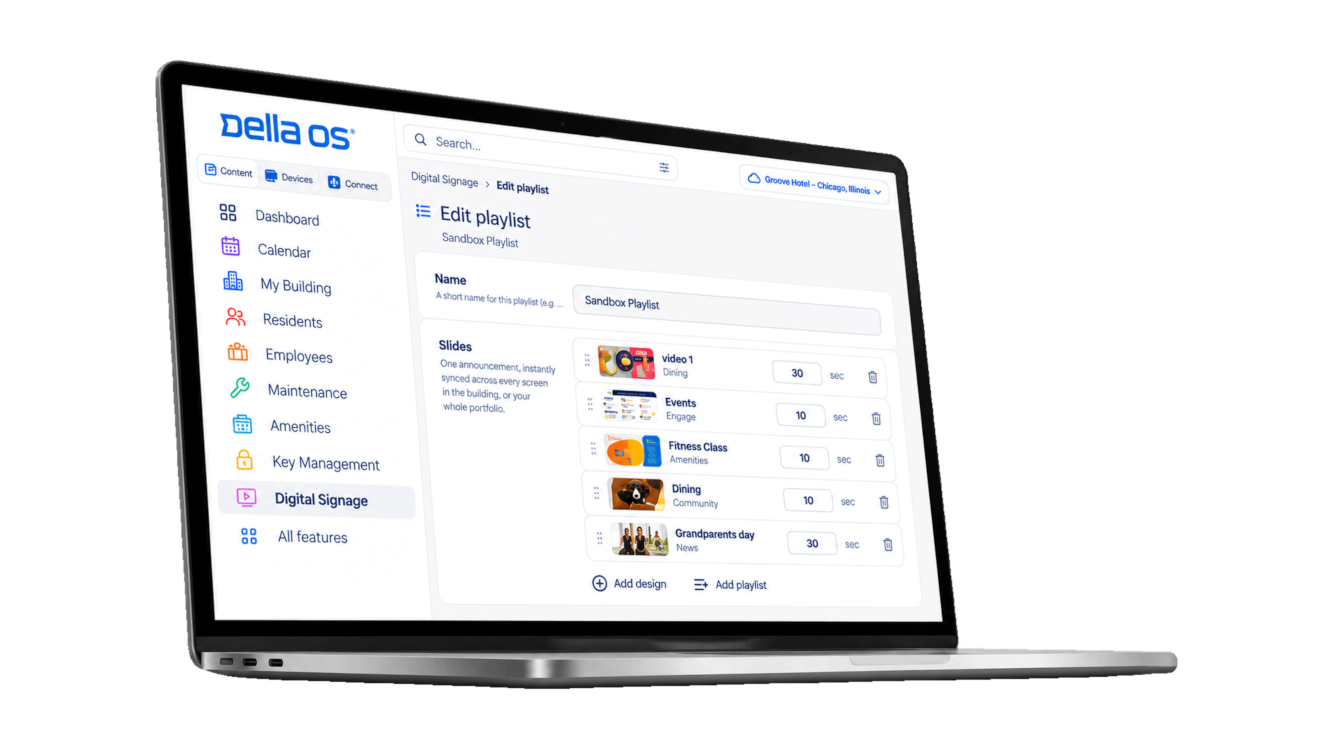
Recent examples include Zoom Signage, which extends digital signage functionality to meeting room displays, and property technology provider Della OS, which has integrated signage management into its smart building platform. Della OS is already used to manage more than 100,000 residential units, giving the company direct access to a large installed customer base.
Vertical expertise meets digital signage
The new entrants share a common characteristic: digital signage is not their primary business. Instead, they originate from vertical markets such as workplace collaboration, property management, healthcare, education, or hospitality. Their signage offerings are often less feature-rich than those of dedicated digital signage CMS providers. Yet for many customers, they deliver exactly what is needed.
The reason is simple. Vertical software vendors already own the customer relationship, are deeply integrated into operational workflows, and enjoy a high degree of trust within their respective industries.
For independent digital signage software vendors, this creates a difficult competitive environment. Even when their platforms offer superior functionality, they often struggle to match the convenience of a CMS extension that is already integrated into the customer’s core business platform. Pricing is another advantage. Adding signage as an extension to an existing software subscription is often considerably cheaper than deploying a standalone CMS.
A property-focused signage platform
This week’s launch of Groove Digital Signage powered by Della OS illustrates the trend perfectly. The new solution targets hospitality, senior living, multifamily housing, student accommodation, and commercial real estate. Built on the Della OS smart building platform, the signage offering combines AI-driven content creation, advanced scheduling, and centralized management across entire property portfolios.
Users can create playlists through a drag-and-drop interface and publish content either to a single screen or across hundreds of locations from one dashboard. The platform includes template-based content creation designed for non-designers, reducing the need for dedicated marketing teams.
More importantly, the solution leverages Della OS’ deep integration into property management processes. The platform already connects property management systems, smart locks, HVAC controls, resident applications, Wi-Fi infrastructure, access control, parcel management, maintenance services, and resident communications.
This enables signage content to be directly linked to operational data. Community calendars, amenity schedules, maintenance updates, resident announcements, dining menus, event information, and guest communications can all be managed through a single platform.
“Della’s AI-driven signage creation maps an organization’s existing APIs and data models to create meaningful content for residents and guests without the need for a dedicated software or marketing team,” said Della CTO Zaid Kazi at the launch.
Data integration becomes the battleground
Historically, digital signage vendors differentiated themselves through media player support, content design tools, proof-of-play reporting, scheduling flexibility, or network management.
The emergence of vertical CMS providers shifts the focus toward business process integration and industry-specific workflows.
Property managers, for example, may value direct access to occupancy data, resident information, maintenance schedules, and building systems more highly than advanced signage capabilities. Similar patterns can already be observed in workplace collaboration, where Microsoft Teams Rooms and Zoom increasingly extend into adjacent signage applications.
For digital signage specialists, the development represents both a challenge and an opportunity. While vertical providers may take market share in standard deployments, more complex projects will continue to require dedicated signage platforms with advanced functionality, scalability, and ecosystem integrations.