
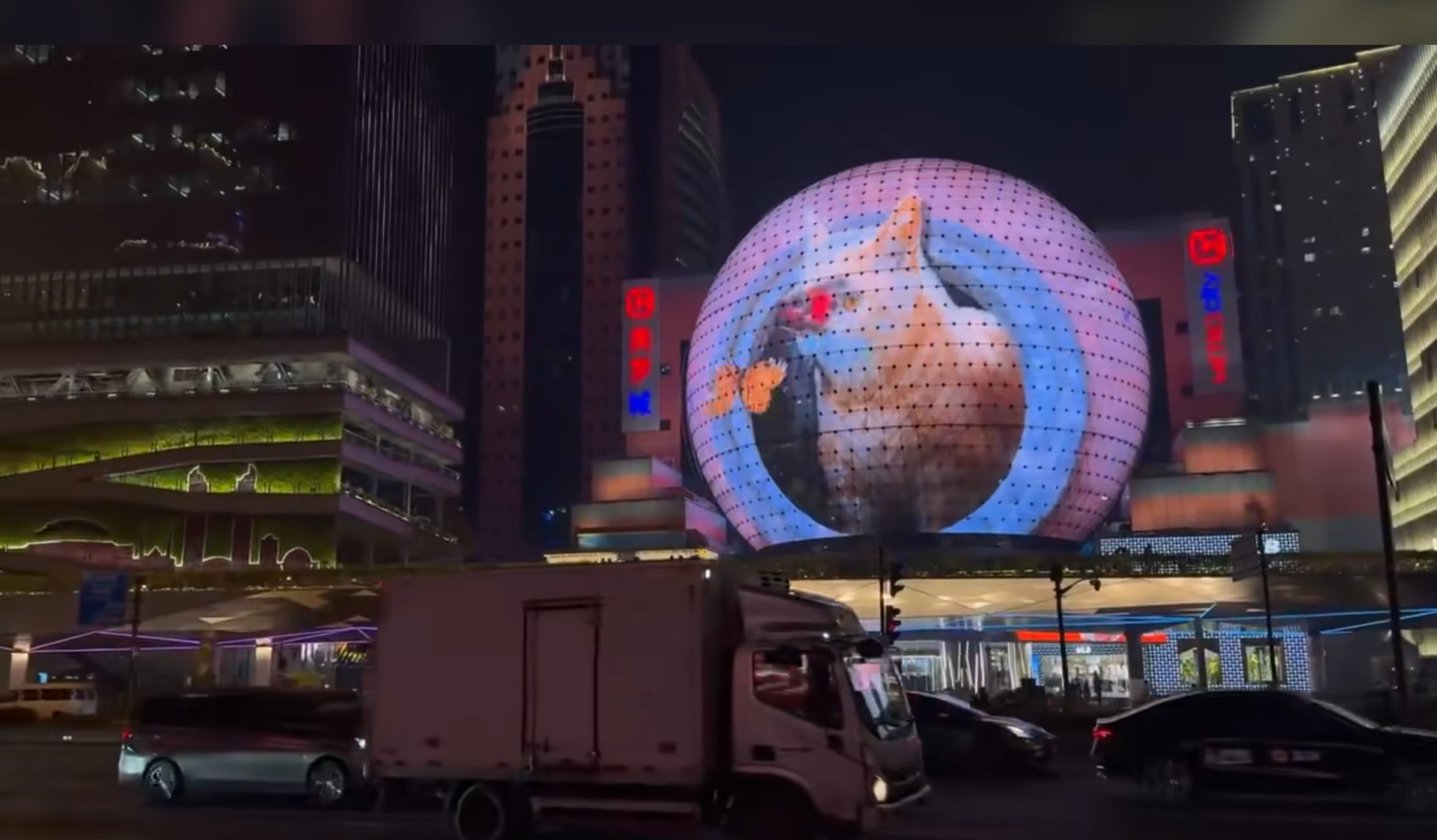
Back in late 2024, I put up a post wondering if the whole thing with “naked eye 3D” on big LED displays was in the last moments of its 15 minutes of fame period, and for the most part I think that’s the case.
But that doesn’t mean we’re done with it, and it certainly doesn’t mean there aren’t still manufacturers pushing the concept.
A friend sent me a Linkedin post from, of course, a Chinese LED manufacturer that somehow tries to attach whatever remaining buzz there is for forced perspective LED display creative with whatever buzz remains for giant LED spheres – most notably the huge one in Las Vegas.
“Global First! The Birth of the Naked-Eye 3D Spherical Giant Screen!”
It is a 41 meter diameter LED sphere sitting on a roof just above street level at MetroCity in Shanghai, the display manufactured by Mightary LED – an unfamiliar firm I assume is mainly focused (like many) on the China domestic market.
“Mightary uses cutting-edge correction & splicing technology to fit creativity into a sphere!”
I have thoughts …
First, if you are going to promote something (acknowledging language hurdles), get the name right. The post says Merro City Exhibition Hall, but it is MetroCity and it is a shopping mall, not an exhibition center.
You are currently viewing a placeholder content from Default. To access the actual content, click the button below. Please note that doing so will share data with third-party providers.
Second, if you are going to promote a project as 4K (the post says this thing is “3,888 4K screens seamlessly spliced”), use video that makes the creative look better than circa 2006 standard def material. The video used here suggests this thing looks terrible, and is best seen from blocks away, not from the sidewalk across the street.
The 4K description seems like a very liberal interpretation of 4K, as the pixel density would not be anything like a fine pitch indoor LED screen.
Third, it’s not 3D, and there is no such thing as naked eye 3D for outdoor LED displays. It is a nonsensical term cooked up by one Chinese manufacturer and then widely adopted and co-opted by other Chinese LED makers, small and large.
There are indoor LED displays that have a lens over them that make the things autostereoscopic (glasses-free 3D) but they look terrible.
They do make some sense
Doing a display in something other than a big rectangle has merits. It is different, and would likely stand out in what is probably a riot of screens in a busy commercial district of one of the world’s mostly densely populated megacities.
Though the post suggests this is new, the sphere atop the mall entry has been there since 1998, adding low rez LED in the 2000s and then just over four years ago, upgrading to the current hardware build.
A sphere as an attraction has merits, and the one in Las Vegas shows with big budgets and talented creative, it can be very buzzy.
But the naked eye 3D thing is bogus, and mostly pointless.
Buzz is now more of a low hum
Though I am theoretically retired, I still pay attention and I still get carpet-bombed with PR pitches. I see a fraction of the story pitches and references to 3D creative that I was receiving just a few years back. I also get a general sense the outdoor media companies, brands and creatives have kind of moved on from what was largely an eye candy thing to bring in, as something new, to creative meetings with clients.
There are several issues, though:
Designing creative for a sphere is custom work. You can’t just take a file done for a conventional billboard and run it on this (and have it not look like hell).
In most cases, the 3D visual illusion only looks good from a very specific and narrow viewing angle – so the car/dinosaur/rocket/dragon/timepiece/whatever that seems to pop out of the boundaries of the display only does that for onlookers in JUST the right viewing sweet spot.
Mixed research findings
All that stated, with my general teenager eye-rolling attitude to this stuff obvious, here’s what research says, based on an AI query about efficacy versus conventional creative.
In short, there are pros and cons …
“Attention & stop-rate” multiplier
Studies suggest forced perspective creative triggers a “disruption” response in our brains not matched by conventional creative.
Impression volume: Data from providers like BCN Visuals and Outsmart indicates that 3D billboards can generate up to 400% more impressions than 2D static boards, largely due to social media “pass-along” value (55% of viewers are inclined to film and share 3D ads).
I have heard directly from media companies that the social media sharing aspect of these creative pieces was more important than the on-premise viewership, but I am (probably very safely) guessing the novelty of this stuff from 4-5 years ago has worn off and social sharing (and interest) has dropped well off.
Dwell time: Eye-tracking research shows that 3D creative holds attention for 3.5 to 4 times longer than 2D. This is attributed to the “puzzle-solving” nature of the brain trying to reconcile the optical illusion.
Brand recall vs. brand recognition paradox
Recognition vs. recall: 3D elements significantly boost brand recognition (identifying the logo/package when seen again) but do not always correlate with higher unaided brand recall (remembering the name without a prompt).
The “spectacle” effect: Sometimes the “Wow Factor” of the 3D illusion is so high that it creates “advertising clutter” in the viewer’s own mind, with viewers remembering the effect, but forgetting which brand was behind it.
Perception & consumer trust
Brand authority: Approximately 68% of consumers rate brands using 3D OoH as “more premium.”
Purchase intent: Campaigns utilizing 3D see a roughly 17% uplift in smartphone-based brand actions (searching the brand immediately after exposure) compared to 2D.
Technical limitations
The “Sweet Spot” limitation: Since forced perspective has a sweet spot, efficacy drops by as much as 60-70% for viewers standing outside this 45-degree cone, where the image appears distorted or “stretched.”
Cognitive load: If the 3D creative is too complex, it can lead to “cognitive overload,” causing viewers to look away sooner because the brain finds the distorted perspective from non-optimal angles frustrating to process.
Spectacle versus substance
So that research suggests wow factor/eye candy creative and hardware can have an impact, but it is not going to do a hell of a lot more than make people look … at least for the first couple of encounters, and even then, briefly.
What matters more is substance – a campaign with an emotional hook and a call to action that leads to tangible results.
I don’t know what a cat looking through a hoop does for a mall, but I’m guessing the retail tenants would rather have material that pulls people inside to shop.
(Image: Screenshot)