
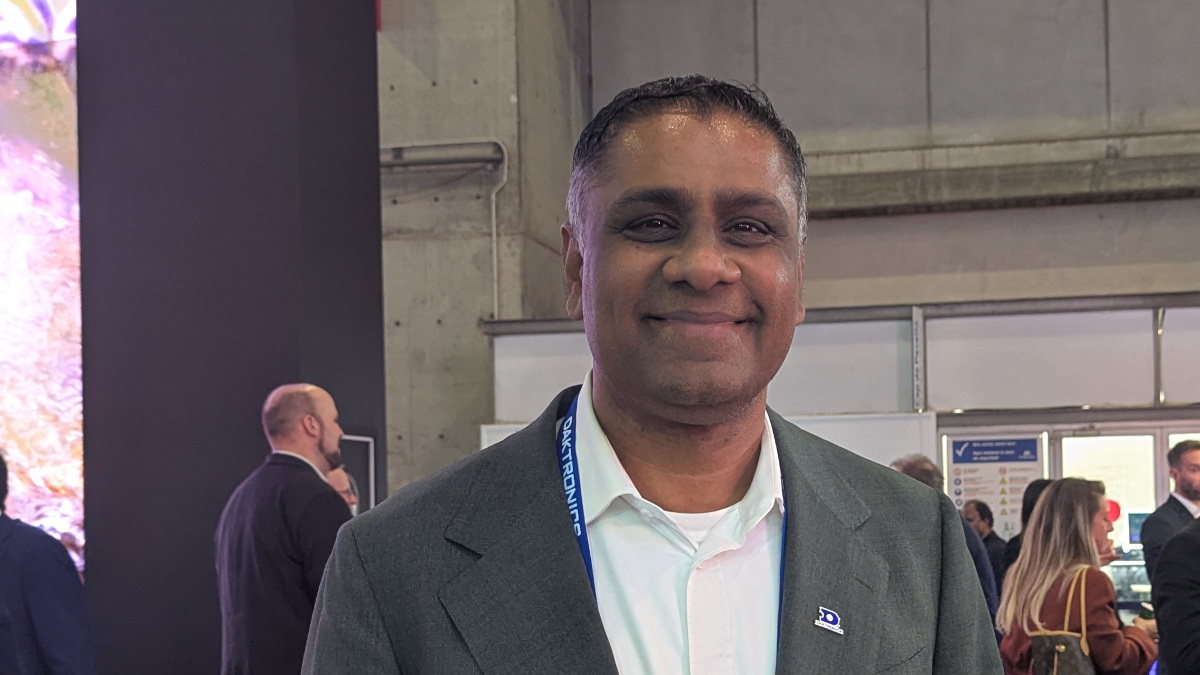
The first three days of his new job threw Ramesh Jayaraman, the new president and CEO of Daktronics, right into the halls of ISE in Barcelona. He had a busy start – but that reflects his future tasks at the US-based LED manufacturer pretty well. Jayaraman was brought in at the start of 2026 and is expected to lead Daktronics into a new growth era, after the conflicts between investors and the leadership.
Before he joined Daktronics, Jayaraman served as Senior Vice President and Americas Integration Leader for Bosch Home Comfort. Prior to that, he had leadership roles across Bosch’s global Energy & Building Technologies portfolio, at Harman Professional Solutions, Ariston Thermo Group, and Tyco/ADT.
Coming from outside the LED industry, his first job at Daktronics is assessment, so he was a little bit careful in our interview with future outlooks. For the first months, he outlined a rather conservative strategy: Going deep before going wide, and focussing on present strengths as a first step.
MicroLED opens up strategic options
One of the things to watch under Jayaraman’s leadership will be Daktronic’s strategy regarding X Display, a US-based tech company specializing in mass transfer and MicroLED equipment. Daktronics has been a shareholder of X Display since 2020, but recently acquired the assets and intellectual property as well as specialized staff.
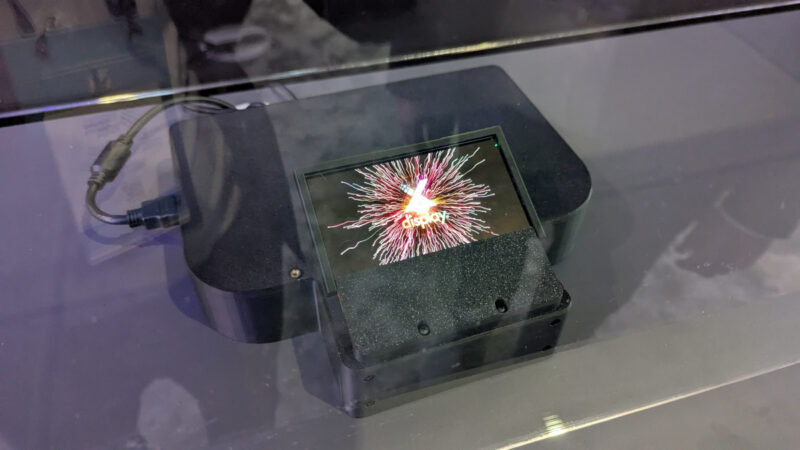
This could open up some interesting possibilites for the manufacturer. At ISE, Daktronics showed how a future MicroLED product could look like: On display was a COG display with a pixelpitch of 0.18 millimetres, in 5,1”, with LEDs the size of 13 x 20 microns. It is clear that this would be an overkill for digital signage, but there are other high-potential markets that could be adressed, like Automotive or Defense.
So Daktronics could take a similar direction to Dayton, Ohio-based Stratacache, which is committed to start MicroLED production in its factory in Eugene, Oregon, as soon as possible.
But Jayaraman stresses that Daktronics’ MicroLED production is still in its early stages. “We’ve invested in backend test labs, and own the intellectual property of XDC already. The focus is now on advanced engineering.” He hopes that things are moving in a direction where Daktronics can talk about the details in the coming months.
The move would not just open new markets, it would offer production stability in a more and more complex and crisis-loaden world.
And this is one topic important to Daktronics – to diversify its production capabilities. ”Actually, towards the middle of this year, you’ll see a factory come up in Mexico as we increase facilities to keep up with customer demand,” says Jayaraman.
E-sports as an emerging vertical
Besides the long-term strategy, Daktronics can also look into the near future with confidence. The figures of the third quarter 2025 – which ran until January 2026 – are looking good: The company’s sales grew by 21.6 percent YoY. According to Jayaraman, the growth was a result of orders in the sectors High School Parks and Recreation – particularly for video scoreboards – as well as of record order bookings in Transportation led by the aviation sector, and five MLB stadium projects with installations planned to take place this spring.
And the company announced that it now has a backlog of $342 million for the next quarter, which is up 25 percent from prior year. There is the Fifa World Cup coming up in North America, where Daktronics is involved in some of the venue projects. “Many stadiums featuring our technology will be supporting these high-level soccer events, from Hard Rock Stadium and Mercedes-Benz Stadium to Gillette Stadium and Arrowhead Stadium in the USA, to Estadio de Rayados in Mexico,” says Jayaraman.
Stadiums, arenas, and other sports venues are still Daktronics’s home turf – and a very dynamic market, as Jayaraman observes: “We see a movement from LED displays to experiences, and we want to be a part of that as we go ahead,” Jayraman says. “In sports, it is more and more about the whole experience. Not just the experience on the video wall, but in the entire stadium, from the time a person walks in to the time a person leaves. And how you start playing with these experiences will be critical.”
And there is another segment, in which the Daktronics CEO sees great potential: E-Sports, where the development is similar to the traditional sports world.
New ways of growth exist for the US-based LD manufacturer – from e-sports arenas to MicroLED production – and Daktronics plans to take them.