
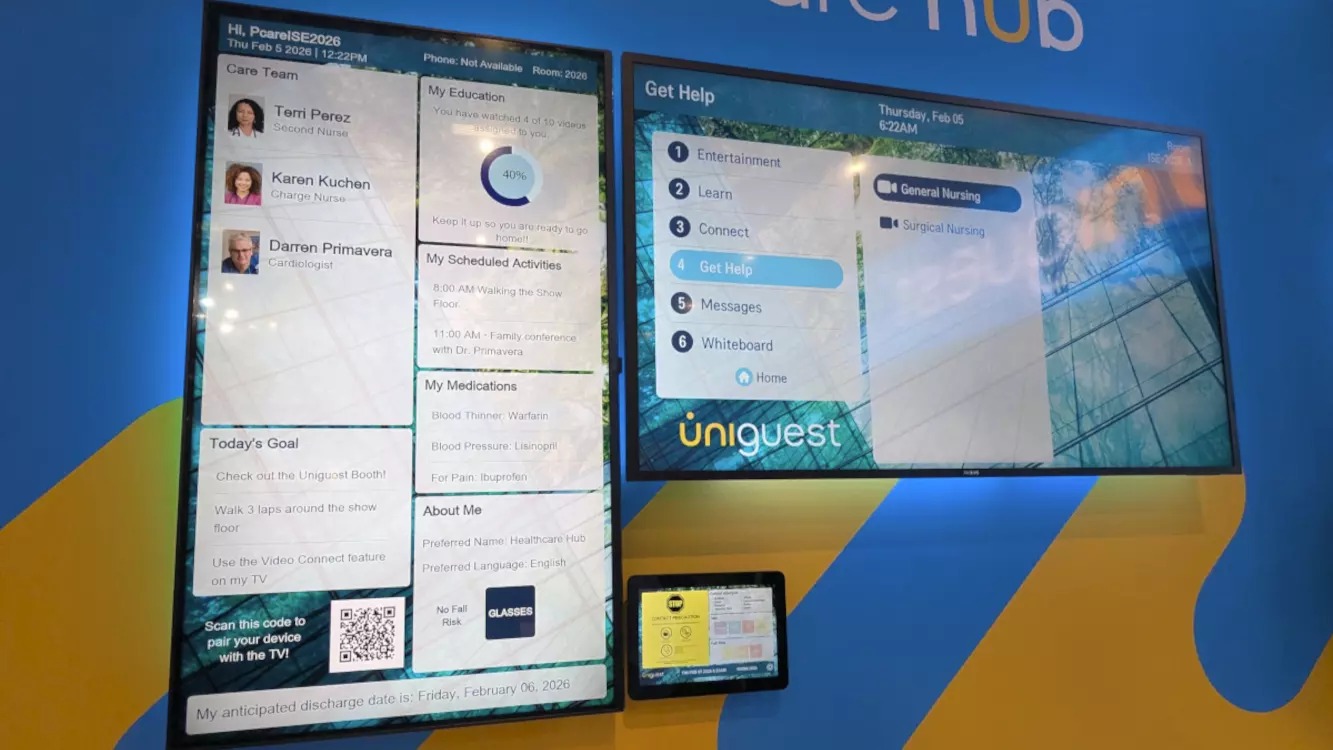
While LED installations drew the crowds at ISE 2026, LCD technology quietly reaffirmed its role as the backbone of professional display deployments.
ISE 2026 did not present a radical reinvention of LCD. Instead, manufacturers showcased steady evolution: slimmer profiles, improved brightness uniformity, better energy efficiency, and more sophisticated industrial design. The message was clear: LCD does not need to reinvent itself to remain relevant. It remains the most practical and cost-effective solution for a wide range of digital signage, education, and corporate applications.
Industry commentary and data from Futuresource Consulting suggest that while LED’s growth curve is strong, LCD still accounts for the majority of installed professional display volume. In many environments, seamless modularity is not required. Reliability, affordability, and ease of deployment matter more.
Retail networks, meeting spaces, transport hubs, and back-of-house enterprise signage continue to favor LCD for its predictable performance and established supply chains. Even as LED gains ground in premium spaces, LCD remains the default specification for everyday deployments.
What has changed is the role LCD now plays within the wider AV ecosystem. At ISE 2026, displays were increasingly positioned as endpoints inside integrated software environments rather than standalone hardware products. Content management systems, remote device monitoring, security layers, analytics dashboards, and cloud orchestration platforms are becoming central to value creation. In that context, the panel itself – whether LCD or LED – becomes one component within a broader workflow architecture.
This aligns with observations from invidis regarding the practical integration of AI into CMS platforms. The real shift is not about display technology alone, but about how software ecosystems automate content delivery, optimize scheduling, monitor uptime, and generate performance insights. LCD networks, often deployed at scale, particularly benefit from this evolution because efficiency and manageability are critical in large multi-site rollouts.
ISE 2026, therefore, did not signal the decline of LCD. Instead, it reinforced its position as the dependable workhorse of professional AV – increasingly powerful not because the panels themselves have dramatically changed, but because the software environments surrounding them have matured.
(Image: invidis)