
New details from Pixel Sharp reveal the technical challenges behind July’s Bayeux Tapestry projection on the White Cliffs of Dover, including portable battery power, double-stacked Panasonic projectors, fog and an approaching electrical storm.
Behind the Dover Projection: Four Projectors And No Grid Power On The White Cliffs
When imagery from the Bayeux Tapestry appeared across the White Cliffs of Dover earlier this year, the result looked deceptively simple: scenes inspired by the nearly 1,000-year-old work spread across the chalk before giving way to a giant “Merci” message to France.
Projection specialist Pixel Sharp delivered the one-night installation for the British Museum, with Disguise servers handling media playback and mapping. New details from Pixel Sharp and Panasonic now reveal considerably more about how the team pulled it off.
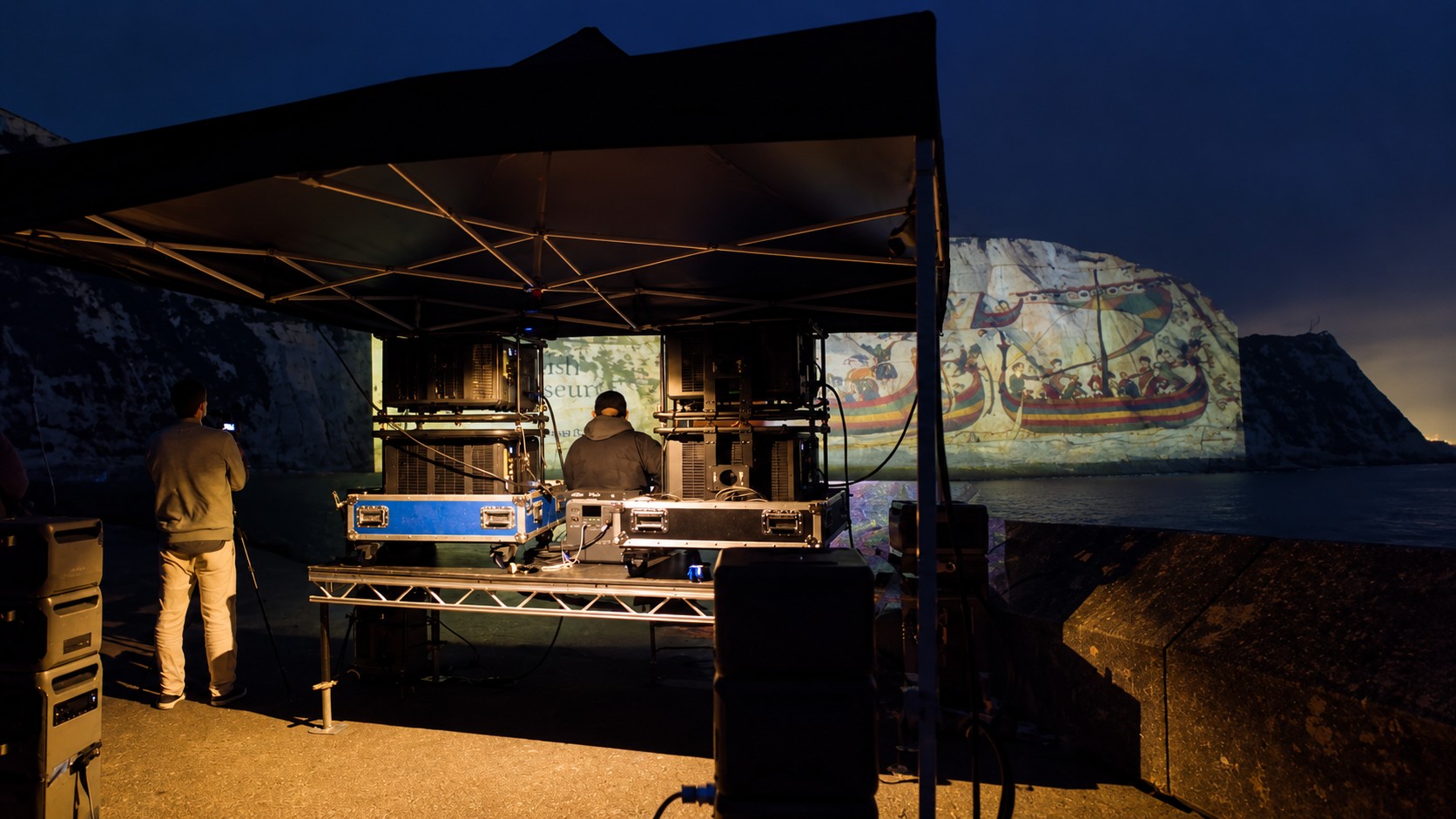
The projection position had no access to grid power, making it impractical to move large quantities of equipment.
Pixel Sharp deployed four Panasonic RQ35K 4K laser projectors in two double-stacked pairs, running the system from portable battery power. The combination gave the team the brightness needed for the large outdoor canvas while keeping the equipment manageable enough for the remote location.
For Pixel Sharp founder and director Jon Sharpe, portability was part of the technology decision from the beginning. Larger equipment could have required additional vehicles, lifting equipment and crew — all serious considerations at a site with difficult access.
An unpredictable canvas
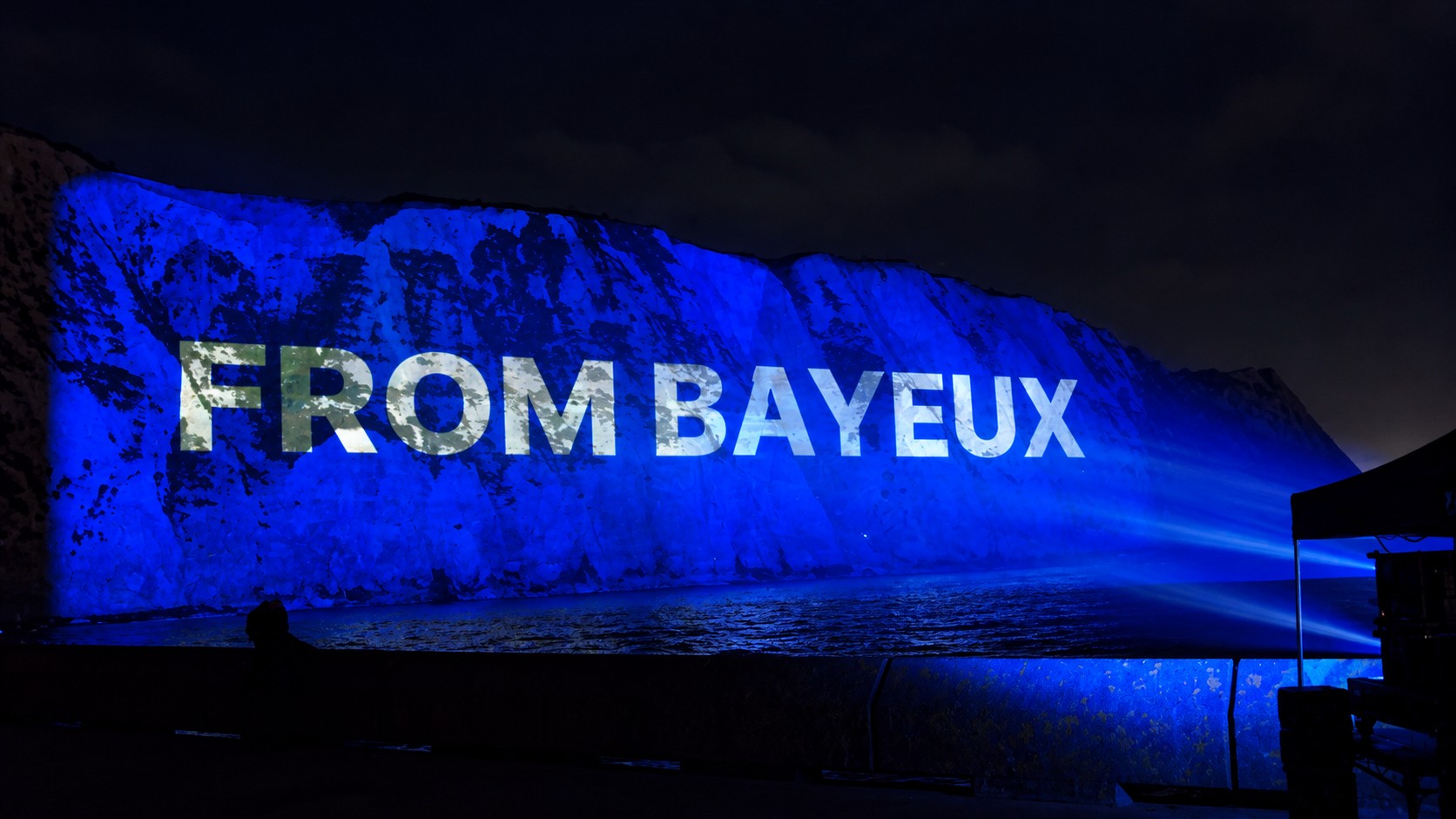
The natural projection surface presented another challenge. The White Cliffs are neither flat nor uniformly white, with moss and vegetation affecting color and contrast in places.
Pixel Sharp worked with the British Museum’s content team before the installation to define the usable projection area and adapt the material accordingly. Darker colors required particular attention, while typography had to remain legible across the distance and uneven surface.
The team also prepared alternate layouts that repositioned imagery and text across the available canvas, providing options once the projectors were installed on site.
Four projectors against the clock
Sharpe says Pixel Sharp favors 3-Chip DLP technology for multi-projector mapping because consistent color and image uniformity make it easier to blend several projectors into a single canvas.
That became particularly important in Dover, where the team had only a short nighttime window to install, align, and map the four projectors and capture the finished projection.
Pixel Sharp positioned the projectors in roughly two hours and spent another hour and a half mapping the imagery.
Then the weather intervened.
A bank of fog moved across the cliffs during preparation, reducing visibility to the point that the team temporarily struggled to see the surface it was trying to map. The fog eventually cleared, only for an electrical storm to begin approaching the coast.
With projectors and large portable batteries operating at an exposed outdoor location, the team captured the required images and shut down earlier than planned.
The resulting projection combined Bayeux Tapestry-inspired imagery with the “Merci” message marking France’s loan of the historic work to the British Museum.
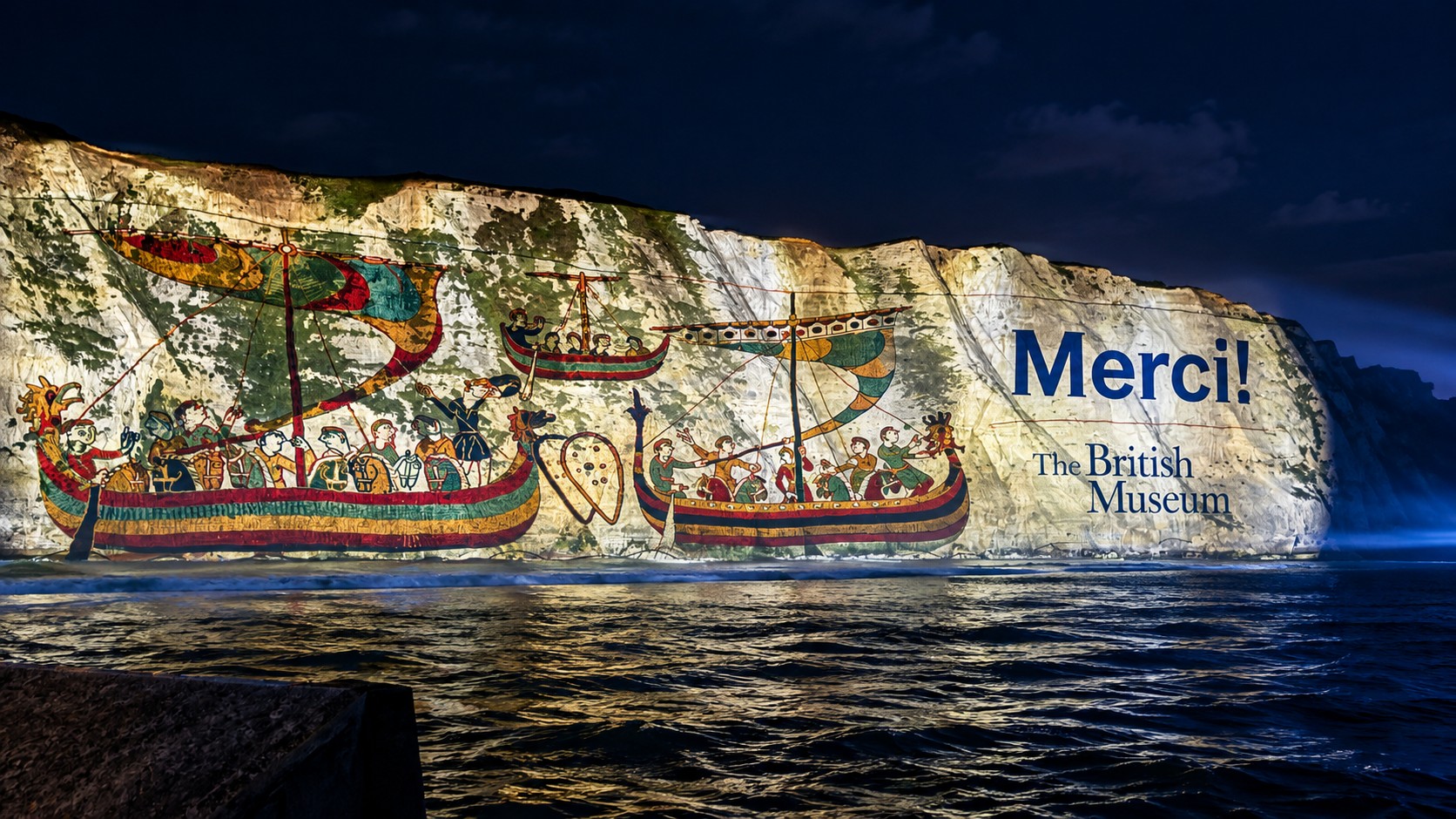
For Sharpe, the project also demonstrated one of projection’s advantages over conventional displays: the location itself can become part of the content.
“The whole value is that you can take your message and give it context by placing it on a location, or by changing the shape of how it’s viewed,” Sharpe says. “When you present something in a unique way, people are going to remember it.”
The Bayeux Tapestry is on display at the British Museum until next summer after returning to England for the first time in centuries.