Mark Schmidt, CTO of Panoptec Group, talks to invidis about the biggest trends in the control room industry, the synergies between subsidiaries Vuwall and G&D, and the ideal resolution for command-and-control screens.

Mark Schmidt, Vuwall and G&D: “Big Growth in the Security Sector”
C&C rooms are a highly specialized digital signage segment — and a highly successful one. Visual solutions providers have reported steady growth in this space for years, driven partly by the volatile global security situation.
Panoptec Group is a major player in the control room industry. The company brings together Vuwall, Guntermann & Drunck, known as G&D, and Tritec, allowing it to offer integrated solutions for managing entire control room ecosystems. invidis spoke with Panoptec CTO Mark Schmidt about the key developments in the command-and-control sector.
invidis: Mark, what makes C&C applications unique?
Mark Schmidt: In control rooms, the goal is always to monitor a situation. That means processing many different types of sources — camera feeds, mapping apps, and other software. Fire and police dispatch centers in particular handle a huge number of signals. The real challenge is bringing all these signals together and visualizing them the right way.
Where do you see growth for control rooms?
We’re seeing strong growth in the security sector — defense, government and surveillance. Many control rooms in this space are currently being planned and equipped. Cybersecurity is also becoming a bigger topic, control rooms for internal IT, for example. Through G&D, we’re also strong in air traffic control.
Since early 2025, G&D and Vuwall have been sister companies under Panoptec Group. What does that mean for your solutions?
In regards to a holistic approach, this has major advantages. Vuwall comes more from the video wall side – how to distribute many signals across a video wall. G&D focuses more on the operator desk – how does an operator actually work with those signals? By combining the two, we can create synergies and streamline solutions.
Can you give us an example?
One example is our management software, which now controls both sides at once. On the signal distribution side, I can save distinctive scenarios. On the user management side, I can assign specific permissions, so individual operators only see certain sources and can only display them in certain areas of the video wall.
Cybersecurity is becoming more pressing across the digital signage industry. That’s certainly a major factor for control rooms too, right?
Of course it’s extremely important to us, but our starting point is different. We physically separate our networks. Data comes together in a customer’s system, but beyond that handover point, we are truly separated from it. That drastically reduces the attack surface — structurally, there is no cross-over between the systems. In some ways, that high level of security is actually a challenge for us.
What do you mean by that?
In digital signage, everything is very open, which makes the system vulnerable but also flexible. In C&C scenarios, we don’t have the option to just tap into a signal somewhere. System A isn’t allowed to communicate with system B, but we still have to display both on the video wall. That’s the challenge: how do you transmit signals without obstacles. Besides of that, we of course hold the key security standards: SOC2, ISO 27001, Common Criteria and DODIN APL, plus FIPS 140-3 for encryption between systems.
Looking at hardware, the whole digital signage industry is shifting from LCD to LED. Does that apply to control rooms too?
Smaller control rooms still use LCD displays, simply because they’re cheaper and need less space. It always depends on how many signals you need to display within a given area. If that area isn’t too large, LCD can still deliver good pixel density.
So when LED, then fine-pitch LED?
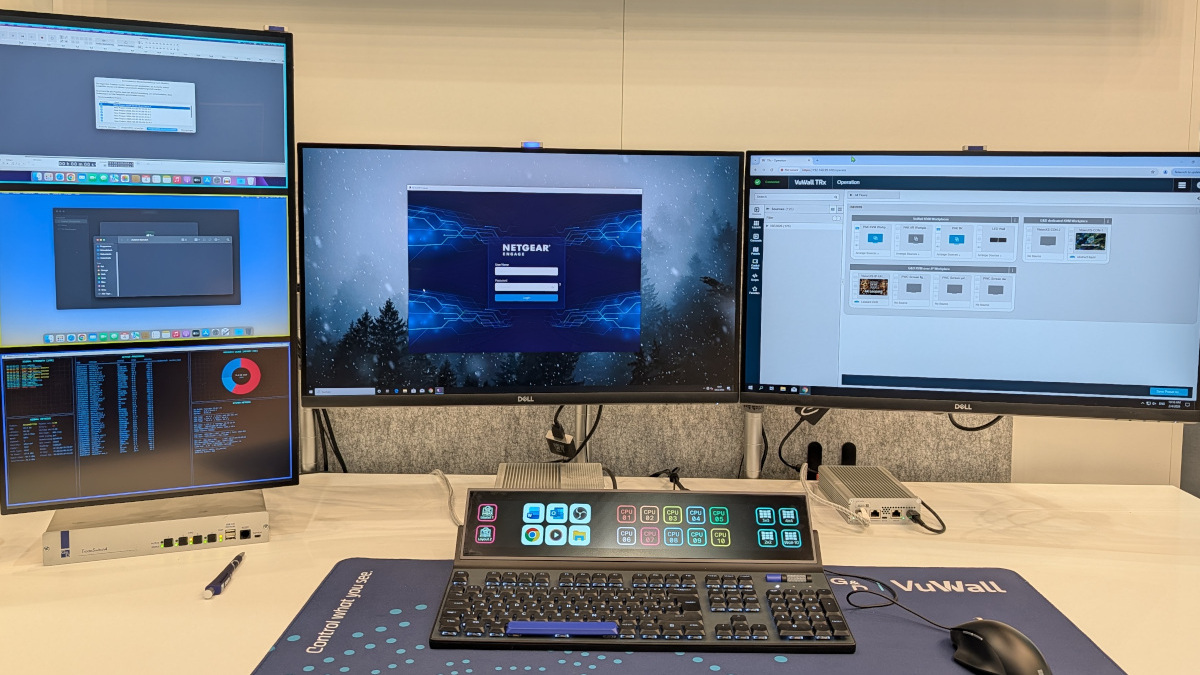
Overall, the trend is clearly moving toward high-resolution LED walls. If you need to monitor hundreds of camera feeds, you need a low pixel pitch. But there’s also a shift away from very large walls toward personal video walls. When an operator wants to see details, they pull the signal directly to their desk, where they can go much deeper than on the video wall. The wall itself is there for the big picture.
What does that mean for control room equipment?
We’re seeing more 5K displays at workstations, along with growing demand for multiview applications. We’re also developing new solutions ourselves — for example, our Commandkeyboard Advanced, a keyboard with a built-in display. That makes operation more intuitive, especially in situations which are stressful for the operator.
What other developments do you see?
Control rooms are increasingly being consolidated. In the past, there were many small control rooms. Now there are several satellite locations but one main control center. Overall, everything is getting bigger.
G&D recently announced a joint venture with CT Square to enter the Indian market. What other regions have potential?
India is a very interesting market for us, but we have many installations worldwide. Right now, there are also very large projects in Germany, including police stations, fire departments and government agencies.