
LCD displays are a mature technology, yet their capabilities are still being pushed. MicroRGB highlights ongoing innovation in the premium segment, and the first models made their way into the digital signage market.
Technology: Premium Panels Prove That LCD Is More Than The Digital Signage Workhorse
LCD technology continues to play a pivotal role in the digital signage market. Despite the growing share of Directview LED and OLED solutions, LCD remains the backbone of many professional installations thanks to its scalability, availability, and cost efficiency.
However, this does not mean innovation has slowed down. On the contrary, much of today’s development focuses on refining LCD’s role as a dependable workhorse: slimmer form factors, improved brightness uniformity, higher energy efficiency, and increasingly sophisticated industrial design.
ProAV Technology in the invidis Yearbook
This article is part of the technology chapter in the invidis Yearbook 2026. The “Bible of the Digital Signage Industry” contains numerous other technology analyses, ranging from LED and e-paper displays to digital signage software. Download the yearbook from our Downloads section.
At the same time, genuine technological advances are emerging. One notable example is MicroRGB technology. As is often the case in the LCD space, it originates from the consumer TV segment.
Earlier this year, the first models were unveiled at CES in Las Vegas, aiming to redefine the premium display category. Manufacturers such as Samsung, LG, Sony, and Hisense have already introduced corresponding solutions into their portfolios.
Exceptional contrast
Traditional LCD displays have long relied on white or blue LEDs combined with color filters for backlighting. The MicroRGB approach replaces this system with individually controlled red, green, and blue LEDs integrated directly into the backlight. This eliminates part of the optical loss caused by filters and enables more accurate, more saturated color reproduction. While the technology still uses an LCD panel, its visual output is increasingly approaching OLED-like characteristics.
In addition, manufacturers combine MicroRGB with fine-grained local dimming. This allows small, precisely defined zones of the display to be controlled independently – meaning black areas can appear truly black as the corresponding LEDs are switched off.
Current MicroRGB panels feature 1,000 or more dimming zones, comparable to premium TVs. This significantly enhances black levels, overall color depth, contrast performance, and HDR capabilities.
Early signage applications
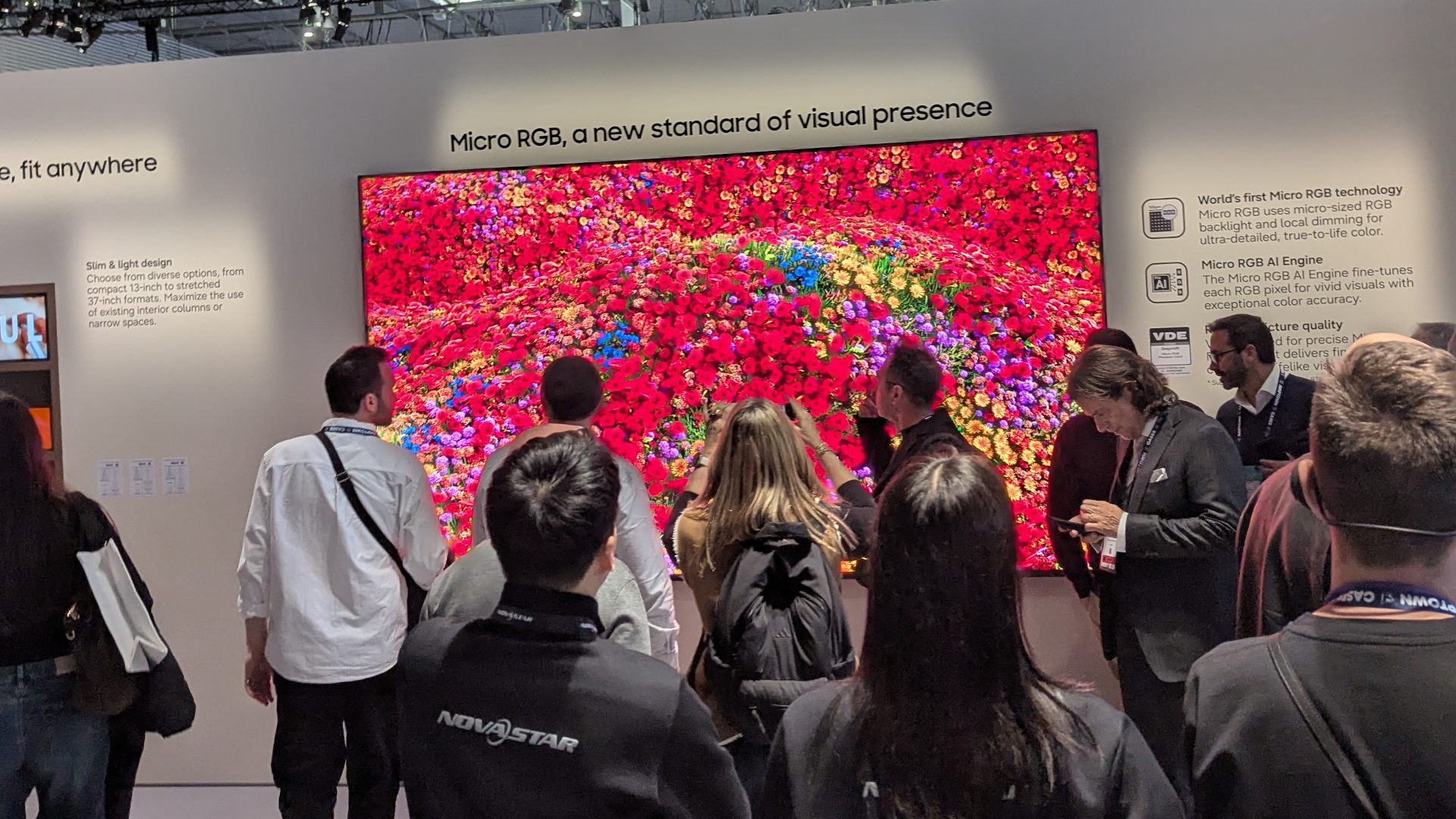
One of the first companies to bring this technology into the digital signage space is Samsung. At ISE, the manufacturer showcased a professional 130-inch MicroRGB display. Samsung’s implementation uses a very dense arrangement of MicroRGB LEDs that can be individually controlled – unlike conventional LED backlights, where LEDs are typically managed in groups. This results in a total of 5,670 independently controlled zones. The outcome is a substantially richer color depth and striking black levels, with peak brightness reaching up to 1,000 nits
To further enhance image quality, Samsung developed its Micro RGB AI Engine. This system analyzes each frame in real time and automatically adjusts color and brightness. The first 110-inch model also includes Micro RGB Color Booster Pro, which detects washed-out color areas and enhances their saturation and vibrancy. The display is designed to cover the full BT.2020 color gamut.
Energy efficiency through MiniRGB
Hisense is taking a slightly different approach in the digital signage segment. At ISE 2026, the company presented an 85-inch 4K high-brightness display based on MiniRGB technology. The target applications are primarily window-facing and semi-outdoor environments. The display reaches a peak brightness of 4,000 nits, with Hisense claiming that MiniRGB enables this performance while using up to 55 percent less energy than conventional LED backlights.
Further developments may already be on the horizon. According to the company, Hisense has invested several billion euros in recent years to advance MiniRGB technology.
Room for diversification?
Taken together, these developments show that LCD technology is far from reaching its limits. For premium brands, precise control of color, contrast, and brightness has become one of the key avenues for differentiation from standard low-cost LCD products.
Whether MicroRGB displays will ultimately gain widespread adoption in the digital signage market will largely depend on price. In this segment, scale is critical – and with it, cost. OLED technology has demonstrated the visual benefits of superior color and contrast reproduction, but the B2B market has so far shown only limited willingness to pay a significant premium for it.
Continuous evolution
LCD continues to serve primarily as a scalable, cost-optimized workhorse technology. However, a gradual evolution is clearly underway, reflected in a range of emerging features, including:
- Pantone certification (e.g., BenQ)
- AI capabilities (e.g., PPDS)
- Anti-glare displays (e.g., Sony)
- New 3D effects (e.g., Samsung)