
The Fifa World Cup is more than football's biggest tournament. For stadium owners, architects, and display manufacturers, the knockout venues have become a global showroom where the next generation of technology competes for the attention of decision-makers from around the world.
Six Stadiums, Millions of Pixels: The LED Titans Powering the Fifa World Cup Quarter- and Semifinals
When the final whistle blows at the 2026 Fifa World Cup on July 19, one nation will lift the trophy.
Yet, behind every replay, every goal celebration, every player introduction, and every sponsor activation stands an enormous ecosystem of audio and video canvases that has transformed the modern stadium experience. Some video displays stretch the length of a football field. Others wrap continuously around an entire stadium. Together, they represent years of engineering, millions of LEDs, and hundreds of millions of dollars in investment.
While fans focus on the football, the venues themselves become demonstrations of what is possible in modern sports presentation.
Besides the big billboards, other digital signage systems are big success factors for modern sports venues: from wayfinding to menuboards. But for the quarterfinals and the semifinals of the World Cup, let’s focus on the big LED display technology of the venues hosting those games.
We use both stadium names: The “real” name and the name given for the time of the world cup due to the rigid sponsoring rules.
Atlanta Stadium aka Mercedes-Benz Stadium
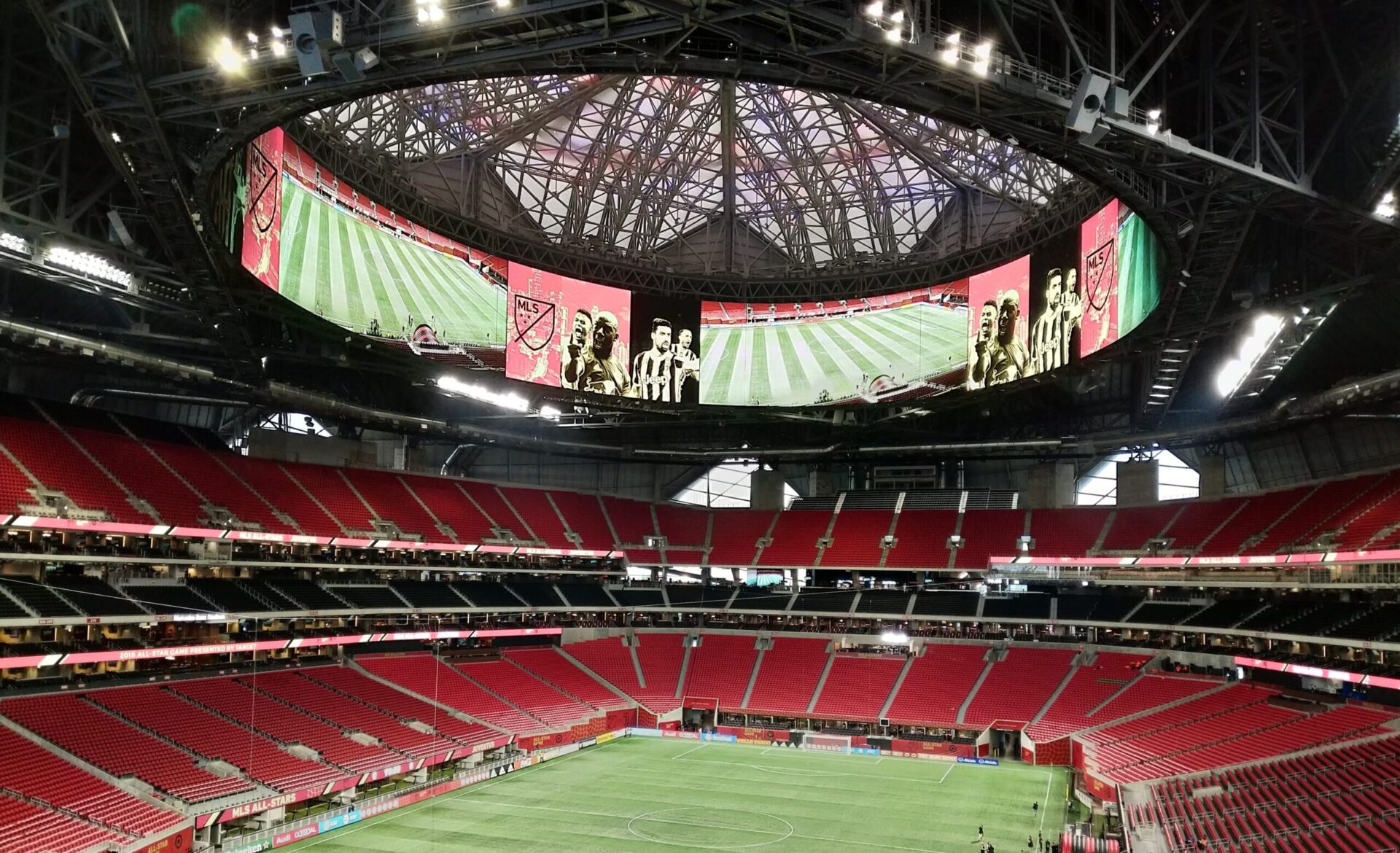
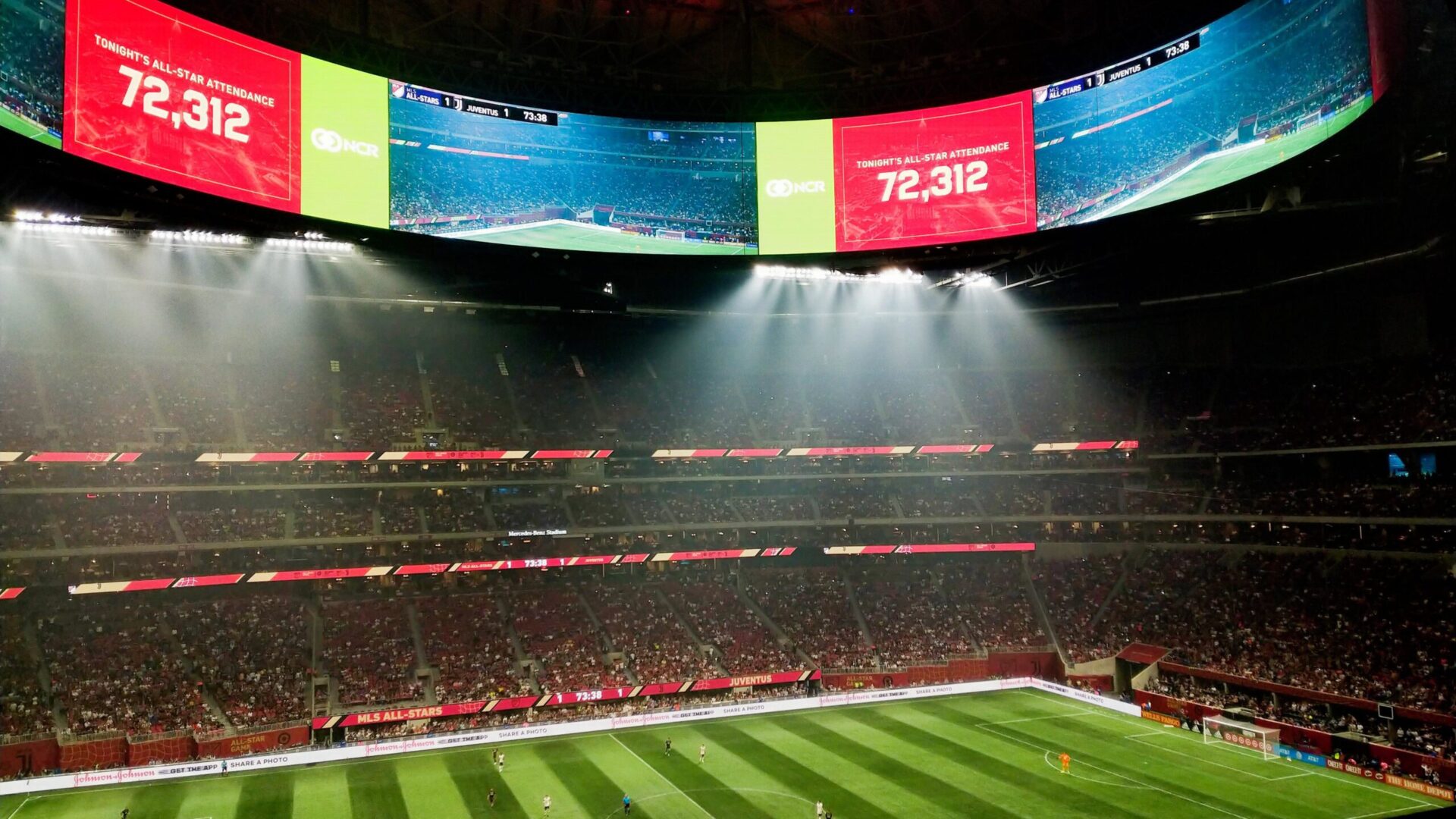
When Mercedes-Benz Stadium – home of the NFL’s Atlanta Falcons – opened in 2017, its most talked-about feature wasn’t the retractable roof. It was the Halo Board. On Juy 15, the World Cup Semifinal between England and Argentina will take place here.
Designed and manufactured by Daktronics, the 360-degree display wraps around the stadium’s roof opening, stretching approximately 58 feet (17.7 meters) high and 1,075 feet (328 meters) in circumference, covering nearly 62,000 square feet (5,760 square meters) of LED display area. Using a custom 15HD pixel layout, the installation remains one of the largest continuous LED displays ever built inside a sports venue.
Unlike traditional center-hung scoreboards, the Halo Board is part of the building’s architecture, ensuring spectators throughout the stadium have clear sightlines while creating an immersive visual experience synonymous with Mercedes-Benz Stadium. Daktronics also supplied the stadium’s towering Mega Column display and additional digital signage, creating a comprehensive digital ecosystem throughout the venue.
For broadcasters, the Halo Board produces unforgettable television images. For architects and venue designers, it demonstrated that the scoreboard no longer needed to hang inside a stadium – it could become part of the stadium itself.
Dallas Stadium aka AT&T Stadium
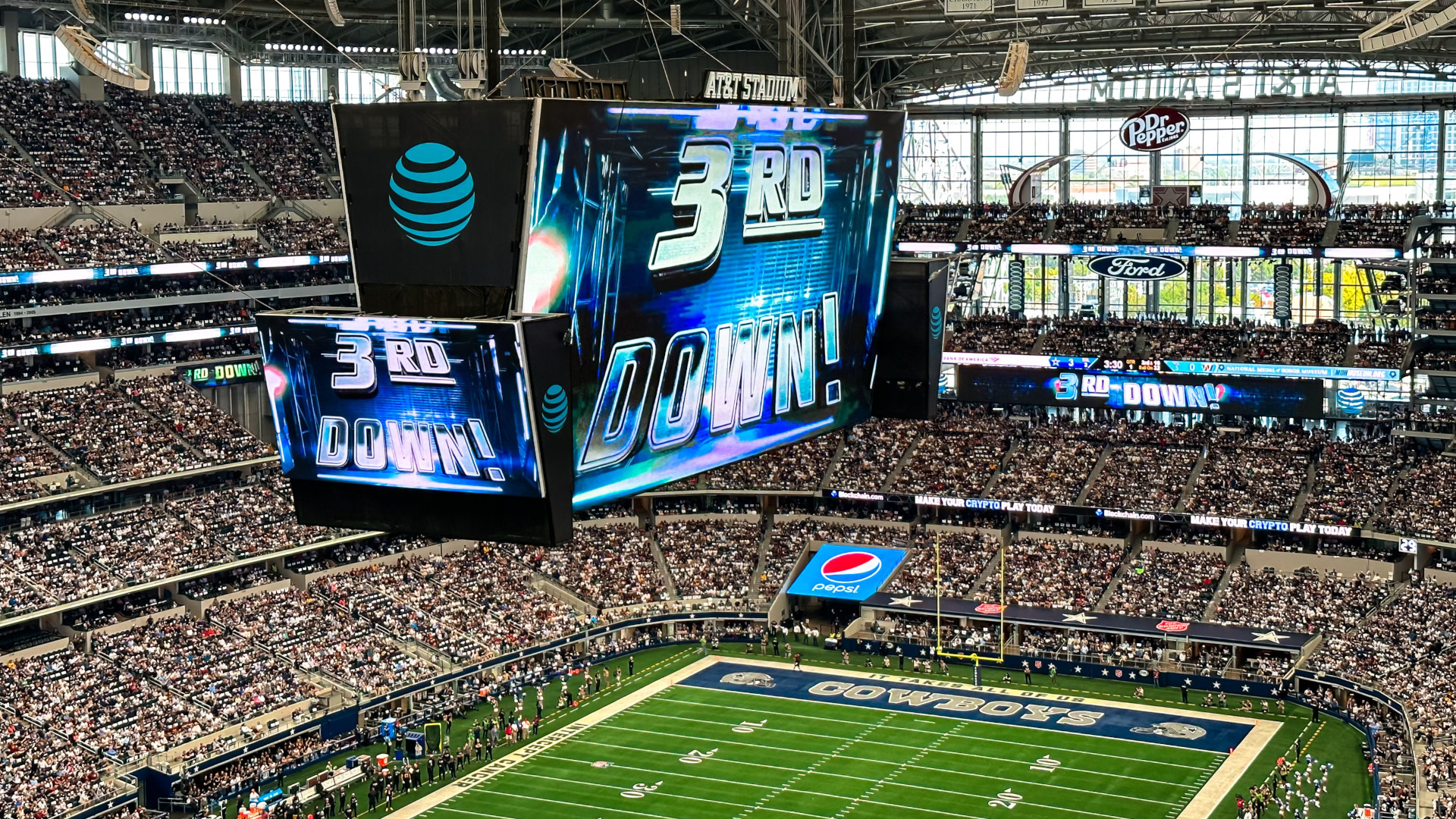
The Semifinal between France and Spain on July 14 took place in a special venue: Long before giant video boards became commonplace, AT&T Stadium, for the Fifa World Cup, Dallas Stadium, redefined expectations.
When it opened in 2009 as the new home of the NFL’s Dallas Cowboys, the enormous Mitsubishi Electric Diamond Vision center-hung display immediately became the benchmark for sports presentation. It changed expectations for sports presentation and helped spark an industry-wide race toward larger, brighter and more immersive stadium displays.
Suspended roughly 90 feet (27 meters) above the field and weighing more than 500 tons, the system features two massive primary displays measuring approximately 72 feet (22 meters) high by 160 feet (49 meters) wide, complemented by two end-zone screens.
The stadium also includes more than 3,000 screens throughout the luxury suites, concourses, concession areas and more, offering fans viewing options that extend beyond the action on the field.
At the time, it was widely regarded as the largest high-definition video display in the world and quickly became as much a tourist attraction as the stadium itself.
More importantly, it changed the industry. Stadium owners, architects and display manufacturers suddenly had a new benchmark. The race to build larger, brighter and more immersive stadium displays accelerated across North America and beyond, influencing many of the venues that now host the 2026 Fifa World Cup.
More than 15 years later, AT&T Stadium remains one of the world’s premier sports venues, with its iconic video board continuing to define the fan experience while reminding the industry of how transformative a single bold technological decision can be.
Los Angeles Stadium aka Sofi Stadium
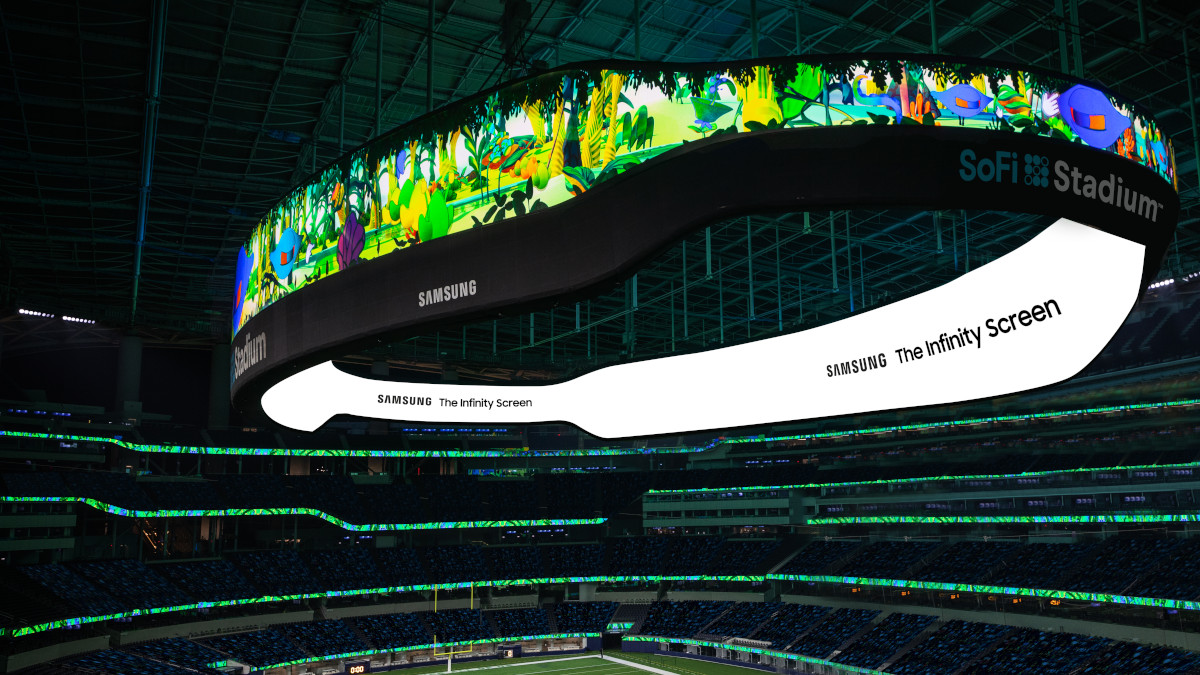
If one display has become synonymous with next-generation stadium technology, it is the Infinity Screen suspended beneath the translucent roof at Sofi Stadium – home to the NFL’s Los Angeles Rams and Los Angeles Chargers. On July 10, it hosted the quarterfinal match between Spain and Belgium.
Manufactured by Samsung, the double-sided oval display stretches approximately 120 yards (110 meters) in length and varies from roughly 20 to 40 feet (6 to 12 meters) in height, creating one of the largest continuous video experiences in world sport. With nearly 80 million pixels spread across both sides of the structure, the display delivers true 4K-quality imagery throughout the venue while serving as the centerpiece of Sofi Stadium’s integrated digital ecosystem.
The ellipse features 6,500 square meters of LED display with an 8-millimeter pixel pitch and 4K resolution, and is the highlight of the new mega-stadium on the West Coast. The LED wall also incorporates a state-of-the-art JBL audio system comprising more than 260 of the stadium’s total 4,500 speakers. With half a million watts of power (out of a total of 1.3 million watts), the digital signage content is impossible to miss.
Unlike conventional center-hung scoreboards, the Infinity Screen appears to float above the playing surface, providing spectators with uninterrupted views of live action, statistics, replays, and entertainment content regardless of where they are seated. It is a defining architectural feature of modern stadium design and is widely regarded as one of the most ambitious LED installations ever constructed.
More than simply displaying the score, the Infinity Screen transformed expectations of what a stadium video board could be. Like AT&T Stadium’s center-hung display before it, Sofi’s installation has become a global benchmark, inspiring venue owners, architects and technology providers to rethink how digital displays can shape the live event experience.
Miami Stadium aka Hard Rock Stadium
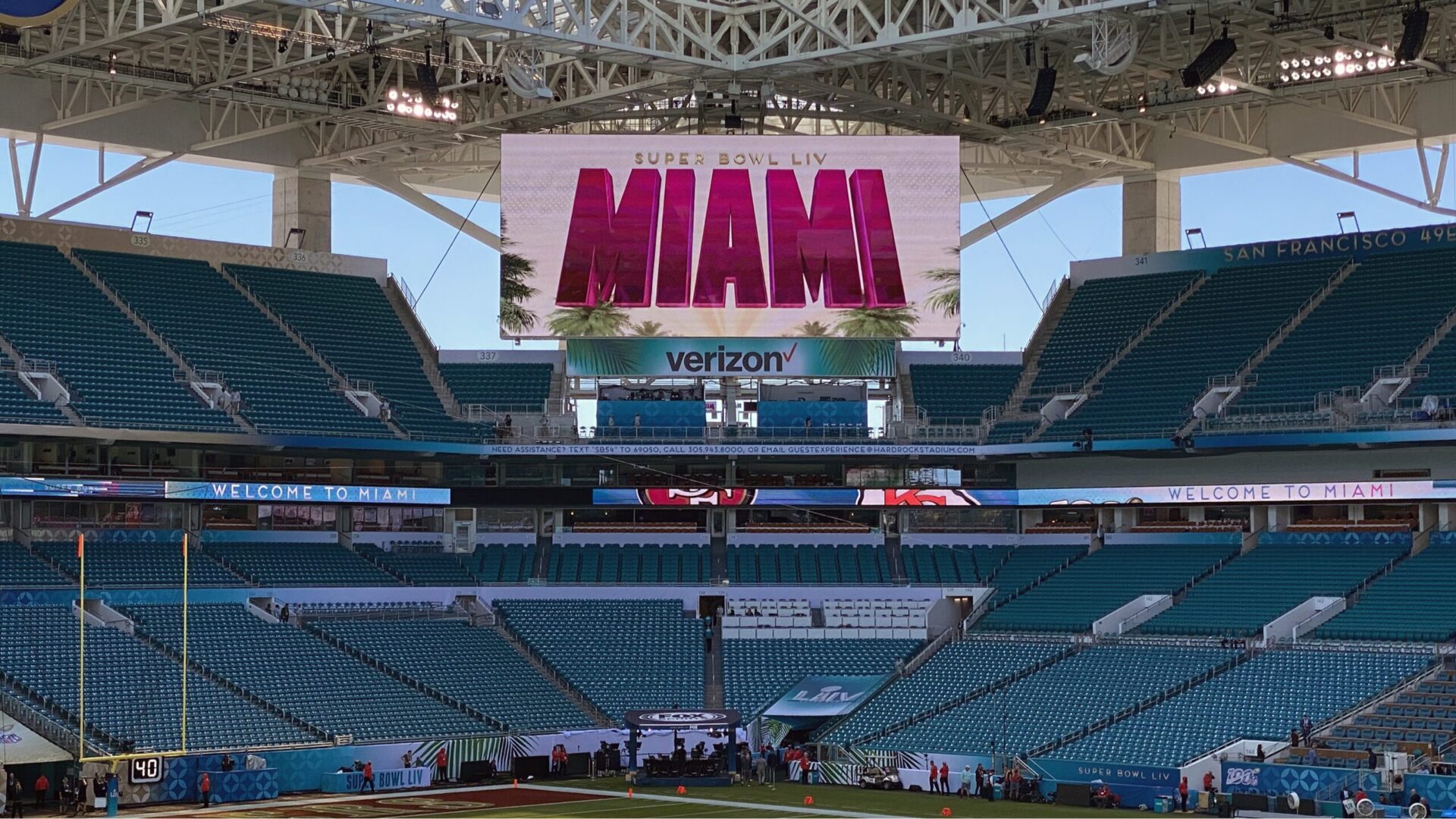
Few venues have embraced major international events quite like Hard Rock Stadium, where the July 11 quarterfinal saw England defeating Norway. The stadium is also home to the third-place match on July 18.
Already home to the National Football League’s (NFL) Miami Dolphins and the college football powerhouse Miami Hurricanes, the stadium has successfully transformed itself into a year-round destination capable of hosting Formula One, international concerts, tennis, college football championships and now the Fifa World Cup
Supporting that versatility is an extensive Daktronics display network anchored by four massive corner video boards, each measuring approximately 49 feet (15 meters) high by 111.5 feet (34 meters) wide. The venue’s digital ecosystem also includes three ribbon displays, highlighted by a fascia board stretching more than 2,100 feet (641 meters) around the seating bowl, creating a digital canvas. Together, the displays create a continuous visual experience that can be adapted for everything from the World Cup to NFL football, Formula One racing, and concerts.
That flexibility has become increasingly important as stadiums seek to maximize revenue beyond their primary tenants. Behind the scenes, Daktronics’ control systems enable operators to manage live video, sponsorship activations, statistics and graphics across the venue from a single integrated platform.
The World Cup provides another opportunity for Hard Rock Stadium to demonstrate that versatility, giving its LED systems a prominent role during two of the tournament’s showcase matches.
Boston Stadium aka Gillette Stadium
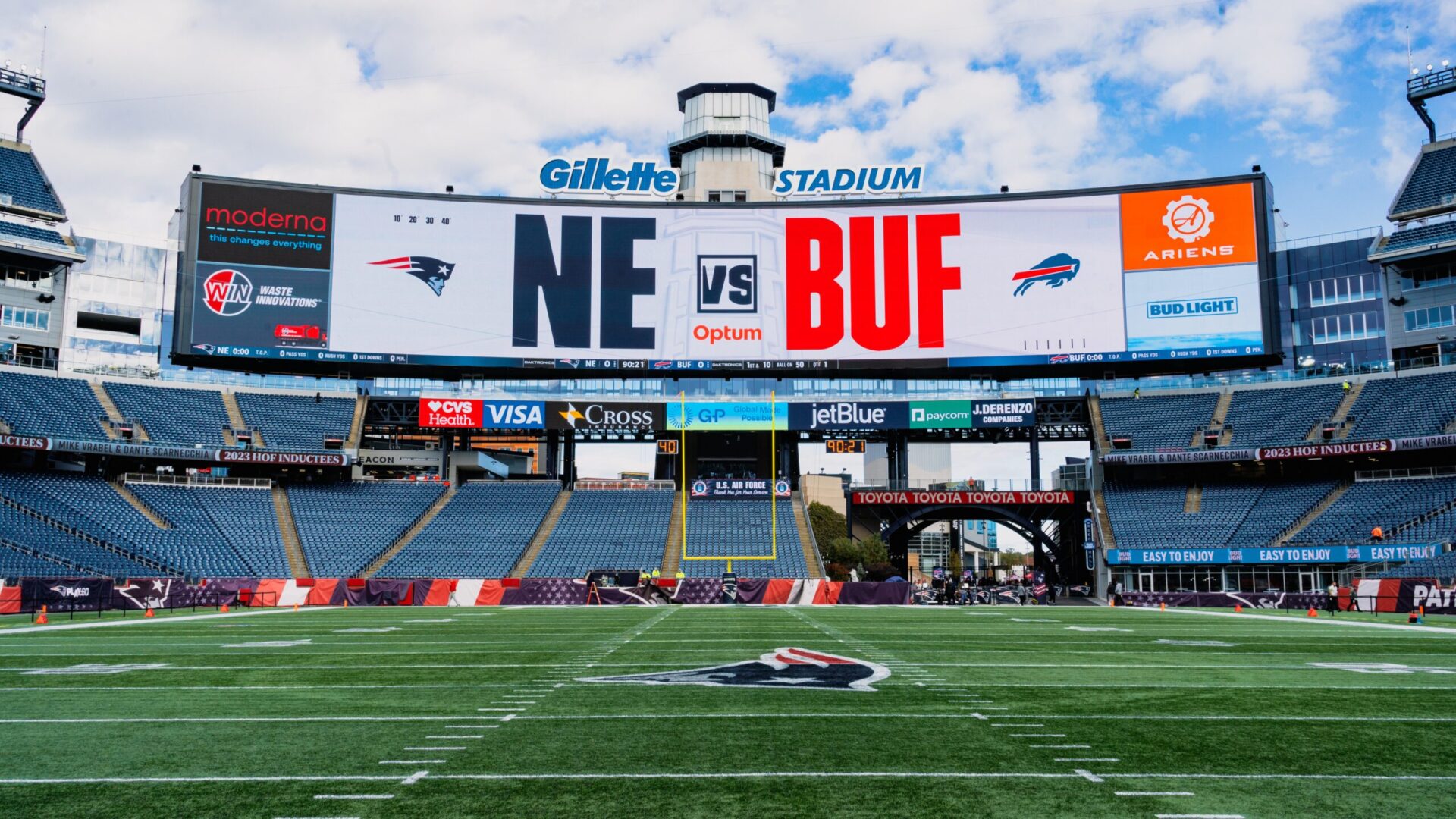
Gillette Stadium has never been shy about making a statement. It hosted the quarterfinal match between France and Morocco on July 9.
Home to the NFL’s six-time Super Bowl champion New England Patriots, its massive north end-zone display, supplied by Daktronics, measures approximately 60 feet (18.3 meters) high by 370 feet (113 meters) wide, covering more than 22,000 square feet (2,044 square meters) and making it one of the largest outdoor end-zone displays in professional sports.
Just below the main video board in the north end zone is an additional ribbon board measuring 10 feet (3 meters) high by 214 feet (65 meters) wide. The end zone also features a field-level outdoor display measuring 3.5 feet (1.1 meters) high by 82 feet (25 meters). The main video board, ribbon, and field-level displays all feature 10-millimeter pixel spacing.
As fans enter from the north, they will be welcomed to the stadium through the gate with a canopy measuring 3.5 feet (1.1 meters) high by 163 feet (49.7 meters) wide, featuring a 5.9-millimeter pixel spacing. Two indoor displays, measuring 18 feet (5.5 meters) high by 64 feet (19.5 meters) wide, and an elevator display, measuring 9 feet (2.7 meters) high by 16 feet (4.9 meters) wide, are installed in the G-P Atrium to capture fans’ attention while inside the premium area. These three displays feature 2.5-millimeter pixel spacing.
Other recent upgrades expanded Gillette’s digital footprint to 47 LED displays totaling nearly 48,500 square feet (4,506 square meters). Ribbon boards, concourse displays and premium-area screens are linked through Daktronics’ Show Control platform, allowing stadium staff to synchronize live video, graphics, sponsorship messaging and statistics throughout the venue.
Rather than relying on one spectacular video board, Gillette demonstrates how today’s stadiums increasingly operate as integrated digital ecosystems, where every screen contributes to the fan experience.
Kansas City Stadium aka Arrowhead Stadium
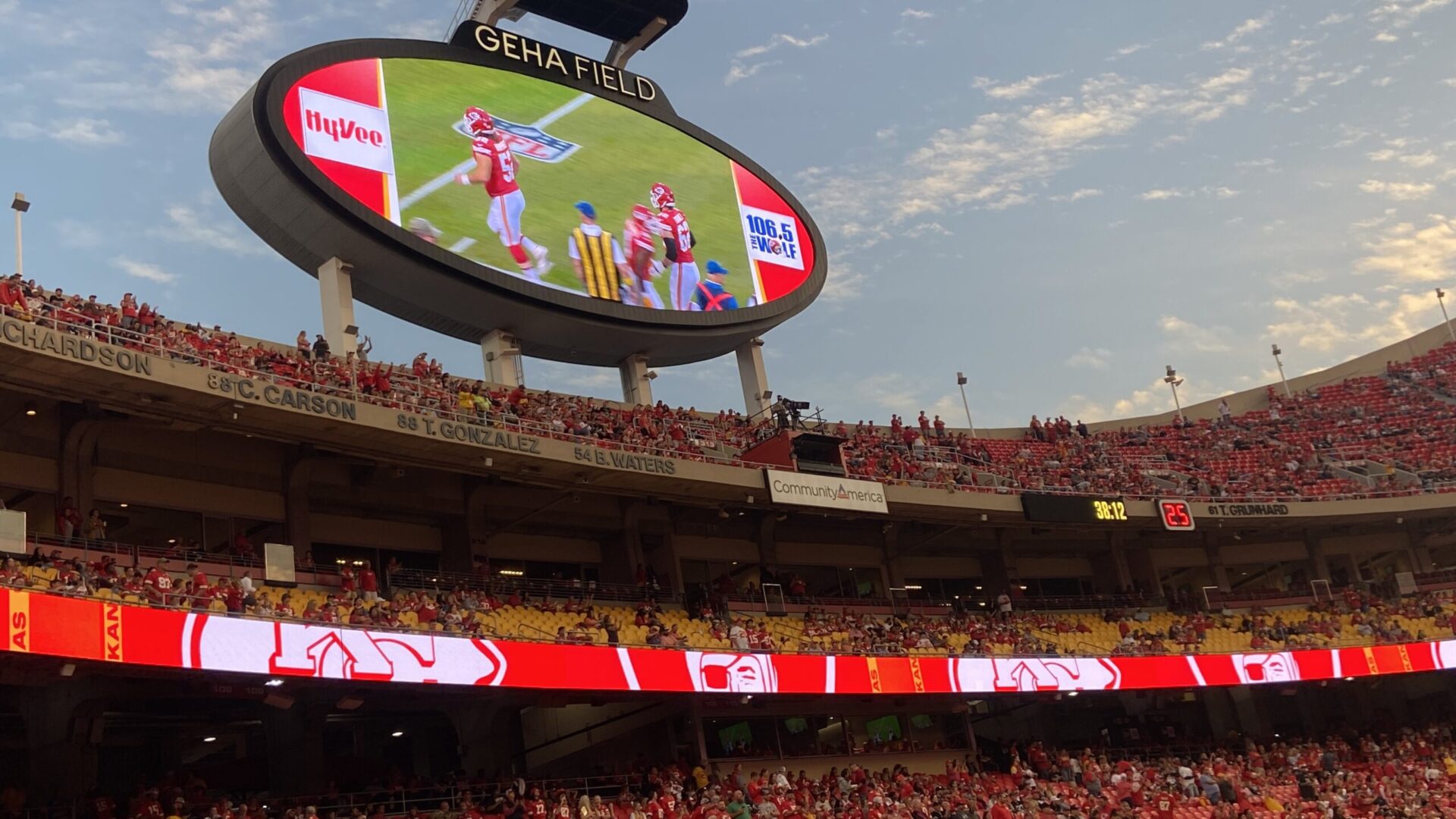
Arrowhead Stadium – home of the NFL’s four-time Super Bowl champion Kansas City Chiefs – is one of football’s most intimidating venues, famous for passionate supporters and record-breaking crowd noise. That noise surely was a factor in the quarterfinal match between defending champion Argentina and Switzerland on July 12.
Its signature west end-zone display, supplied by Daktronics, measures approximately 37 feet (11.3 meters) high by 150 feet (45.7 meters) wide. Installed in 2019, the board incorporates more than five million LEDs and was among the first football stadium displays designed to support High Dynamic Range (HDR), delivering richer colors and improved contrast during live broadcasts and replays.
Combined with ribbon displays throughout the seating bowl, the system delivers live video, statistics, sponsor messaging and game presentation elements that keep spectators engaged throughout every match.
The project demonstrated that even one of the NFL’s oldest stadiums could adopt state-of-the-art display technology without sacrificing the venue’s historic character.
The stadium’s legendary atmosphere still comes from its fans, but the digital presentation amplifies every introduction, celebration, and dramatic moment, ensuring spectators throughout the venue never miss the action.
Immersion as the common goal
Despite their different approaches, each venue shares a common goal: transforming the stadium from a place to watch sport into an immersive digital environment.
And what about the biggest game of all? Stay tuned for a separate article on the technology at New York New Jersey Stadium – home of the 2026 World Cup Final.