
Intuiface is launching the Experience Generator, a next-generation signage platform that shifts content creation from traditional CMS workflows to AI-powered, agent-driven experience building. Backed by a new CRDT-based architecture, the platform enables real-time collaboration between users and multiple AI agents, positioning Intuiface as an interactive experience layer that integrates across any CMS ecosystem.

CMS: Intuiface Launches Next-Gen Signage Architecture
Interaction specialist Intuiface is introducing a new experience creation paradigm: Experience Generator. With this next-generation signage solution, the company is implementing a fundamental shift towards agentic content creation and a real-time collaboration architecture. After years of development, the Toulouse-based provider has begun its move away from a fully manual editor and XML-based data structure to a blended AI/visual editing approach supported by a CRDT-based data structure – a modern standard enabling real-time, multi-agent & multi-user collaboration on a single project.
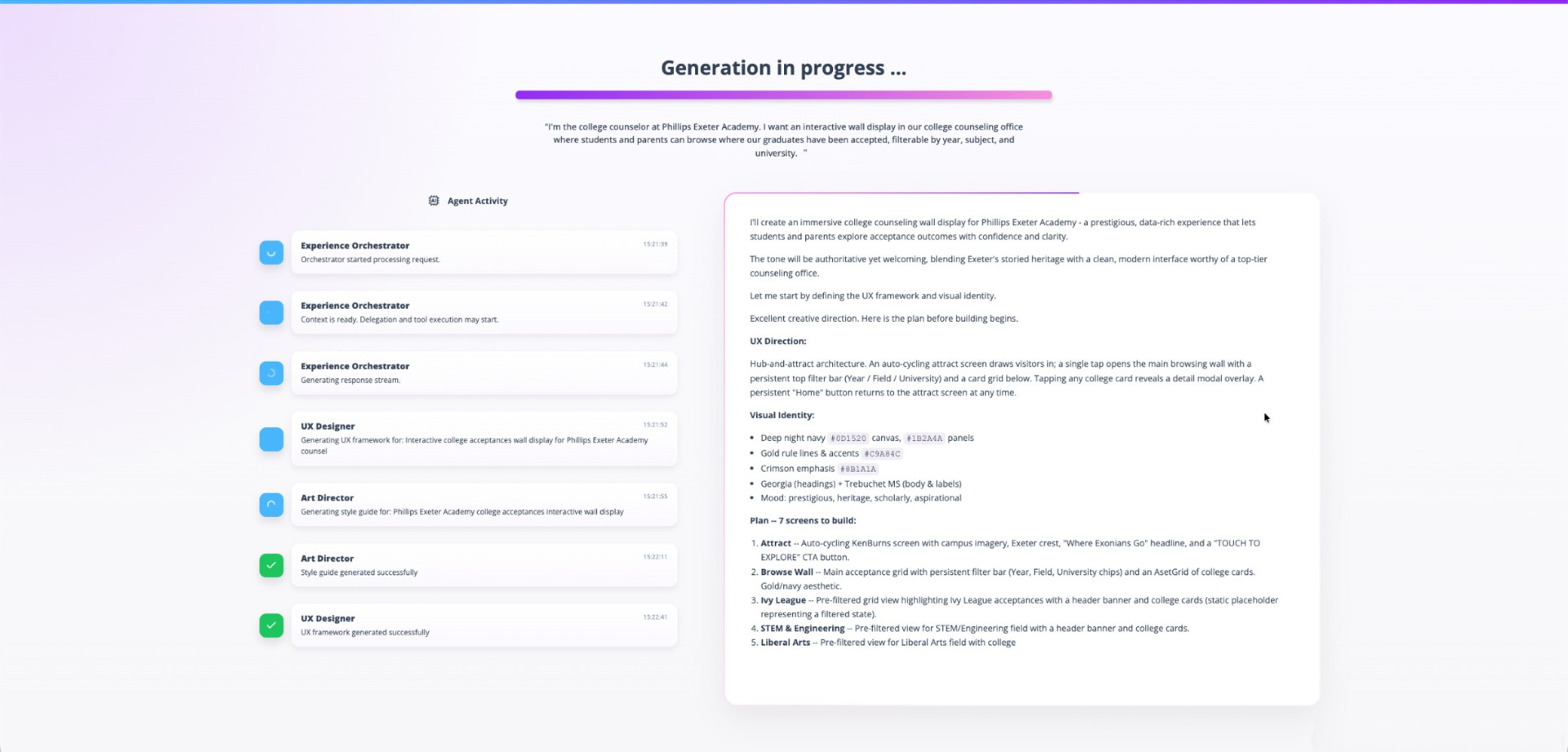
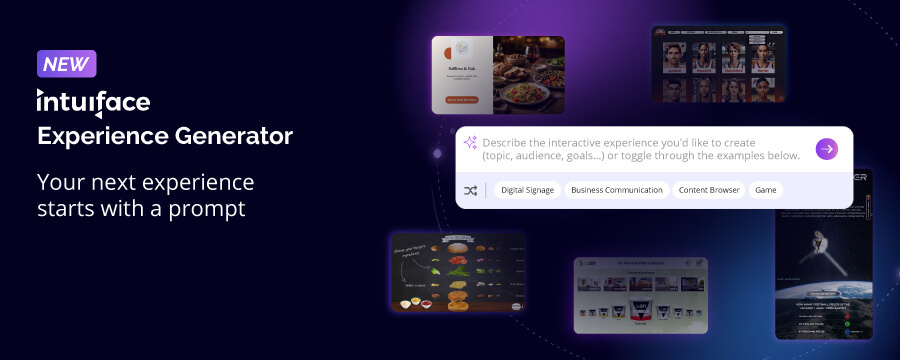
Intuiface Experience Generator enables users to describe the experience they want, and a suite of Intuiface AI agents collaboratively builds a working, interactive experience. CEO Mathieu Yerle to invidis: “With Experience Generator, you describe what you want the experience to achieve, and a coordinated team of specialized agents builds a working, interaction-ready result – not a prototype, not a template, but an original experience you can publish, edit, and refine in our native platform ecosystem.”
Interest in Intuiface has been growing beyond traditional signage applications. After interactive signage, the second-largest use case is now sales and marketing enablement, where customers turn catalogs, slide decks, and CRM data into real-time, connected, interactive experiences.
In addition, the academic and cultural sectors are emerging as a key growth area. Institutions like universities and museums are looking for more engaging digital touchpoints, moving beyond static information screens toward interactive, experience-driven environments for students, faculty, and visitors.
Further distancing from a traditional CMS
This low-threshold, prompt-based approach further reduces the friction of creating complex interactive experiences. Even with Intuiface’s exiting no-code approach, users benefited from specialized know-how and hands-on familiarity with best practices and principles for venue-based digital content. Intuiface’s new AI-driven prompt paradigm follows a fundamentally different logic: instead of navigating intricate toolsets, users describe what they want and the system generates the experience with best practices embedded from Day One.
Intuiface has built its reputation on anticipating technology shifts. Twenty years ago, it was the first ISV in digital signage to embrace no-code – a concept that has since gone mainstream in the AI era. Now, the company is positioning itself at the forefront of the next wave: agent-driven workflows blended with visual human-driven edits.
“The needle hasn’t moved much in the industry,” CEO Mathieu Yerle told invidis. “CMSs have become increasingly commoditized. But the emergence of agentic AI introduces new opportunities for online and offline interactive signage. The future – not only in our sector – lies in agents working with and for the creatives.”
From Monolith to Agent Ecosystem
Intuiface is evolving from a monolithic authoring tool into an orchestrated ecosystem of agents. Instead of relying on a single user-led composer, multiple AI agents collaborate in parallel, all with synchronized access to the same data set.
This marks the beginning of a new operating model in digital signage, defined by close collaboration between human users and AI agents, a clear specialization of tasks across multiple agents, and continuous orchestration rather than traditional linear workflows.
Agents used by Experience Generator are modeled after typical functions in a creative agency and include:
- Experience Orchestrator – The lead agent. It interprets the request, plans the build, delegates to the specialist agents, and assembles their work.
- UX Designer – Flow, navigation, information architecture, onboarding, accessibility, content hierarchy.
- Creative Director – Visual identity, aesthetic direction, design system, visual coherence.
- Scene Builder – Constructs complete scenes from high-level direction: layout, layers, visual elements.
- Experience Editor – Writes and edits the experience itself using the CRDT document model: structure, properties, asset configuration.
- Interaction Designer – Wires the interactivity: triggers, actions, and navigation between scenes.
- Visual Generator – Generates imagery.
- Web Researcher – Pulls external content and data from web-accessible internal systems.
By distributing these tasks, Intuiface aims to significantly increase production efficiency while reducing manual effort. This modularity also enables the onboarding of additional agents with minimal overhead. The company expects to release updates more frequently and respond more flexibly to market demands.
From XML to CRDT
The transition from XML to CRDT (Conflict-free Replicated Data Types) marks a structural change with far-reaching implications. Traditional file formats such as XML struggle when multiple entities – whether AI agents or human users – simultaneously access and modify the same content, often leading to version conflicts.
CRDTs resolve this limitation by enabling real-time, distributed collaboration without conflicts. Next-generation productivity platforms like Figma already use the approach. “After two decades, Intuiface is moving away from XML to CRDT files, enabling multiple AI agents to work simultaneously on one file. We’ll use this model to introduce, in the near future, multi-user collaboration for experience creation as well. This is a true Figma moment for Intuiface.”
From Standalone CMS to Modular Platform
With its ability to operate as a headless, fully modular platform, Intuiface is looking to further expand its role. Typically used as a standalone CMS, Intuiface experiences will continue to be based entirely on pure web technologies, enabling the output of Intuiface Experience Generator to be embedded in any third-party CMS framework. Even CMS software suites – promising to provide everything under one roof – can benefit from an interactivity specialist that the larger stacks increasingly need.
“There are excellent CMS platforms out there, and it would be a shame not to leverage them. We’re built to work across any of them – we’re the interactive experience layer, whichever CMS sits behind it.”
- Hospitality Displays: Samsung’s The Frame Hospitality TV Now Available In The US
- India: Kramer Creates Flexible Meeting Spaces for Sailpoint
- US$18 Million Cost-Cutting Plan: Daktronics to Close Ireland Factory
- Sphere Abu Dhabi: Blue Rhine Wins Exosphere Installation Contract
- Joan Interview: From E-Paper Pioneer to Workplace Platform