
The Infocomm plan was to do a few write-ups and maybe even another video like the one I did after ISE a few months back. However …
Haynes Column: E Ink Getting Serious About E-Paper Digital Signage, But Price Still A Barrier
I got too busy. I got sidetracked endlessly. Trapped at times in demos that went on and on (I’m polite). Plus I only had 1.5 days on the floor, because I needed to watch Canada in an afternoon (Vegas time) World Cup match. And so on.
Then I got home and went straight into a mega-project reviving and upgrading a fenced-in (because of deer) raised bed garden that was aging out and threatening to tip over or disintegrate. Hundreds of fiddly little metal raised bed fasteners later, and a truckload of gravel and soil moved out of necessity by bucket, not wheelbarrow. But that’s all done now. Phew.
So … now I have time to get back to some notes and interview recordings from the big ProAV trade show last month.
As outlined in a previous after-show post, there was not a lot of stuff on the Infocomm floor – on the display side – that went beyond advances on what’s already very good. Flat panel displays are a seriously mature product and LED is also well past the state when onlookers got the tingles seeing fine pitch units, and the shakes from hearing prices.
Both technologies keep getting better, but that’s now in little increments, not big leaps.
E Ink Making Those Leaps
The display technology that IS genuinely making big leaps is E Ink, the Taiwanese/American company that brought electronic paper to the market for consumer e-readers and commercial electronic shelf labels.
The company has for many, many years been slowly advancing its capabilities for color support, and in Las Vegas, it was showing products that are ready for the market for some well-defined use cases in digital signage and digital out of home. But it is super important to keep in mind that this tech is not a true and legitimate alternative to flat panel or LED displays in most applications.
People are best served thinking of it as a print replacement – for things like in-window or wall-mounted posters, and for DooH wall-mounted or sidewalk totems that don’t need video and don’t have big-dollar brand advertisers insisting on absolute color accuracy.
It’s greatest strength is the ability to deploy these things and run them off batteries – possibly augmented by solar collectors – and not relay on the physical set-up or operating costs brought on by grid power.
There were a bunch of companies on the Infocomm floor showing e-paper, and it is important to take on board that they’re almost all (save some reflective LCD stuff) product that uses E Ink product and then adds varying amounts of a display company’s special electronics sauce to offer some distinction.
So Sharp and Samsung, to name just two, have their own e-paper displays, but at their core they’re both E Ink units.
E Ink’s head of Europe, Pete Valianatos, kindly gave me 15-20 minutes of his attention at the stand to walk through where things are at. It was impressive, but also a bit confusing.
Three core products
There are three core products aimed at the digital signage/DooH/print replacement markets …
Spectra 6 is the prettiest, and the most positioned as a print-quality replacement. It uses red, blue, yellow, and white reflective pigments, surfacing the right colors and blending them to realize visuals that look pretty damn close to high quality print. But digitally changeable.
One of the great advances made by E Ink is the image refreshes are now animated and artistic – instead of looking like the paper is having a medical emergency by madly glitching out. The animations make you look just at the glitching did/does, but without making onlookers wonder what’s wrong.
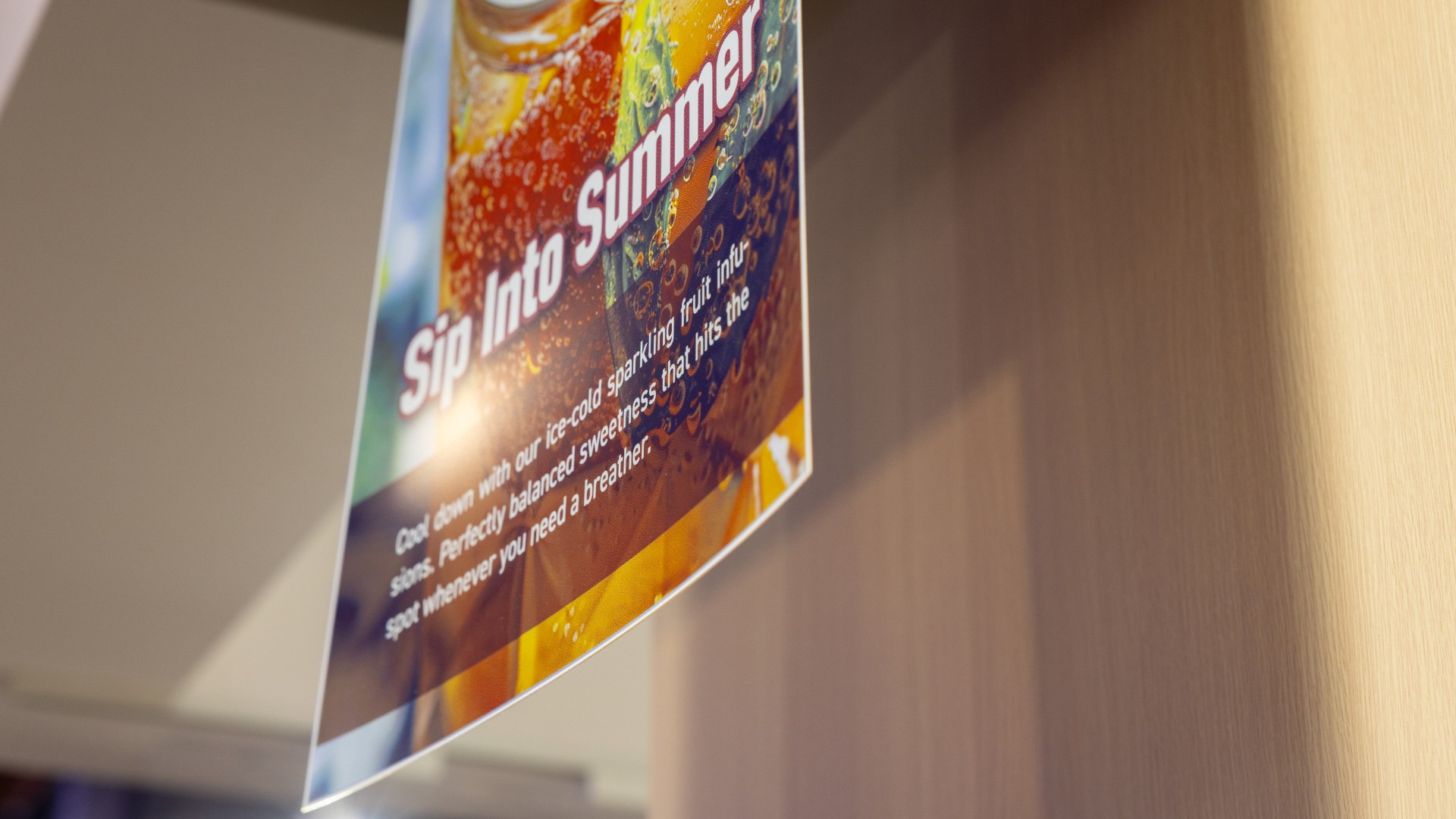
Just as a proof of concept, the company had a pair of Spectra-6s mounted on a flex plastic substrate instead of rigid glass. The Spectra 6 is at its root a film, and these were just suspended and waving in the show floor breeze, like laminated menus. I’m not sure what the use-case might be, but it was/is super-cool, regardless.
There was also a proof of concept 75-inch unit that was two units tiled, one atop the other … with a small, inoffensive horizontal seam. And there was a Spectra 6 made to the A1 print industry standard dimension.
Kaleido 3 is kinda the budget “good enough” product aimed at the indoor AND outdoor DooH and public information display market. E Ink calls it the workhorse option for those markets.
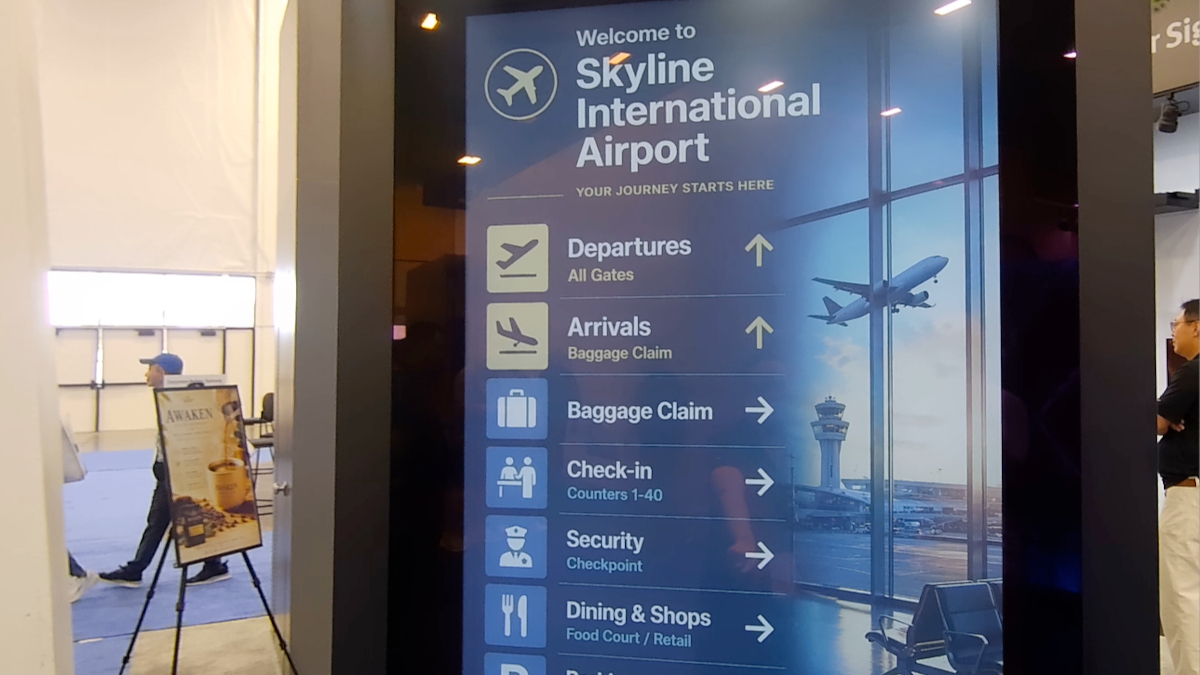
It can be tiled to create big format totem displays, but it is a black and white product that has a color filter on top. That reduces the overall brightness, and also means colors are muted. The base technology allows for quick refreshes, so it can do animations – even low-frame rate video.
I’ve seen that video on the Kaleidos, and it is absolutely a compromise. I don’t know why people would use it. But who knows.
Companies like Taiwan’s Dynascan and US-based Agile Display Solutions have Kaleido-based totem products, and Agile had a unit at the E Ink stand.
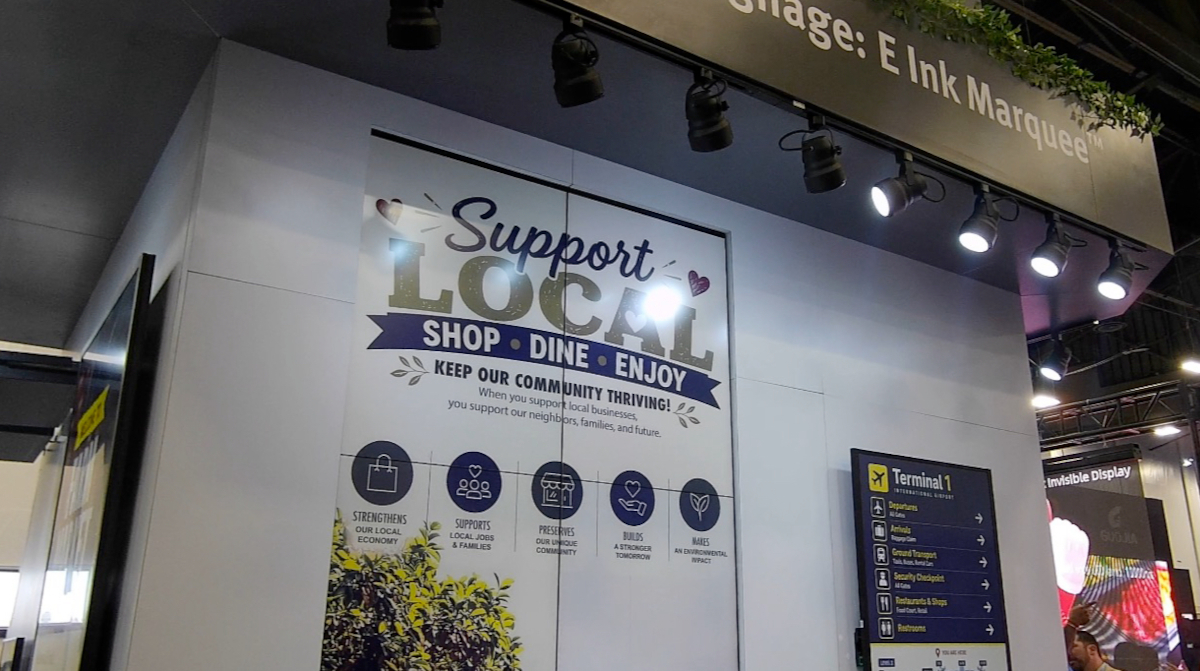
The next-gen for outdoor is a product called Marquee. It uses a four-particle ink system that is a big step up in visual quality and “pop” from Kaleido, much closer in look to the Spectra 6. It has been ruggedized for the outdoor DooH market and has the kind of wide operating temperature range that means it can be used in brutally hot southern Arizona or in Minnesota’s chilly winters.
What I saw was a 2 wide, 3 tall array of 40.5 inch panels that rolled up to the dimensions of a typical large format DooH display. There’s also a 55-inch Marquee in development.
While Kaleidos have a very limited color range of 4,000 something, Marquee uses something called dithering to mix colors, making it possible to support what I was told was millions of colors.
Marquee is just at the engineering sample stage and the hope is it will be starting to ship late this year or more likely early 2027. If that’s the case, it is logical the launch would be timed to coincide with ISE 2027 in Barcelona.
E Ink also has a product called Gallery, which is like Spectra 6 but aimed at the consumer market for applications that need much richer, saturated color gamuts for high-resolution graphics and photography. Think changeable digital artworks frames.
There is a video has a good walkaround the stand, without any of the pom-pom cheerleading you have to endure with paid booth visits.
Fuzzy on price
I did ask, but still got some pretty fuzzy narrative about pricing for these products. That owes in part to E Ink being a supplier to manufacturers, who then make products and set their prices. I think it also owes to unit prices still being high and causing some sticker shock.
So a price discussion with E Ink and its partners might pivot to long-term ROI, saving on energy, production costs, labor and so on. All of them are valid. But companies like Sharp and Philips are selling 25” and 32” e-poster displays for close to or more than US$2,000.
Which is likely why you see press releases for teensy rollouts, because deploying at scale – at those prices – either ain’t happening much. Or at all.
I did speak about price with the guys at Agile Display Solutions, which seems to see e-paper as a true new line of business as opposed to what smells like a “we have e-paper, too!” exercise for the big pro display brands.
For Kaleido – which the Oregon-based company puts in sealed, weather and people-ready enclosures – I was told units of matching display dimensions are about 1.5X the cost of high-bright outdoor-rated LCD versions.
That would be workable, I suspect, for some media companies. But I’m also thinking once those guys see the much richer colors of Marquee, they’re going to want that.
All told, E Ink has made a lot of big strides in the last few years. I first saw color e-paper more than a decade ago at Computex in Taipei. It was muted and kinda terrible. But a big technical achievement, nonetheless. Now, color E Ink looks really good.
But it is not a replacement for LCDs and LEDs. It is largely its own thing – best suited for situations where power is expensive to get, put in place and use, and geared to when the visuals will change by the hour, day, week or month – not 30 times a second.
In a lot of ways I think the sign printing industry should be paying much more attention to this than the digital signage ecosystem, which is aware and liking at it.
If past experience talking to the sign business is any indicator, I’m guessing most in that industry barely know this is coming.