
Built on an evolving database of 200+ vendors, the tool highlights how little differentiates many offerings — and where real value lies. Useful for filtering options, but still limited by vendor marketing quality.
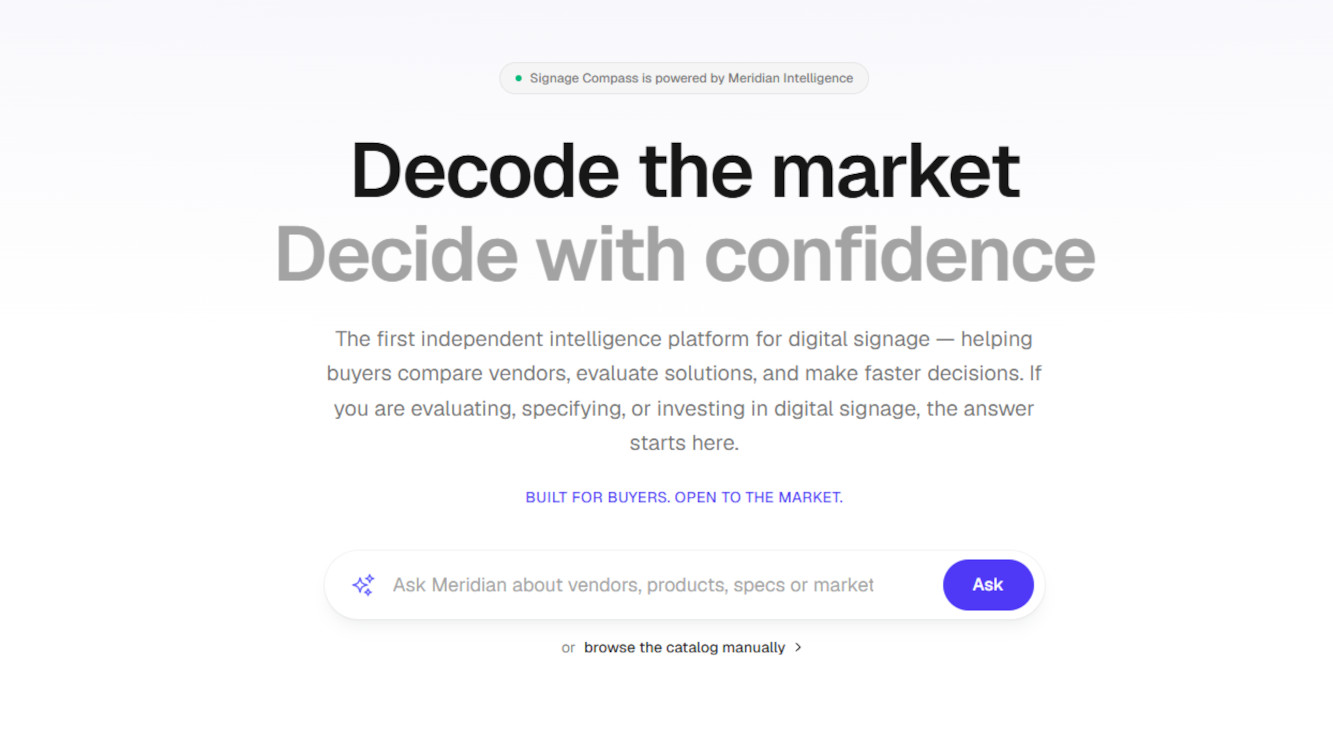
Haynes Column: The Signage Compass Is More Than Another LMM, But …
Beyond the simple and obvious problem that there are far too many digital signage management software platforms on the market, there is a more subtle challenge of trying to separate and sort all the vendor options in different and useful ways.
Vendor sales and product leaders would argue the fine elements of this, but there’s no getting around how all of these platforms are basically offering and doing some variation of the same thing.
A couple of years back, my friends at Munich-based Invidis (which now publishes Sixteen:Nine) started talking up and quietly showing a new product/service called Software Compass, a web-based platform that allowed software vendors to be evaluated and benchmarked.
The idea was to offer something neutral that vendors could use to see how they stacked up against competitors when it came to capabilities.
That meant a relatively small pool of potential paying users for the toolset, and the Software Compass has evolved since that time to broaden the potential user base. When I was in Munich recently, I chatted over a tall weisse beer (I know, shocking) with the lead on the initiative, software veteran Marco Wassermann.
The 2026 iteration is now branded as Signage Compass, and leans heavily into the capabilities of an AI LLM to build up a knowledge base of the companies that make up the global digital signage ecosystem – notably but not only the software guys.
There have been other efforts through the years – I have gone down the path myself at least a couple of times – to develop a database of companies. But it has always been a lot of hard, time-eating work picking through websites and other material to itemize everything.
Then whatever is built up needs to be updated.
Leveraging AI
AI changes all that, and the 200-plus companies now in the Signage Compass are listed, sorted and characterized using the always-working power of an LLM. I submitted a few company URLs out of curiosity, and in pretty short order the AI engine crawled and scraped the information off public sites and built up a profile.
It’s imperfect, owing a lot to the garbage in, garbage out axiom.
It’s very hard to develop a detailed profile on what a company has and offers if the website is loaded with buzz terms and over-used phrases. A lot of vendors are light on detail because they don’t want to share whatever secret sauce they have with customers, or they want potential customers to engage directly.
The flaws also have to do with a lot of small companies that have minimal or no marketing budgets, so they roll their own. Often badly.
People who build software or hardware tend to stumble in product marketing because they get hung up on their specs, and forget the critical message of conveying why people might want what they offer. Most end-users don’t terribly care how stuff works. They want to know what it will do for them.
I sense a lot of small companies also parrot what their competitors say.
Navigating with a compass
I told Wasserman I’d like to poke around in the Signage Compass, and he kindly furnished me with a master-of-the-universe level login. Once in, I tried some simple and more exotic searches.
First, I asked about the term “easy” – because everyone and their sister goes hard on that as a lead term in marketing materials.
The answer: “Virtually all of them do. Across the knowledge base, ‘easy,’ ‘ease of use,’ ‘easy to use,’ ‘easy setup,’ and closely related phrases appear in the marketing and case study content of essentially every vendor surveyed. It is one of the most ubiquitous claims in the digital signage industry, used by vendors across every market tier — from entry-level SME tools to enterprise platforms.”
I expanded on the question to ask about the most common marketing terms being used, which are Content, Scalable, Real-time, Cloud-based and Easy.
The Compass says these terms are “essentially noise. They appear so universally that they carry zero competitive differentiation. Any vendor using “scalable,” “real-time,” and “cloud-based” in the same sentence is writing industry wallpaper.”
Terms that are less used but carry more weight are ones like Brand Consistency, ROI and Analytics.
To be clear, I don’t think companies should stop using terms like easy and real-time. They just shouldn’t be the lead attributes, because they’re “table stakes” terms these days. If your platform isn’t easy to use and can’t handle real-time data, you’re kinda dead.
Everybody does retail
Next, I asked the Signage Compass about the most common vertical markets cited by vendors. It will surprise no one that retail and workplace were the top two, followed by healthcare and education.
They are big addressable markets, so it makes sense. But it should be a wake-up call for any company that says it does retail, but doesn’t really have deep insight, expertise or integration with the tools and information systems that drive that sector.
As I have nattered on endlessly about, software companies are well-advised to find their thing – their vertical or special capability – and be THE most logical and go-to option for that. Just saying you do retail is not a path to glory.
Pricing confusion
One source of irritation I have long had with how CMS companies go to market is the lack of a simple standard around pricing. Some have subscriptions based on end-points, like media players or smart displays. Some sell based on screens, when they really mean end-points. Some actually do sell on screens – so five screens driven by one media player is five licenses (I think this is nutty). And some price based on per-site or venue, regardless of the screen or media player count.
Still with that topic, I asked for typical pricing, and the Signage Compass suggests the standard SaaS fee per month is roughly $18 to $22, with some reaching below $12. That lines up with my understanding. For ages the common fee was about $25, but with time and competition, that number has gone down.
But the big qualifier there is those are rack rates, while a hell of a lot of deals with any scale are getting signed for sub-$10 or even sub-$5 per month.
Zeroing in on support
I did one more search, this time more nerdy – asking about Android support. This is where I think something like this Compass gets particularly useful. The returned breakdown listed those platforms that are compatible with or (better) natively support Android. It kicked back a set of vendors that included, where it has been stated on websites, the type of Android support but also the version.
It would take a pile of work to come up, let’s say, with options that support Version 11 or higher, but this kicks that all back in seconds using a simple prompt.
The particularly useful thing about the new approach that leverages AI is that it can be automated. So … if a vendor refreshes its website with more updated technical material, it gets crawled by the LLM. So the material is up to date, something damn near impossible to do with manually maintained directories.
Is this the answer to all needs? No. What a company says it does and supports isn’t necessarily what it really can do and support. The AI can’t evaluate or bullshit filter by crawling a website.
But it’s a nice little tool that can speed up sourcing and filtering options.
There are three pricing tiers, including a freebie one with very basic capabilities, and then paid Evaluate and Command versions.