
When a major signage vendor collapses, it’s not just a company that disappears - it’s entire networks left vulnerable overnight. This guest piece explores why single-vendor ecosystems create hidden risk and how a more flexible, decoupled approach can keep your screens on, no matter what happens upstream. A guest perspective by Brian Selman, VP North America, SignageOS.
Guest Article: When One Vendor Falls, Should the Whole Network Go Dark?
One of the largest players in digital signage is being dismantled right now. Assets sold off, subsidiaries wound down, clients left to figure out what comes next. Most operators never planned for it, because most never thought it could happen to a company that size. It can, and it just did.
I think the real story isn’t the company. It’s everyone downstream of it: the brands whose entire in-store networks were suddenly tied to a balance sheet they didn’t control.
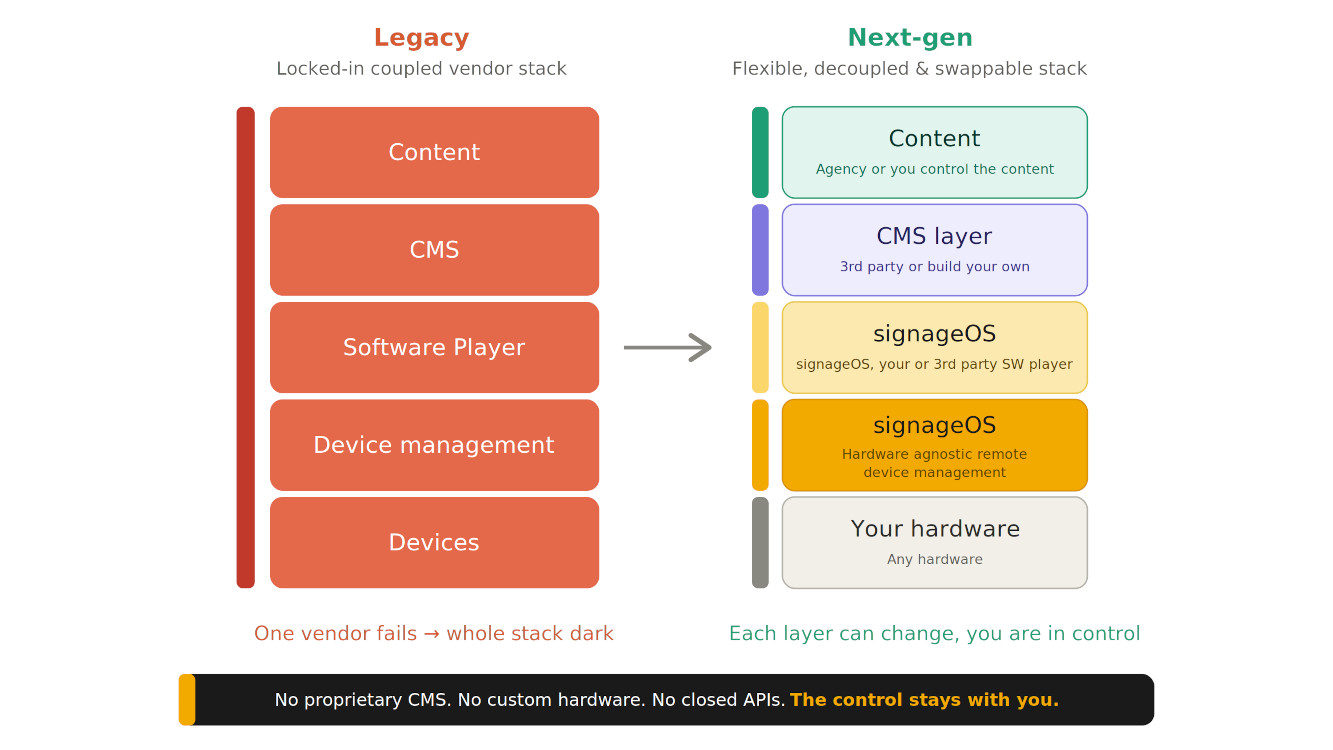
When one vendor owns the whole stack (the hardware, the player, the CMS, the analytics), that company’s failure becomes your failure. The screens don’t care why the vendor went under. They just go dark.
This isn’t about piling on. There’s no winning when a two-decade name unwinds and people lose jobs, and the pressures squeezing this industry are hitting everyone. But the lesson isn’t about one company’s bad run. It’s about how the network was built, and that’s something buyers can do something about right now.
When one vendor fails, the whole stack fails
For most of this industry’s history, buying signage meant buying one vertically integrated bundle: one vendor for the displays, the players, the CMS, and increasingly the data layer too. It was convenient. It was also a quiet bet that the vendor would still be standing, and still pointed in your direction, for the life of the network.
When that bet holds, you never notice the risk. When it doesn’t, you find out every layer was sitting on a single company’s survival. One vendor fails, and the whole network goes with it: your playback, your management, your proof-of-play to advertisers, all of it. That’s not a knock on any one company. It’s just what happens with a coupled architecture.
Decoupling changes what a vendor failure costs you
There’s a better way to build, and it’s where I see more enterprise brands heading. Decouple the layers so each one can change on its own, on your timeline, by your choice. The hardware is yours, picked from dozens of certified platforms, not lock-in. The CMS is a choice too: buy one off the shelf, or build your own. And the layer in between should be standardized infrastructure, not a proprietary trap.
The point is that no single layer can take the whole network down. If a CMS stumbles, you swap it and the rest keeps running. If a hardware line gets discontinued, you change hardware without rebuilding everything above it. The investment travels with you instead of getting stranded with a vendor.
That’s the role we play at SignageOS. We own the device runtime that turns 50-plus hardware platforms into one hardware-agnostic foundation, but on purpose, no proprietary CMS, no custom hardware, no closed APIs. It’s not hard, but it’s complicated, and our job is to take the complicated part off our partners’ plate.
This isn’t theoretical. Some of the largest mixed-fleet networks in the world already run this way, hitting enterprise-grade uptime across tens of thousands of screens on hardware they chose themselves.
Of course, someone will point out that SignageOS is a layer in that stack too. It’s a fair point, and it’s why being open matters. A standardized, API-driven foundation behaves differently than a proprietary bundle: it’s interoperable by design, it doesn’t tie your hardware or content to one company’s roadmap, and it’s built to keep your network running. That’s the whole reason this layer should be a standard and not a silo.
You don’t have to start over
If you’re inside a single-vendor stack today, the point isn’t that you made the wrong call. Plenty of strong networks were built that way, and many of our own partners run exactly those kinds of networks, reducing the coupling over time by introducing signageOS underneath. You don’t have to rip anything out. Start where you are and decouple gradually. The goal isn’t to throw away what’s working. It’s to make sure that if any one piece goes away, the rest of your network doesn’t go with it.
The question every buyer should ask
The brands that come through the next few years in good shape are the ones asking a different question when they buy. Not just “what can this vendor do for me today?” but “what happens to my network if this vendor isn’t here in three years?”
If the answer is “the whole thing goes dark,” that’s not a partnership. That’s exposure. No setup is risk-free, and anyone who tells you otherwise is selling something. But the most resilient networks aren’t the ones built on the most impressive single vendor. They’re the ones designed so that no one failure takes everything with it.
That’s what I’d build toward, and it’s worth protecting.