
When Microsoft first rolled out the Microsoft Device Ecosystem Platform (MDEP) in 2024, it largely flew under the radar of the digital signage industry.
MDEP was originally introduced as an Android-based operating system designed initially for meeting room devices — think Teams Rooms hardware, collaboration bars, and other purpose-built endpoints that needed strong security, predictable update cycles, and tight integration with Microsoft’s identity and device management stack.
From the outset, the platform was also designed to be software- and hardware-agnostic, supporting open standards and enable mixed-device scenarios instead of expensive, custom-made room solutions.
Those characteristics translate well beyond meeting rooms, and over the past year Microsoft has started positioning MDEP as a potential foundation for digital signage. The logic isn’t simply about running signage players on a different operating system. Microsoft’s larger objective is to establish an open, secure device standard that allows AI-enabled endpoints to communicate with each other as part of a shared infrastructure.
In practical terms, that could look like an employee booking a workstation through an app before leaving home, then being guided through the building by digital signage once they arrive. Wayfinding displays, room schedules, sensors, and access systems could all respond in context, tied together through a common identity layer and managed on the same platform. In that model, signage becomes less of a standalone AV system and more of a participant in a broader, intelligent environment.
Another key advantage of MDEP is its integration into Microsoft Intune, which means entire device ecosystems – not just screen networks – can be centrally managed through one interface.
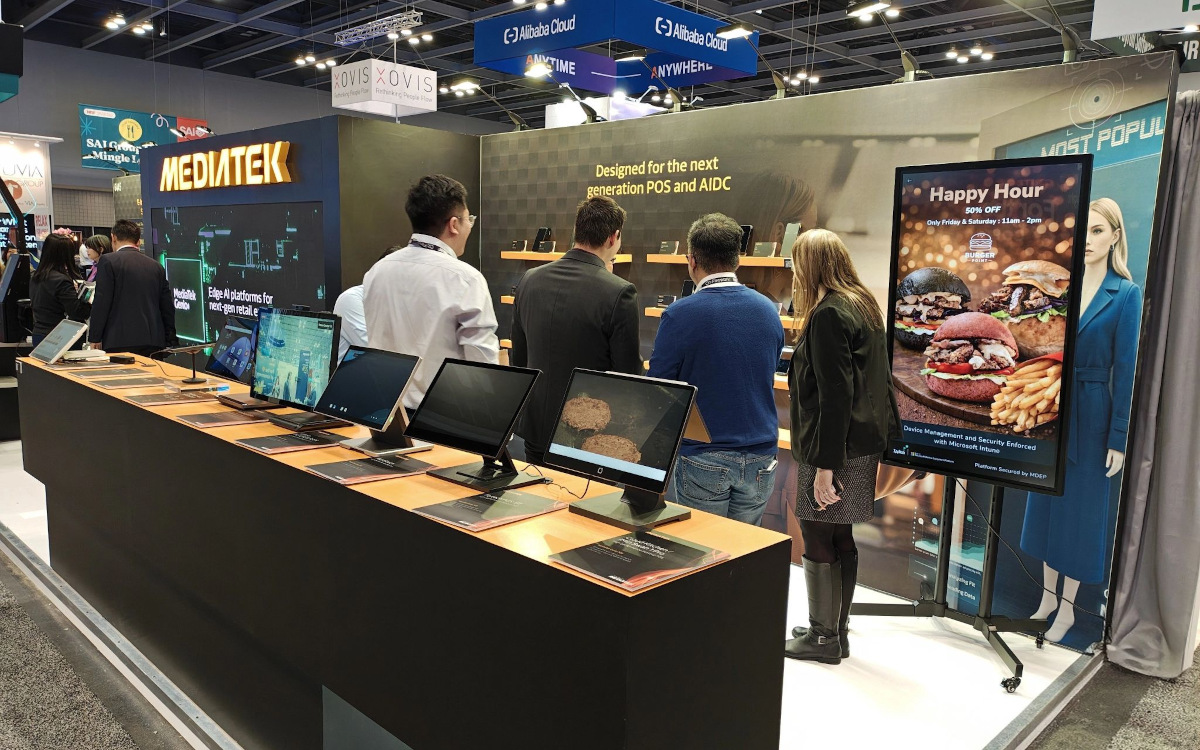
This platform approach wasn’t invented by Microsoft — its supported by many others, like Google, Samsung, and LG. And Microsoft has yet to convince the digital signage industry of the necessity of having yet another platform to develop their solutions on. But the tech giant took a concrete step forward at NRF 2026 in New York, where it announced the first digital signage solution running on MDEP together with IAdea and Mediatek.
The jointly developed solution is aimed at 24/7 retail applications such as restaurant menu boards, DooH displays in high-traffic environments, and interactive kiosks. At the hardware level, it’s powered by Mediatek’s Genio 720 system-on-chip, which supports ultra-wide 5K or dual 2.5K displays and delivers up to 10 TOPS of edge AI performance.
On top, IAdea is introducing its IAdea DSM (Display Solutions on MDEP) platform, which sounds very much like the original premise of SignageOS’ middleware solution: DSM is designed to sit between the operating system and real-world deployments, enabling integration with established CMS platforms, menu board systems, and kiosk applications.
Looking ahead, ISE 2026 will likely bring more detail around this solution and additional MDEP-based collaborations. It will be very interesting to see how digital signage software and hardware specialists respond to the platform — whether the prevailing reaction is a measured “interesting” or a more weary “not another platform.” Then again, Google’s ChromeOS was met with similar skepticism when it first appeared in signage, yet over the past three years it has managed to broaden its partner ecosystem quite significantly.
http://localhost:10013/2025/07/15/microsoft-pushes-to-standardize-digital-signage-with-android-based-platform/