
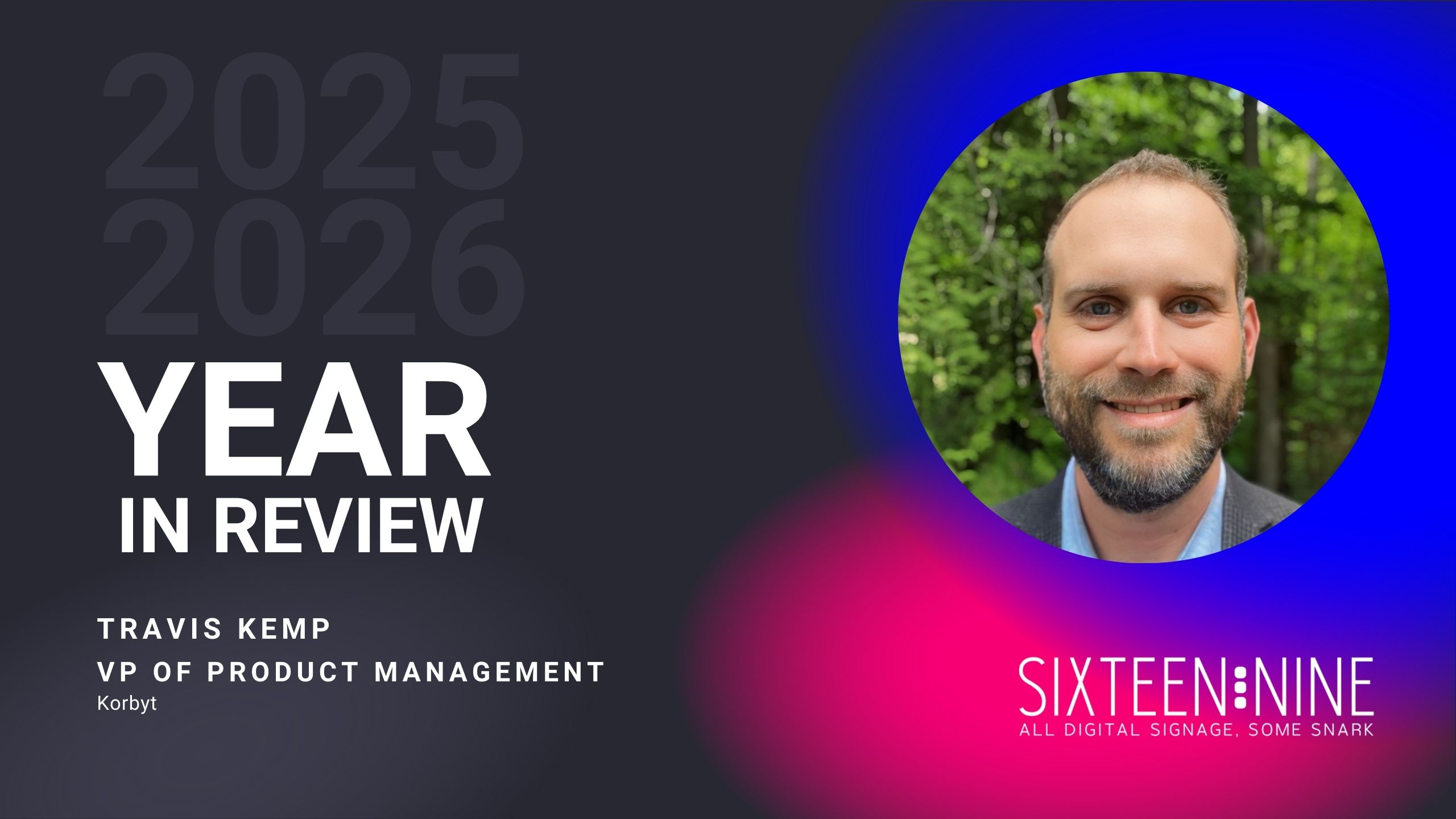
Korbyt has been busy in 2025, steadily rolling out updates across hardware and software but Travis Kemp’s Year in Review for Sixteen:Nine summarizes where the company is taking its workplace experience platform. Some keywords to summarize what he says: customer-centricity, practical AI, operational simplicity, and vertical specialization. I’m especially keen to see its new AI agents at ISE 2026.
In 2025, we made a deliberate shift to organize our entire product roadmap around customer priorities rather than chasing feature parity with competitors. That sounds simple, but it requires real discipline and strong cross-functional alignment to execute. One of the first steps in this effort was implementing Pendo across the platform, giving us real visibility into how customers actually use the product versus how we assume they use it, insights that are already influencing how we prioritize development.
Last year’s most significant product milestone was the unveiling of 5CAI, the new suite of AI agents for our Korbyt Anywhere workplace experience and digital signage platform. Among the first of those agents to go live was CreateAI, which enables customers to edit and modify images directly within the platform. It’s a practical application of GenAI that saves considerable time without forcing users to switch between tools.
We also shipped the foundation of our intelligent device management solution, beginning with real-time screenshot refresh, which sets the stage for the proactive device monitoring capabilities we’ll roll out in 2026.
In terms of big industry shifts, 2025 was the year of managed signage. The industry continued moving away from transactional project delivery to ongoing service partnerships, with customers increasingly wanting accountability for outcomes over time, not just screens installed. M&A activity accelerated as well, driven by the move toward managed services, and the reality that organic growth alone won’t get most players to scale.
In parallel, AI emerged as a defining industry trend, reshaping expectations around automation, intelligence, and productivity, and influencing how platforms evolve and differentiate. AI moved from buzzword to practical application, with an important caveat: most AI investments in the industry are focused on internal efficiency, and time & cost savings, rather than direct customer demand.
On the hardware side, commoditization became undeniable, shifting differentiation away from devices themselves and moving toward software, services, and operational simplicity. The competitive landscape also shifted, with customers increasingly evaluating us against Microsoft Viva and integrated workplace suites rather than traditional CMS competitors. All of this unfolded amid continued economic uncertainty, as the DBCI declined throughout the year and the gap between industry outlook and current conditions widened, making clear ROI proof more critical than ever.
Looking ahead, at ISE 2026 we’ll launch our newest AI agent – ConciergeAI – which integrates conversational AI into our room-booking solution. By bringing conversational AI directly into Outlook, we reduce booking time from minutes to seconds and remove friction from the booking workflow, improving adoption. For legal and banking & financial services customers, where admins manage dozens of bookings a day, this delivers a measurable productivity gain.
We’re also excited about advanced device management that will help our customers perform predictive maintenance, rather than operate reactively. This shifts AV and IT teams from firefighting to proactive oversight, catching black screens and frozen content before anyone notices, auto-recovering issues without manual intervention, and ultimately predicting failures 24-48 hours in advance. Overall, the goal is to reduce professional services dependency while maintaining brand standards, especially for distributed enterprises managing hundreds of locations.
Finally, in a competitive and uncertain market, we’re taking a more intentional approach to our go-to- market strategy. We’re doubling down on deeper vertical focus in banking & financial services, legal & business services, and manufacturing, where we’ve seen the most consistent, use case-driven impact. Rather than trying to be everything to everyone, we believe the strongest and most repeatable value comes from deeply understanding the operational realities and proven use cases of specific industries.