
Six months after joining the Vertiseit family, Scala is undergoing its most significant transformation in years. The digital signage pioneer is returning to a channel-first strategy, embracing hardware agnosticism and preparing for expansion into Asia, all while leveraging one of the industry's most recognized brands. An invidis interview with Scala CEO Sebastian Kryh.
Scala Returns to Its Roots: Channel-Only and Hardware-Agnostic
“We are taking Scala back to its roots,” says CEO Sebastian Kryh. Since acquiring Scala from Stratacache earlier this year, Swedish digital signage specialist Vertiseit has moved quickly to reshape both the company and its market positioning. Under the Scala brand, the former Dise platform and Scala’s enterprise offering are now united, signaling a new chapter for the nearly 40-year-old digital signage software pioneer.
The power of the Scala name
Few brands in digital signage carry the same weight as Scala. Founded in 1987, the company helped shape the industry long before digital signage became mainstream. According to Kryh, the impact of reviving the Scala brand was felt almost immediately.
“More inbound leads than ever” and a noticeable increase in invitations to tender have followed the transition from Dise to Scala. Long-standing partners welcomed the move, with many asking why it had not happened sooner.

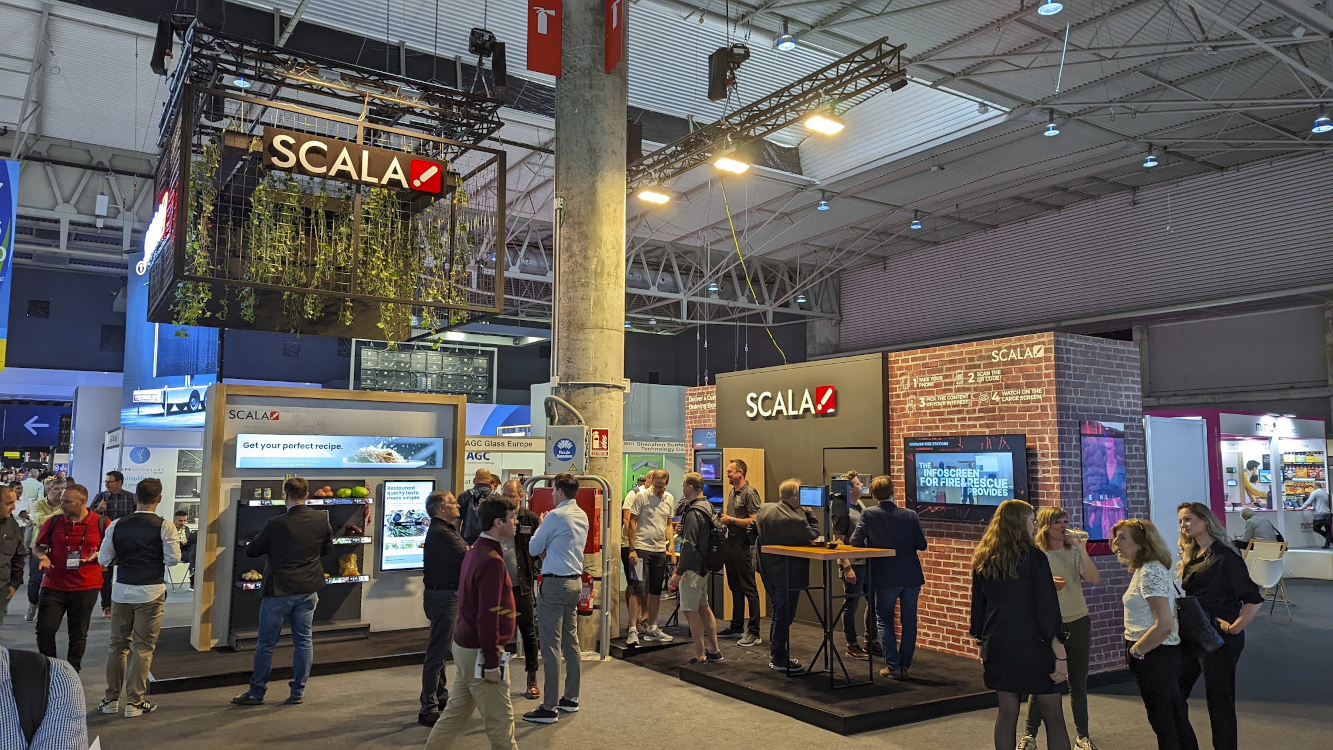
For the Vertiseit team, the difference is significant. While Dise had built a solid reputation, Scala remains a globally recognized brand with deep roots across North America, Europe and parts of Asia. The rebranding was accelerated ahead of ISE, where Vertiseit wants the message to be clear: Scala is back.
A sharp turn away from the Stratacache era
Perhaps the biggest strategic shift concerns the channel. Under Vertiseit’s ownership, Scala operates exclusively through partners. No direct sales model, no competition with system integrators, and no commercial conflicts between the software vendor and its ecosystem.
The approach stands in contrast to the industry’s increasingly common vertical integration strategies. “All of our partners have their own personality. That’s what makes a strong ecosystem,” says Kryh.
The philosophy extends beyond software reselling. Scala is strengthening relationships with technology partners such as Nexmosphere, Place Exchange and hardware manufacturers while deliberately avoiding revenue-sharing models that could compete with integrators or solution providers.
Instead, the company aims to act as an enabler, connecting partners across regions and helping them expand internationally.
Becoming hardware- and OS-agnostic
Another major shift is taking place on the technology side. For years, Scala was closely associated with dedicated Windows and Linux player environments. That strategy is changing.
The company recently announced support for Brightsign media players, marking the first step towards a broader hardware-agnostic roadmap. Additional SoC platform certifications are expected before ISE.
The long-term objective is clear: provide customers and integrators with greater flexibility by supporting a wider range of System-on-Chip and media player platforms rather than tying deployments to a specific operating system.
“We’re not in the hardware business,” explains Kryh. “Our role is to validate devices and ensure partners can deploy with confidence.” For a market increasingly shifting towards integrated SoC platforms from Samsung, LG and other display manufacturers, the strategic reversal is significant.
Two platforms, one vision
Scala’s software portfolio currently consists of two offerings.
- Scala Enterprise continues the legacy Scala platform and remains the preferred solution for partners with established integrations and large enterprise deployments.
- Scala CX, formerly Dise CX, targets modern cloud-based digital experience deployments and shares much of its functionality with Enterprise.
According to the company, feature overlap between the two platforms already reaches 70-80%. Behind the scenes, development continues on a next-generation architecture known internally as IXM. Kryh describes the future platform not simply as a CMS but as an “infrastructure layer for retail.”
To simplify migration, Scala is also investing in tools that convert legacy Scala Script content into HTML-based workflows.
SaaS, security and compliance
While software flexibility is increasing, one aspect of the strategy is becoming decidedly less flexible. All new Scala deployments will be SaaS-first and effectively SaaS-only for new contracts. Existing on-premise customers will continue to be supported, but perpetual licensing is no longer part of the long-term roadmap.
The reasoning is largely driven by cybersecurity and compliance requirements.
Around a dozen developers are currently focused on maintaining and modernizing the Scala Enterprise platform, including hardening security following historical vulnerabilities and preparing for enhanced compliance requirements.
Vertiseit has already achieved SOC 2 Type II certification at group level and is working to bring Scala under upcoming ISO 27001 and SOC 2 certification frameworks. Kryh believes security will become a key differentiator.
Japan becomes the gateway to Asia
The next growth chapter is likely to be written in Asia. Scala has opened its first office in Tokyo, led by long-time Scala executive Guillaume Proux. Japan has historically been one of Scala’s strongest markets, making it a logical starting point for a broader APAC strategy.
The expansion also reflects Scala’s unique relationship with Stratacache in the region. Stratacache APAC will continue supporting existing direct Scala customers while transitioning into a partner role for future channel business.
Once Japan is firmly established, additional expansion into other APEC markets is expected to follow. For Vertiseit, Asia represents an important opportunity to combine Scala’s historical brand recognition with a renewed channel-focused operating model.
Looking ahead to Scala’s 40th anniversary
The revival of one of digital signage’s best-known brands is just beginning. A new Scala brand identity will be unveiled in February, while ISE will provide the first public glimpse of the next phase of the company’s strategy.
The longer-term milestone comes in 2027 when Scala celebrates its 40th anniversary. The company plans a global partner event in Stockholm on 7 October, bringing together former executives, technology partners, system integrators and members of the wider Scala community.