
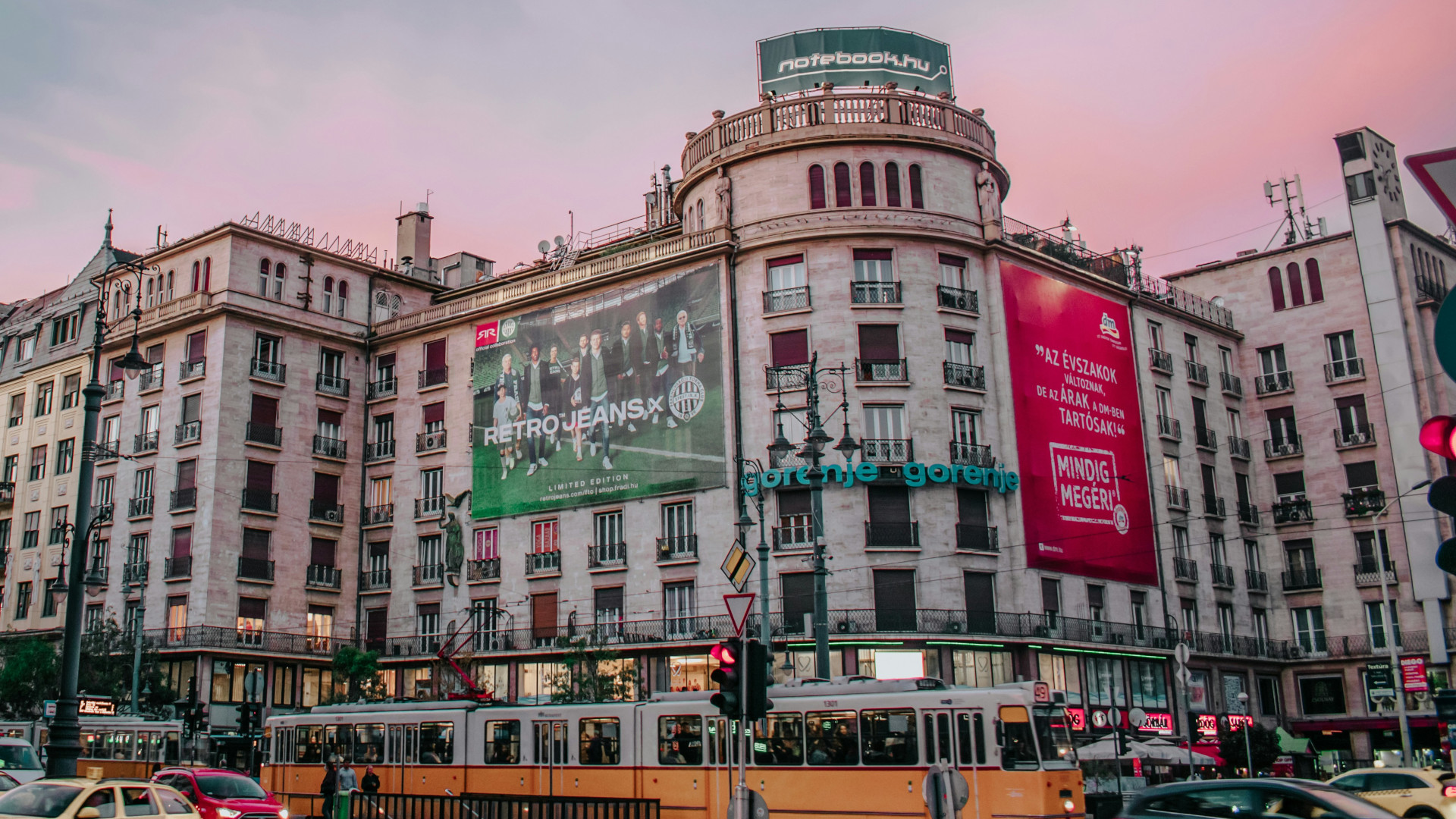
Removal of advertising structures, major restrictions on DooH: A new law in Hungary is bringing radical cuts to outdoor advertising. This could have the potential to reshuffle the market.
Politics and OoH: Hungary Introduces Heavy Out-of-Home Regulations
Prime Minister Péter Magyar’s government is continuing its post-Orbán reform agenda in Hungary. Under Act XX of 2026, the government aims to eliminate “hateful political advertising” from public spaces. However, the legislation reaches far beyond political communication and could reshape the country’s entire out-of-home advertising market.
For example, the new law prohibits advertising structures larger than 15 square meters in public spaces. Operators must remove existing installations at their own expense. It also bans the installation of new freestanding Citylight displays nationwide, as well as mesh advertising banners on construction scaffolding.
Fragmented infrastructure
At the same time, approval authority for OoH installations is being transferred to local governments, increasing municipal oversight.
The move presents additional challenges for DooH operators, who will increasingly face varying approval processes and regulatory requirements. Building networks across multiple cities – or even across districts within the same city – could become significantly more complex as local authorities adopt different rules regarding locations, display types, and advertising content.
In Budapest, the effects are already becoming visible. Individual districts are setting different priorities for enforcement, increasing coordination requirements for operators and reducing network standardization. Industry sources expect that some DCLP formats could disappear from the capital as a result of district-level implementation of the new rules.
Shift to indoor media
According to industry sources, advertisers are already shifting investment toward indoor media, which are less affected by the new public-space advertising restrictions, including subway stations, railway buildings, and underpasses, where municipal rules governing the cityscape have limited reach.
Retail media operators also expected to benefit. Digital screens in shopping centers, gyms, office buildings, and retail stores are not subject to the same restrictions as advertising installations in public spaces. As a result, these segments could receive growing interest from both investors and advertisers.
While traditional outdoor advertising companies and operators of public DooH networks are facing new challenges under the new framework, place-based media networks in shopping centers, transportation hubs, and other semi-private environments fill the gap that the new legislation created.