
Digital signage faces a perfect storm of AI disruption, geopolitical crises, rising costs and consolidation – yet the industry is proving resilient. The DSS "NextGen Signage Keynote" identifies the biggest challenges and the most promising opportunities.

DSS 2026 Keynote: NextGen Signage Meets a Global Polycrisis
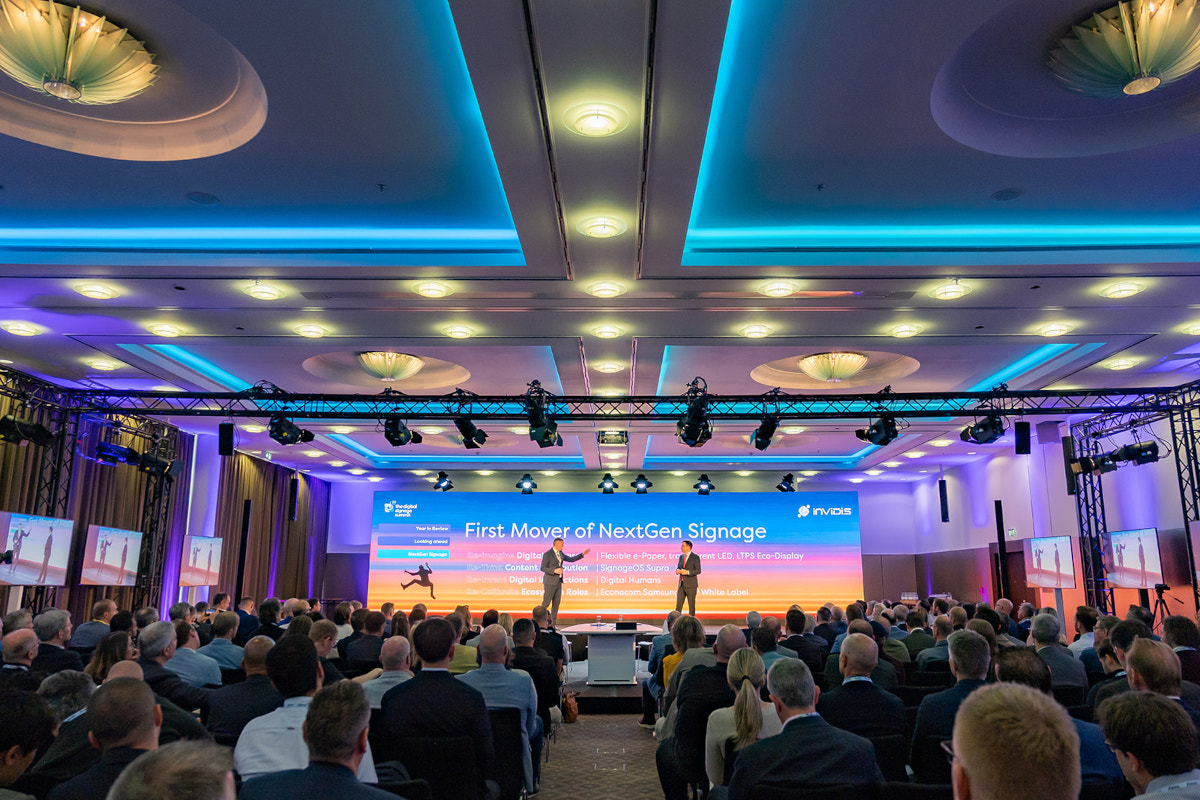
The digital signage industry is no longer just evolving – it is fundamentally changing. This was the core message of the invidis “NextGen Signage” keynote at Digital Signage Europe 2026.
After a difficult 2025, the market enters 2026 with cautious optimism, but also with growing uncertainty caused by geopolitical tensions, AI disruption, cybersecurity risks, and rising cost pressure.
2025: Flat market – but with bright spots
According to the latest Futuresource data, global digital signage hardware sales declined by around 2 percent in 2025. At the same time, software and services continued to grow strongly.
The trend is clear: hardware is losing share, while cloud platforms, managed services, and recurring software revenues are becoming the real market drivers.
For 2026, expectations remain cautious. LED could return hardware growth to slightly positive territory, while software and services continue to outperform.

LED gains ground
The digital signage hardware landscape continues to change: LED steals more and more LCD market share. Experts like the Futuresource analysts predict LED could overtake LCD in revenue volume around 2029.
As prices decline and applications expand, LED is moving steadily into the mainstream.
An industry in “polycrisis”
The market environment remains highly volatile. Rather than facing one single challenge, the industry is navigating multiple overlapping crises at once:
- Tariffs and weak retail demand
- Supply chain disruptions caused by geopolitical conflicts
- Rising transportation and memory costs
- Growing cybersecurity threats
- AI-driven market disruption
This environment makes forecasting extremely difficult. Companies spend less time executing long-term strategies and more time solving immediate operational problems.
Tariffs and Geopolitics Continue to Hurt
Trade tensions and tariffs remain a major concern across the industry. In Europe, skepticism toward US vendors is growing, while in the US, price pressure increases across the middle market.
Retail demand in the US also remains weak. Many retailers continue to delay investments in digital signage or reduce rollout sizes due to economic uncertainty.
At the same time, the ongoing Middle East conflict has created additional supply chain stress. Transportation routes out of Asia became significantly more expensive, especially following disruptions around the Strait of Hormuz. Trucking increasingly replaces shipping for certain routes – but at significantly lower efficiency and higher cost.

Cybersecurity moves center stage
Digital signage networks increasingly become collateral damage in larger cyber attacks. At the same time, typical SoC update cycles are no longer sufficient. Updating devices every 18 to 24 months does not match today’s threat landscape anymore.
The launch of Microsoft’s MDEP ecosystem raises expectations further with quarterly security updates becoming the new benchmark.
AI also changes the cybersecurity landscape dramatically. Tools such as Anthropic’s “Mythos” demonstrate how AI can automatically detect operating system vulnerabilities – but they also reveal just how many vulnerabilities exist.
For the industry, this means security management is becoming a permanent operational task.
The first signs of real industry struggle
Throughout 2025, we’ve also seen growing pressure within the industry itself.
Vestel became the first major display manufacturer to exit the market, underlining the enormous competitive pressure coming from China.
At the same time, Stratacache – long regarded as the world’s largest digital signage conglomerate – is reportedly liquidating parts of its business structure. While the full implications remain unclear, it signals that even the largest Western market players are facing increasing pressure.
Google, meanwhile, has largely stepped back from signage as it focuses on AI and the Android-ChromeOS merger. The new elevated operating system platform is reportedly planned for enterprise launch around 2027 or 2028, after the consumer launch in 2026.
At the same time, Chinese manufacturers such as TCL, Hisense, BOE, and AUO are becoming major market disruptors with their own digital signage solution ecosystems.
AI changes the rules
Artificial intelligence dominated much of the discussion. No-code platforms such as Lovable demonstrate how quickly web apps can now be built. But enterprise-grade digital signage still requires robust infrastructure, security, and long-term lifecycle management that “vibe-coded” platforms cannot easily replace.
The good news for the industry: device-based business models make digital signage less vulnerable to AI agent disruption than traditional SaaS markets.

Managed signage keeps growing
One of the strongest trends remains managed signage.Digital signage networks are increasingly treated as long-term managed infrastructure rather than one-off installations. Remote management, lifecycle services, and operational support are becoming core business areas.
The industry is maturing
Consolidation across the industry continues to accelerate as private equity firms pursue buy-and-build strategies.
Despite ongoing challenges, the overall outlook remains positive. The Digital Signage Business Climate Index (DBCI) rose to 74.2 in Q1 2026, pointing towards optimistic expecations for the coming months.
The most promising segments
Despite all challenges, there are still verticals that show strong growth potential, such as:
- Enterprise communication
- Airports
- Defense
All three sectors benefit from increasing demand for secure, centrally managed communication infrastructure.
What “NextGen Signage” means
The concept of “NextGen Signage” – the central theme of DSS 2026 – is not just about better displays or smarter software. It describes an industry that is fundamentally reinventing itself.
The proposed framework by invidis that will be published in the 2026 Yearbook focuses on four core ideas:
- Re-imagine, for example the digital canvases signage runs on
- Re-think, for example how content is distributed
- Re-invent, for example how users interact with signage
- Re-calibrate, for example how ecosystem roles are structured
The overall message was clear: digital signage remains resilient, but the rules of the market are changing rapidly. The winners of the next decade will likely not be the companies that simply sell and install screens. They will be the companies that successfully combine infrastructure, services, AI, security, and operations into scalable long-term ecosystems – and manage to remove the complexity of established industry practices.