

The term MDEP started popping up in my inbox and on feeds I pay attention to just around the time last year when I started to mentally check out from the day to day task of knocking out Sixteen:Nine, and from paying attention to all things digital signage.
As you can see, mentally checking out didn’t entirely stick, and I remain curious about what’s up, especially things that are new, different and/or better.
Which brought me to looking into MDEP, which is short for Microsoft Device Ecosystem Platform. The Redmond, WA company announced the product and platform a couple of years ago, and it was about a year ago that the concept started to trickle into the digital signage hardware and software communities.
In a nutshell, and a little weirdly, it is the work of a company that was built on the back of the Windows operating system doing something big with Android, the operating system originally developed and still steadily evolved by rival tech giant Google.
MDEP is a hardened, IT-compliant platform for the Android operating system. It represents a nod to a wide need at the enterprise IT level for Android devices that are built with business requirements in mind, versus the wash of Android media players (like set top boxes) that were developed with the consumer market in mind.
Those consumer-first devices tend to bring the benefits of low upfront capital costs, but they can be all over the place when it comes to things like security and firmware support and updates, remote management capabilities and hardware lifecycles.
Through the years, I have heard plenty of stories about the struggles of finding device manufacturers who would reliably stick with a hardware build even shipment to shipment. Software and solutions companies would settle, they thought, on a specific device and then within months open a new container-load that had different components and firmware.
Fun!
So the idea of MDEP is making a shift from an Open Android (AOSP) framework, which is free and available to adapt and tweak, to something that’s buttoned down and built for the needs and realities of large businesses that have many devices and are hyper-aware of cyber-security risks and threats.
What Is It?
Without getting too nerdy (because I can’t), MDEP brings:
- Microsoft’s security stack, which includes stuff like hardware-level “attestation” – meaning the “Yeah, it’s me, I’m cool” security validation is not just software, but all the way down to silicon and encryption;
- Long device lifecycle management, with OS updates that line up with corporate security policies for years, not just months;
- IT Convergence, which is probably the biggest reason why companies look at MDEP. It means big organizations that are already Windows shops, and are not going to move off that, can manage a digital signage network through Microsoft Intune, which is the same “Unified Endpoint Management” tool these big companies use for laptops and mobile devices.
So digital signage can be managed in the same way as other screens deployed around workplaces and office campuses. It moves digital signage from being something of a standalone activity and set-up, to a fully integrated node on a corporate network.
MDEP explains how and why Taiwan-based IADEA has found its way back into digital signage, after the hardware manufacturer spent the last several years much more focused on the meeting room display business – or what it calls facility management.
It was meeting rooms that took Microsoft down the MDEP path, because of how the company’s meetings solution – Microsoft Teams Rooms – involved hardware devices operating in the past on more than 10 different variants of Android. That forced Microsoft to steadily and repetitively test and validate each product before any update was rolled out.
So it was anything but streamlined.
IADEA pushing the idea
Two years on for MDEP, IADEA was at ISE a few weeks ago showcasing its adoption of MDEP for its devices, and touting a variety of digital signage CMS software partners like Appspace, Navori Labs, Comeen, Poppulo, Novisign and Screencloud. Some of those vendors – Appspace in particular – are HEAVILY focused on workplace, so they’d both want and need to be developing to this.
IADEA also has a Taiwan-heavy list of hardware partners that are MDEP-enabled, like AUO Display Plus, TPV, Viewsonic, BenQ, Avocor, Optoma, and i3 Connect.
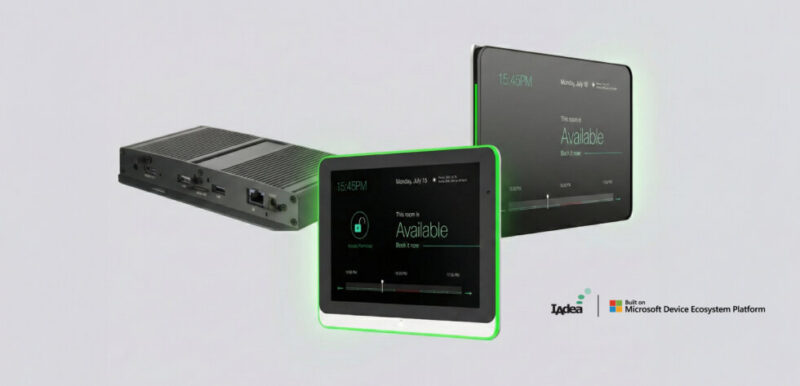
IADEA has a middleware layer called DSM (Display Solutions on MDEP) that’s integrated with Microsoft and uses agentic AI for things like intelligent assistance and guidance, and to automate some workflows.
Doesn’t Chrome OS do this?
So if you know this stuff, you may be thinking: this sounds a lot like the benefits touted by Google’s Chrome OS people, and you’d be right.
ChromeOS is well known and respected for its security and ability to update and manages devices over the web. The argument for MDEP is that for Microsoft-centric IT teams in big companies, MDEP is natively integrated and Chrome OS is not.
While Google has a huge footprint for its Workspace tools, its core market has so far been smaller businesses. Meanwhile, 4 in 5 Fortune 500 companies are Microsoft shops, and probably entrenched in Windows for years and decades to come.
Android is huge when it comes to things like company phones. I did not know 3 in 5 company phones are Android and the number is even higher with big multinationals. But non-phone Android devices on corporate networks – for things like kiosks and signage screens – is a much smaller number.
It would seem that percentage could grow quite a bit if Android devices running ARM chips offer lower hardware costs than Windows devices using Intel, particularly if the reasons the Dr. No guys in IT – who for years have said Android isn’t secure or stable – are going or gone.