
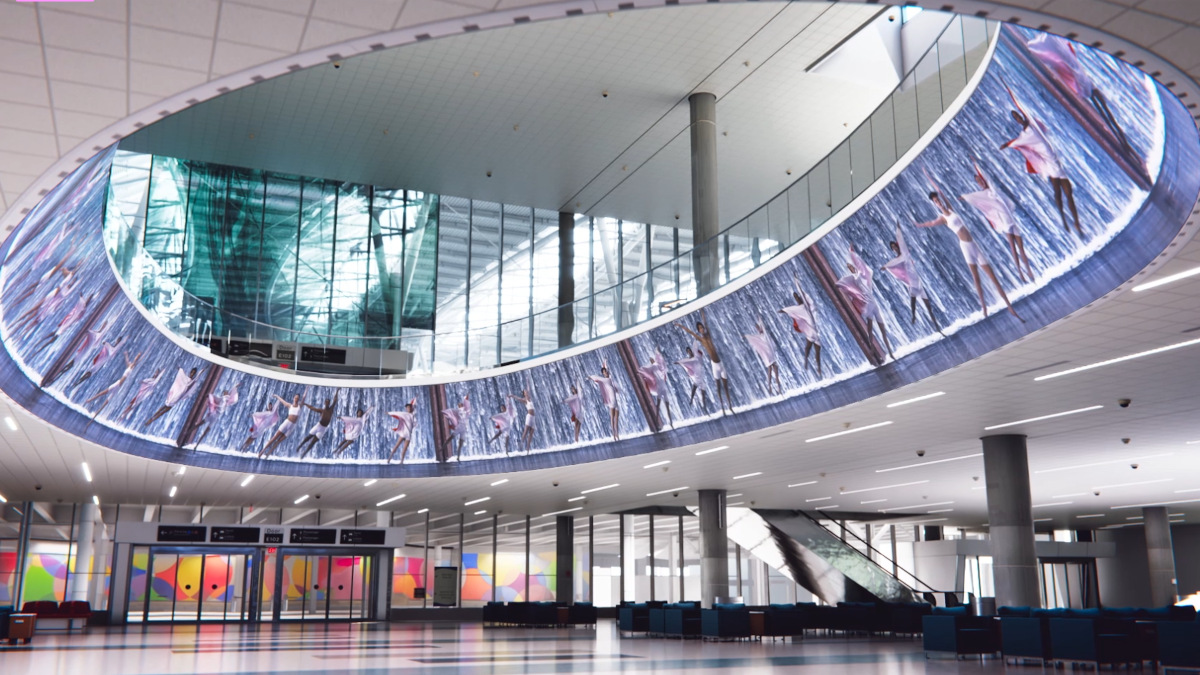
Thinking of airport experiences like the multimedia landscapes we know from travel hubs like Singapore or Orlando, there are really only two companies that come to mind: Moment Factory and Gentilhomme – both out of Canada. The latter of the two has now completed another stunning installation, a 220-foot (67-meter) cylinder LED display at George Bush Intercontinental Airport in Houston, Texas.
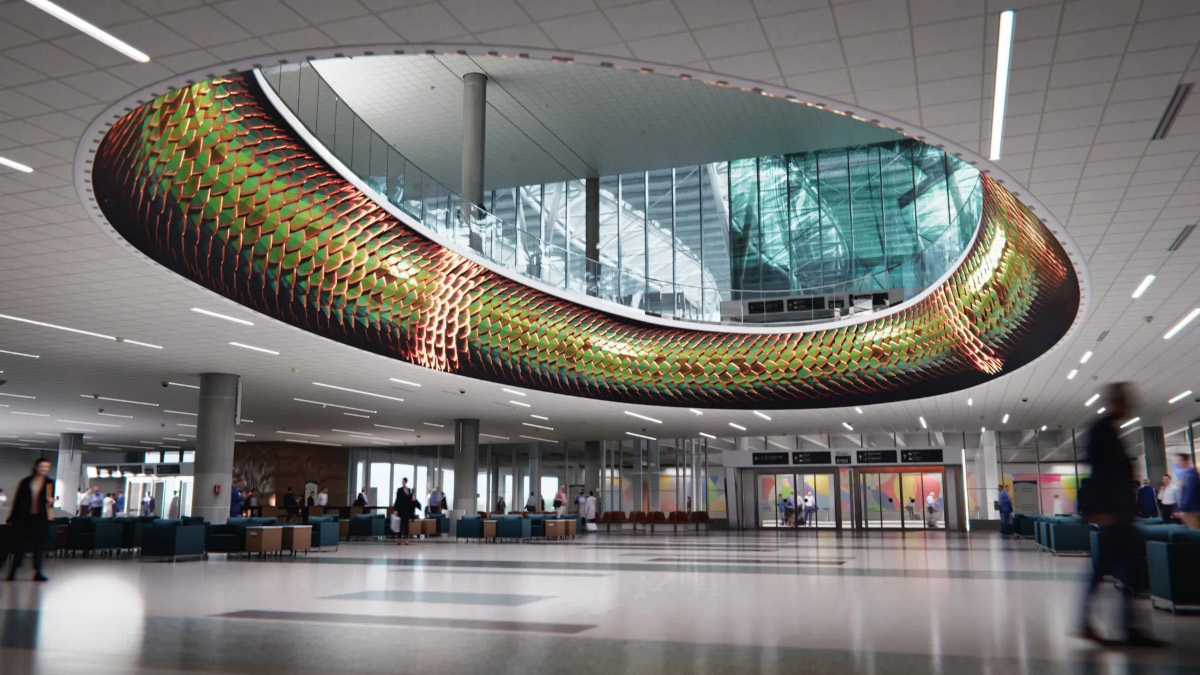
The elliptical structure separates the arrival and departure levels at Houston’s Terminal E. Suspended at a 60-degree angle, the display is visible from both floors, serving as both a media canvas and an architectural centerpiece.
Dubbed the “Oculus,” the display showcases 27 content sequences interpreting Houston’s identity through motion graphics, environmental imagery, and nods to the city’s pivotal role in human spaceflight. Produced by Gentilhomme, the content also reacts to passengers moving beneath the structure. Occupancy sensors track visitor movement, which is processed through a Pixera real-time rendering engine. On the curved LED surface, these movements appear as fluid animations.
This video captures a few of the content sequences:
You are currently viewing a placeholder content from Vimeo. To access the actual content, click the button below. Please note that doing so will share data with third-party providers.
To achieve its elliptical shape, LED manufacturer Nanolumens custom-fabricated more than 2,000 Nixel series modules in slightly trapezoidal forms. Standard modules would have left gaps, preventing smooth, continuous arcs. The display was further divided into eight arc sections, each composed of 36 custom polygonal LED modules. The final installation spans 93 feet in length and 16 feet in height, with a total linear span of 226.5 feet and roughly 1,955 square feet of LED surface.
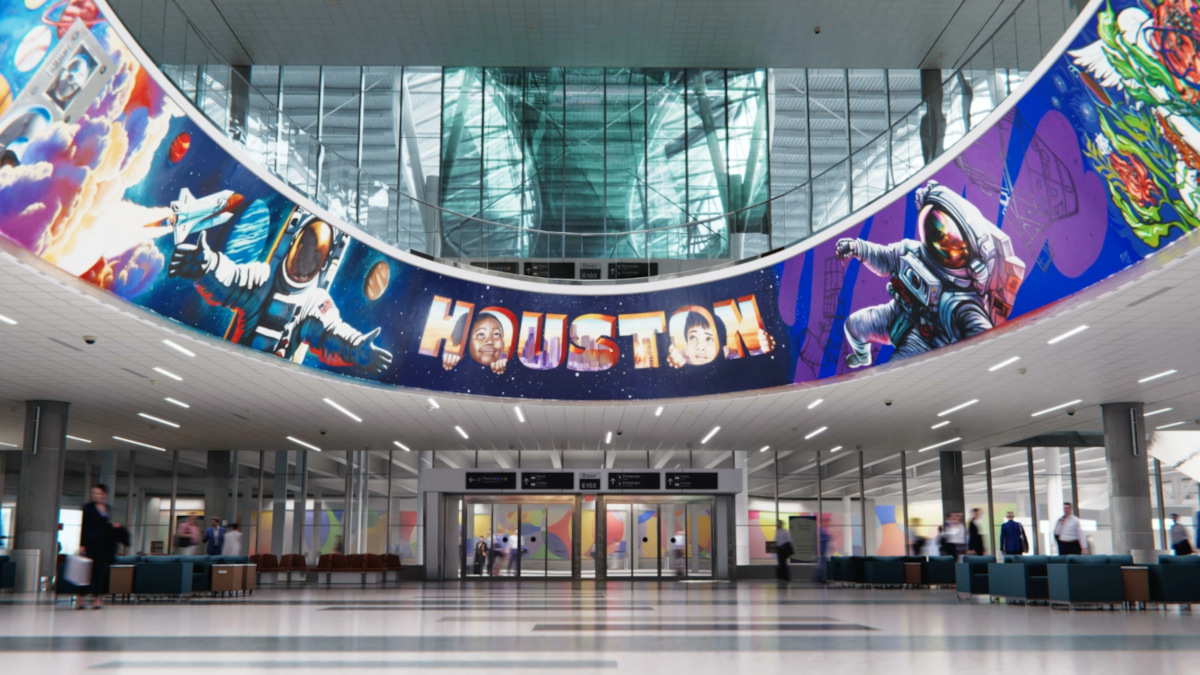
Beyond its geometry, the display’s super high resolution is what makes the installation so striking: The pixel pitch ranges from 2.0 millimeters to 1.4 millimeters – an ultra-narrow pitch for the size of the display and one that makes the content pop even when viewed from close distance. In total, the Oculus boasts nearly 49 million pixels, calibrated to 800 nits.
Before installation, Nanolumens built a full-scale mockup at its Georgia headquarters. Ford AV, which led system integration, then recreated the mockup in Houston so airport stakeholders could evaluate the installation in-person.
Before the installation, Nanolumens first constructed a full-scale factory mockup at its Georgia headquarters. Ford AV, who led system integration for the project, then rebuilt the mockup in Houston so airport stakeholders could evaluate the installation in-person.
While surely not the largest airport LED display, the Oculus is among the most technologically advanced and visually unique. It shows what’s possible when experts in hardware, engineering, and design collaborate from the start – and when content is planned into the budget instead of being treated as an afterthought.
(Images: Gentilhomme)