
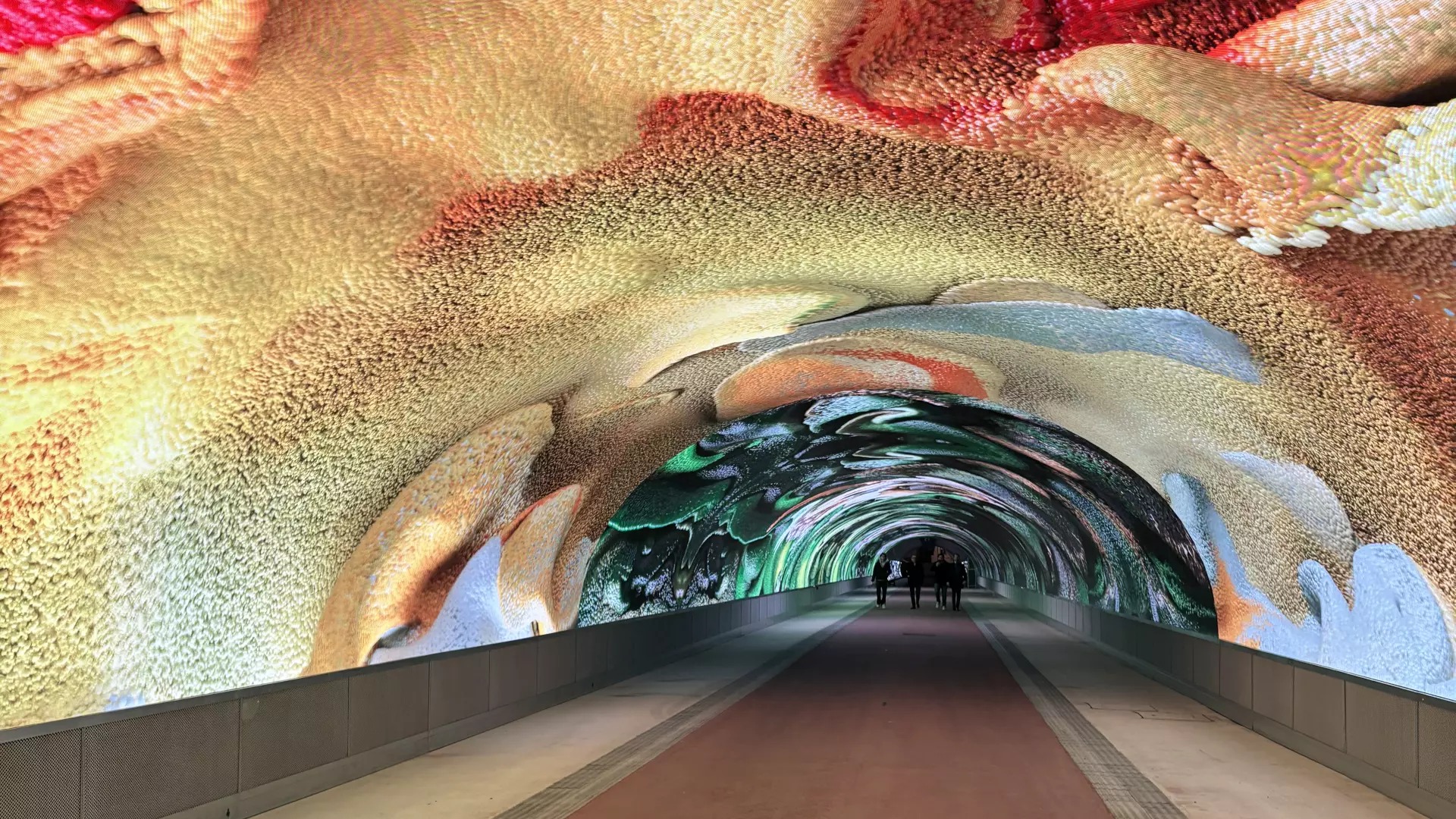
Italian digital signage specialist M-Cube has turned a historic underground tunnel in Gorizia, Italy, into a fully immersive LED art environment, blending contemporary digital media with protected architectural space in a carefully engineered installation.
The project converts a long, enclosed gallery into a continuous audiovisual experience, using LED as both architectural skin and storytelling medium. Rather than treating the tunnel as a simple display corridor, the design turns the walls and ceiling into a synchronized canvas, enveloping visitors in moving imagery and spatial audio while preserving the integrity of the original structure.
Behind the scenes, the scale and details of the build are impressive. The installation relies on roughly 37,000 kilograms of self-supporting structures, avoiding invasive anchoring to the historic tunnel itself. More than 6,000 structural fixing screws and over 44,000 cabinet fixing screws were used to assemble and secure the LED system, which covers approximately 925 square meters (approximately 10,000 square feet). In total, the tunnel is lined with 3,700 LED modules measuring 1000 by 250 millimeters (approximately 39 by 10 inches), made up of around 14,800 individual LED tiles.
A video of the project can be viewed below:
You are currently viewing a placeholder content from YouTube. To access the actual content, click the button below. Please note that doing so will share data with third-party providers.
Signal and power distribution were equally complex. The system incorporates about 7,400 signal connections between modules, supported by nearly 6,000 meters (19,700 feet) of fiber-optic cabling, 15,000 meters of CAT6 network cable, and roughly 10,000 meters (about 32,800 feet) of power cable. Audio is delivered through 23 speakers distributed along the gallery, driven by six amplifiers providing 24 separate amplification channels, with around 5,000 meters (16,404 feet) of audio cabling and 250 square meters of sound-absorbing panels used to control acoustics in the enclosed space.
Content playback is handled through a multi-layered control architecture designed for synchronization and redundancy. The tunnel supports 20 simultaneous 4K outputs, powered by five custom-built playout PCs that manage roughly 4 terabytes of synchronized content. The signal backbone includes 34 fiber-optic converters and 267 independent yet synchronized signal lines, ensuring consistent playback across the full length of the installation.
According to M-Cube, the LED build alone required a team of 15 people working for an entire month, highlighting the labor-intensive nature of integrating high-resolution LED systems in non-standard, heritage-sensitive environments. The result is a permanent digital art installation that demonstrates how large-format LED, immersive audio, and careful structural engineering can coexist within historic spaces, opening new possibilities for cultural venues looking to merge preservation with contemporary digital expression.