
Düsseldorf Airport is testing SAM, an AI avatar that answers passenger questions in real time – and gives the digital signage industry a fresh reason to take digital humans seriously. Combined with 3D displays such as Samsung’s Spatial Signage, the technology could open up a new business field for display makers, integrators and software developers.
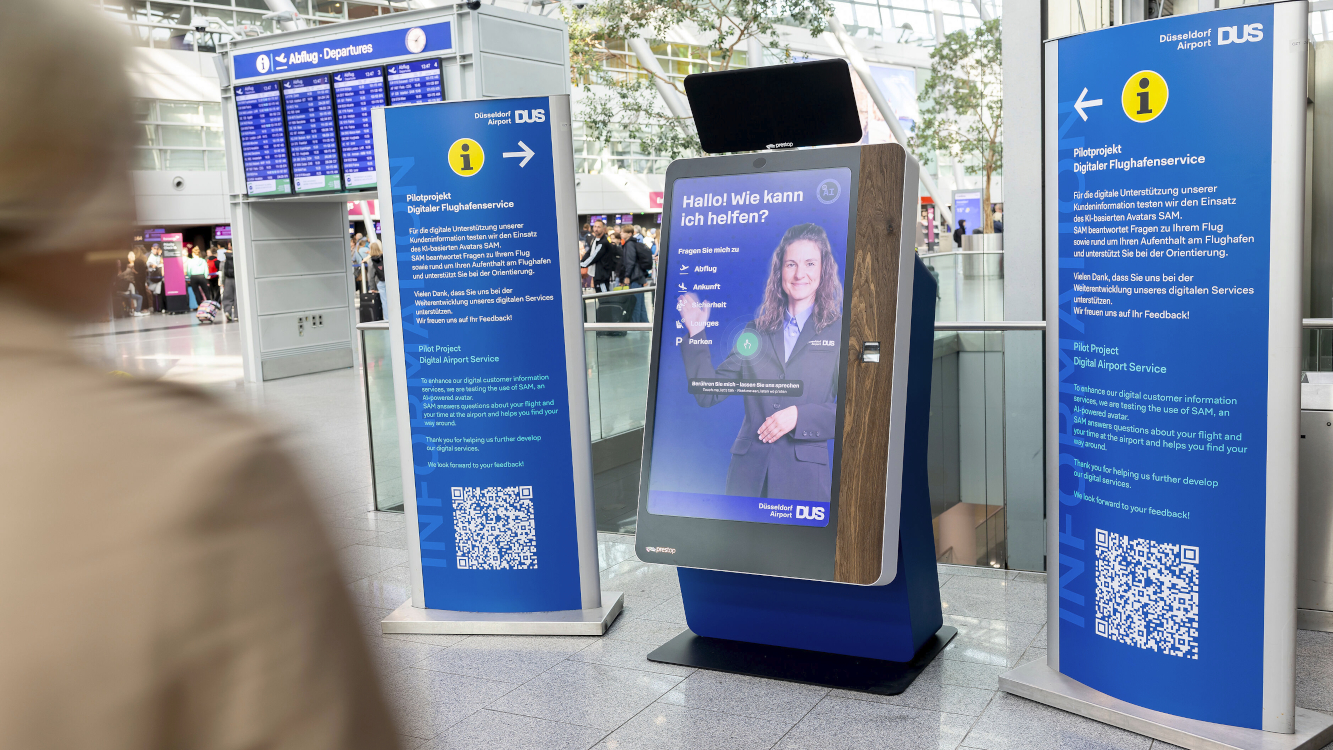
Meet SAM: A Digital Human Goes on Duty at the Airport
Digital humans have been a recurring theme at industry trade shows for years. Now one of them is going to work. Düsseldorf Airport, together with Sita Airport IT and the Essen-based start-up Go Ava, is running a three-month pilot with SAM, short for Smart Airport Messenger. The case is small in scale, but it matters for the digital signage industry because it shows where this technology could become a real business.
What SAM does in Düsseldorf
In the departure hall, SAM appears on a kiosk-style totem as a lifelike avatar in a DUS uniform. Passengers can speak to it in German or English, or type their question on an on-screen keyboard. SAM answers by voice and shows the reply as text at the same time. The same assistant is also available as a voice bot on the phone.
Behind the scenes, Sita’s Agentic AI Platform links general airport information with live operational data. SAM can therefore point to the right check-in counter, name the gate or report current waiting times at security, as well as answer questions about parking and restaurants. Go Ava provides the avatar and the spoken dialogue: it recognizes speech, converts it to text, passes it to the Sita platform and plays the answer back with synchronized lip movements and subtitles. The partners will evaluate response times, data freshness and successfully handled requests. Passengers can also rate the avatar via a QR code next to the stele.
Why this matters for the signage industry
For years, digital signage has mostly been a one-way medium: screens broadcast, people watch. Use-cases like SAM turn the screen into a service channel that listens and responds. That shifts the conversation from content playout to interaction, and it opens several areas of business:
- Hardware: Avatars need portrait displays, microphones, speakers and sensors, in other words, interactive kiosks with more technical features than a standard screen.
- Integration: Connecting an avatar to flight data, product catalogs, queue systems or booking engines is classic integrator work, and it is where projects are won or lost.
- Software and content: Avatar design, voice, dialogue logic and knowledge bases are new content disciplines. Providers like Go Ava stress that their avatars play-out only pre-approved content, which gives operators control over what the avatar says.
- Services: Languages, opening hours and answers need constant maintenance. That points to recurring revenue through managed services and subscriptions rather than one-off hardware sales.
Airports are an obvious first stage, with many languages, constant questions and a lot of time pressure. But the same logic applies to retail, hotels, banks, healthcare, public authorities and trade fairs, anywhere staff shortages meet a high volume of repetitive questions. As Dr. Henning Pfisterer, Head of Aviation at Düsseldorf Airport, puts it, information must be “simple, multilingual and accessible around the clock”.
3D displays as the natural stage
Even the Düsseldorf pilot is not based on 3D displays, it would be the perfect use-case. Samsung launched its Spatial Signage at ISE 2026 as an 85-inch professional display. It uses a lenticular 3D plate, and creating a virtual depth of up to 500 millimeters behind a sharp 2D foreground image, without glasses. These new generation of 3D displays lower the traditionally high cost of 3D content.
A human-shaped figure in portrait format is exactly what such a display is built for. An avatar that appears to stand slightly behind the glass, at roughly life size, feels more present than a flat video on a screen, and it would help a service point stand out in a busy environment.
To unlock their full potential, 3D displays in public spaces should be paired with touchless interaction solutions such as Ameria. By removing the need for physical contact, they reduce friction, enhance the immersive experience, and provide barrier-free access for a broader audience.
What still needs to be proven
The Düsseldorf pilot is deliberately an experiment, and several questions remain open. Does the avatar understand people in a noisy hall? Are answers fast and reliable enough that passengers trust them? Do visitors prefer a face over a simple search interface, or does a lifelike figure feel gimmicky? The cost advantage per interaction of a signage-based digital human compared with a staffed counter has been proven before, but do terminal users value the additional experience versus a plain wayfinding screen needs to be proven in praxis. The partners plan to decide on the future of the service once the pilot is over, based on this data. The industry should follow the results closely.