
In this column, Dave Haynes presents his take on the Amazon Signage Display - and asks questions about the target group, the product strategy and the role of software partners.
Haynes Column: Amazon Adding Signage Displays Is A Sign The Giant Isn’t Just Dabbling, But Where Does It Go From Here?
Amazon announcing recently that it’s adding a smart display to its US digital signage product line is a strong indication the online retailing Godzilla is doing more than just dabbling in this sector, but the move also raises questions about Amazon’s business strategy and actual marketplace traction.
Logic suggests that the company must be moving enough US$100 HDMI sticks – spun out from consumer-grade Fire TV sticks – to warrant adding displays that have the play-out hardware built-in.
It is very hard to get a read from the Amazon product listing, which in one area says “1K+ bought in past month,” while elsewhere it says “100K+ orders for this brand in past 3 months.”
That’s a big gap. Poking around a bit more suggests the 100K rolls in the consumer sticks.
I canvassed a few software companies who have integrated the Signage Stick with their SaaS platforms, and they all said they’ve seen very modest sales – nothing approaching gangbusters/selling like hotcakes territory.
Where Amazon has seen a LOT of traction is signing up partners, with more than 80 companies listed. So Amazon has been very effective in building up a reseller channel for its products.
The issue, however, is that most of the partners listed are very small, running businesses you’d maybe call side hustles.
I have been watching and writing about this sector for 20+ years now. Of the 80+ software partners, I have heard of maybe half of them. And if anyone should have come across them, it would very arguably be me, because the pitches for their attention dropped in my inbox all day, every day.
So it is the old blessing and curse thing. Lots of partners, or maybe too many?
A case for 80:20?
Or perhaps the 80:20 thing, in which 80 percent of sales and actual deployments are done by 20% of the companies – mainly the larger partners that have full-time sales and marketing, established customer bases and clearly defined market verticals.
MOST of the 80 or so would be companies whose main value proposition is low-cost and simple to use.
Neither of those are bad attributes. It’s just that if scores of them all have that pitch, low-cost gets pushed by buyers to damn-near free.
Even with low-low overhead, it takes a LOT of SaaS subscriptions at $2/month to make and sustain a real business. More than 70 CMS providers, for example, try to generate business by offering free trials.
There is a Featured Partners Of The Month listing at the top of partner page, which I am guessing (only) comes with a listing fee. Otherwise, all 80+ options all look the same. So a buyer wholly unfamiliar with the software would have no way of knowing, for example, that Poppulo has 100s of staffers in three countries while the next one alphabetically listed – Posterbooking – has maybe a handful of people in the UK.
I am told the Amazon people on this file have some sort of pecking order or tiering system for the various partners. Logically, the partners who are moving noticeable numbers of units get more attention and input on product development.
While there are likely exceptions here and there, most of the user base for these sticks are small end-users with one or a handful of screens they want to sprinkle around a venue. My contacts suggest what sales have come in have skewed mainly towards the education market.
The Amazon Effect
The Amazon offer is very compelling to a lot of small or small-ish companies because it means the whole hardware headache is off their desks. They’re not building it (or much more likely sourcing it from China). They’re not staging, or shipping, or supporting. They just develop an app that works on the things.
People in much of the developed world habitually look up, click and buy stuff from Amazon, and then see it arrive on their doorsteps in a matter of a couple of days, or in some cases, the same day.
Compare that to going direct to some XYZ Digital Signage company a buyer has never heard of, and that has no people or processes for doing hardware.
For an end-user who decides to roll their own digital signage, and add HDMI sticks to their orders for insulated tumblers, pimple patches and Bluetooth speakers, Amazon is just dead-easy.
Whatever software gets selected probably doesn’t have anywhere near the level of sophistication or security of the top-selling CMS options out there. But the user base like school admins may just need something to schedule and pop up a message that reminds middle schoolers the spring dance is next Friday in the gym.
A “prosumer” product?
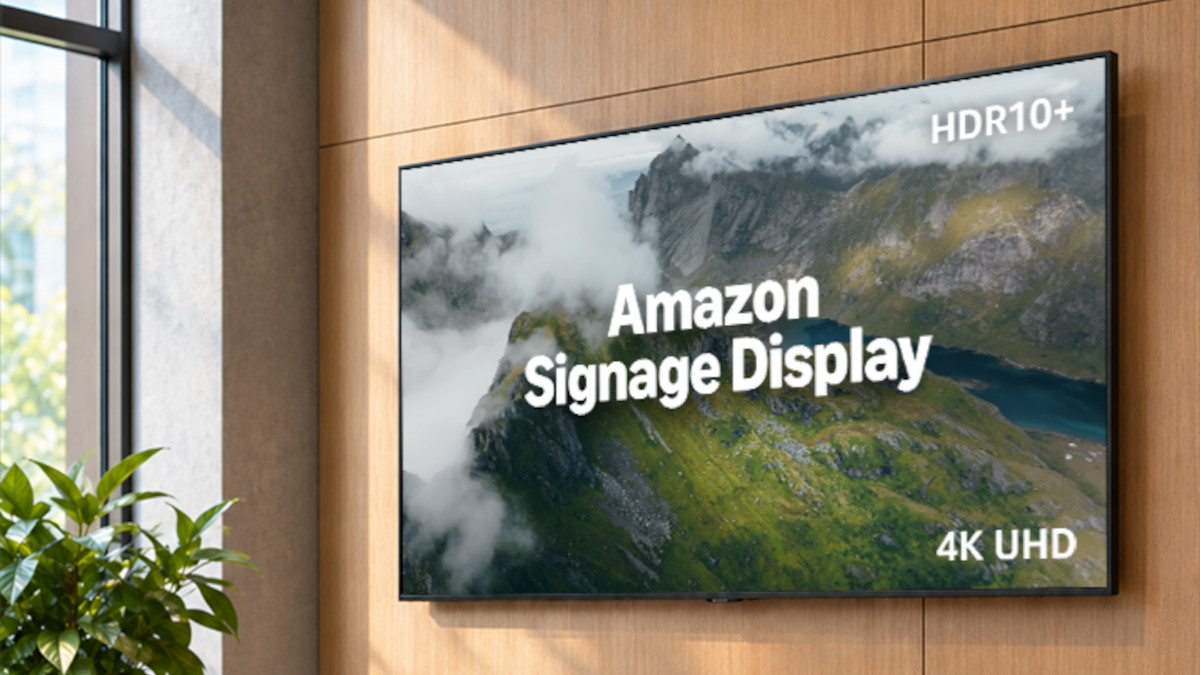
The recently-announced Amazon Signage Display is a 55-inch 4K display sold at $699 USD. Leveraging more than a decade now of system-on-chip smart display experience, the idea with these units is the software ecosystem that has CMS apps that run on the stick can also have those apps loaded, launched and run on the display – negating the need for the external stick.
The original Amazon Signage Stick emerged after years of mostly smaller software companies getting their platform to work on the consumer Fire TV sticks. Those sticks cost as little as $30, so they nicely met end-user demands for low-low-low hardware pricing. But they were coming from a well-known entity and not an Android hardware firm in Shenzhen that might change the build and firmware on a whim, and not tell anyone.
It made sense for Amazon, I assume, to tinker with the hardware and software build to make the stick more commercial-use ready. They stripped out all the bloat – like TV streaming apps and set the thing to boot by default to the chosen signage app.
Plus they got to up the stick unit cost to $100.
Amazon is NOT just getting into the display business with this 55-inch unit. It already has a smart TV line-up, and just as happened with Samsung and its fast-follower LG, smart TVs were expanded into smart signage displays.
It is VERY likely these Fire TV units come off TCL manufacturing lines. Amazon doesn’t say that formally, but it isn’t hard to get a good read. Chin’s TCL is huge and it already has smart displays, including units that have BrightSign players embedded.
There are other Amazon smart TVs in other sizes and it is logical that smaller displays with lower price-points – like a 50-inch – will get added with time.
The displays are rated as “prosumer” – kind of a hybrid of consumer TVs and commercial displays. They’re rated for 16/7 usage – not 24/7 like pro displays – and may have different warranties and tweaked engineering.
Big companies in digital signage
I have watched the Amazon Signage thing evolve the last two or three years, and had a couple of long chats with the guy who led the launch (but is off that file now). I was skeptical about the fortunes for this thing, as through the years some very big companies have come into this sector and then, after a few years, quietly slipped out a side door.
In giant companies, digital signage tends to be a relatively teeny business unit, with a corresponding amount of interest and support from executives. I used to joke that whoever at Google was on the digital signage file must have been on someone’s naughty list – assigned to a skunkworks unit.
That seemed about right for the first time Google came into the sector, but the second wave of involvement has been much more serious, and the tech giant has put solid people and real money into this sector for a few years now.
I’m kinda sorta mostly out of the loop now, but I don’t get any real sense of Amazon doing a bunch more than welcoming software firms to join its partner ecosystem and leverage its mind-blowing sales, warehousing and delivery capabilities.
Maybe the team on this file doesn’t need to be at trade shows and circulating in the industry, because it already has a big ecosystem, and to-die-for top of mind awareness for its brand.
The software question
One intriguing question is whether Amazon will stick with just being the hardware side of the business, or add software. The compelling financial and ease-of-use argument for Amazon Signage gets even stronger if buyers just use the CMS that ships with the stick, and they don’t have to source and then subscribe to a likely unfamiliar software service provider.
My thought was the easy path was for Amazon to just buy one of the 80+ CMS providers. But a contact noted almost all of the CMS options wouldn’t meet Amazon’s understandably hyper-tight security standards.
The company has some 50,000 software developers and engineers on its payroll. If it chose that path, it would be easy. Digital signage software isn’t as simple as it may appear, but writing a secure platform to play out files is a hill to climb, not K2.
I don’t really see what Amazon is doing being a threat to the top 10 or 20 software options out there that target enterprise business and have tools and services tuned to specific needs like corporate, mass transport, healthcare or large-scale retail.
But for the little guys who market “easy and affordable” options for small business and limited-scale projects, what Amazon has might be great. Or maybe not. We’ll see.