
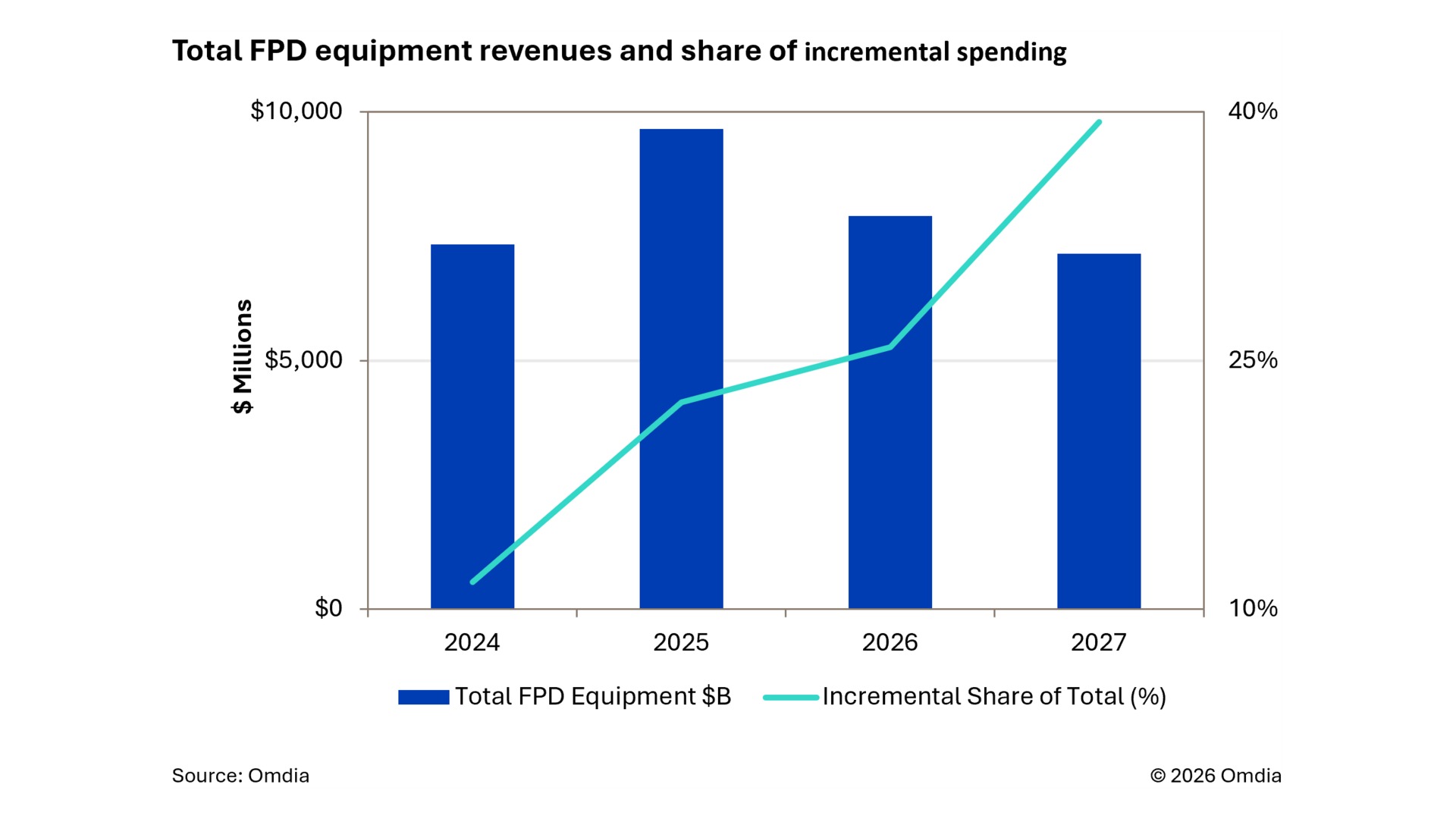
Upgrades and expansion at existing LCD and OLED plants are forecast to account for almost 40% of the flat-panel display equipment market next year, up from 12 percent in 2024.
Omdia Research: Existing Display Factories To Drive Equipment Spending In 2027
Display manufacturers are increasingly investing in upgrades to existing factories rather than building new ones, according to research from Omdia.
Incremental investments — including equipment replacements, production improvements and additional capacity at operating plants — are expected to represent nearly 40 percent of total flat-panel display equipment spending in 2027. That would be a record share and more than triple the 12 percent recorded in 2024.
New factory construction historically accounted for much of the equipment market, which peaked at approximately US$21 billion in 2017. Following the COVID-era surge in display demand, however, manufacturing capacity became sufficient, fewer factories were built and annual equipment spending fell to about US$8 billion.
At the same time, the installed base of LCD and OLED manufacturing equipment has grown older, creating demand for replacement machinery and process upgrades.
Manufacturers target existing capacity
Demand for larger TVs is increasing the amount of LCD panel area required, while Taiwanese manufacturers are rapidly closing older factories. Leading Chinese LCD producers are buying equipment to expand capacity at existing plants, avoiding the higher cost of building factories and restrictions on new LCD investment, according to Omdia.
Korean panel manufacturers, meanwhile, are investing in existing Gen 6 production lines as competition in the high-end OLED market grows. The upgrades support advanced privacy features, under-display sensors, expanded foldable OLED production and improved thin-film transistor performance.
Chinese display manufacturers are also building Gen 8.6 OLED production capacity for IT displays in 2026 and 2027.
Omdia Chief Analyst Charles Annis said incremental investments can be more difficult for equipment suppliers to manage because they involve shorter lead times, limited visibility into future demand and selective purchases. Nevertheless, the spending has become an important source of revenue as construction of new display factories declines.