Blanket statements don’t tend to hold up against scrutiny, so I was intrigued when a guy who has been in and around the digital signage industry for more than 15 years put up a post online suggesting this is a dead business walking.
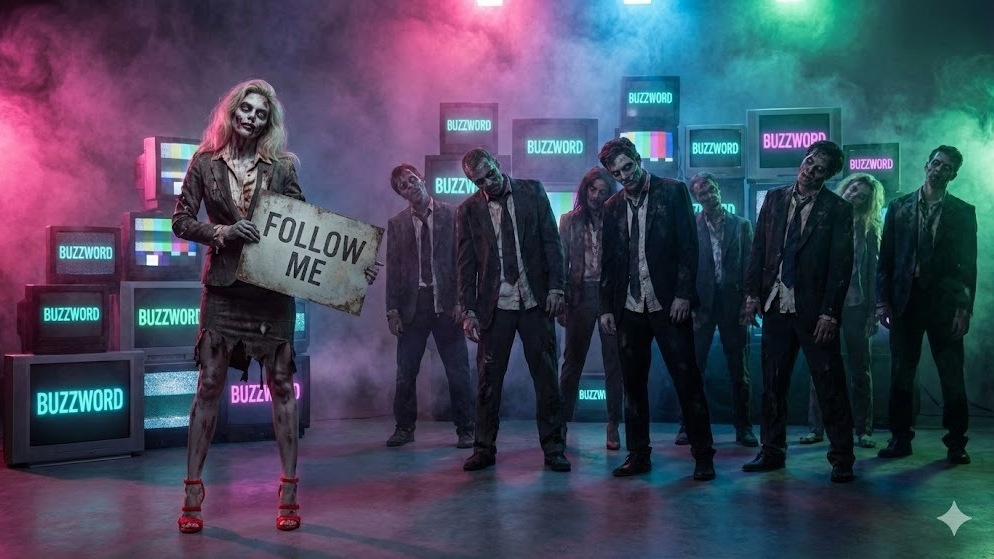
Haynes Column: Is Digital Signage A Zombie Industry? One Longtimer Thinks So …
The argument Niko Sagiadinos made is that “digital signage is a zombie industry that survives only because customers don’t know any better. (Software vendors) do poor marketing, drowning in self-praise and hollow buzzwords that miss the target audience entirely.”
He added in the post: “Honestly, I love digital signage. It’s a brilliant mash-up of technologies with genuine potential to revolutionize marketing and communication.”
“Unfortunately, the industry sabotages itself through opacity, zero collaboration, and a stubborn refusal to adopt common standards.”
Sagiadinos has co-run a small company based in Germany that has, since 2012 or so, developed and evolved a digital signage solution based heavily around SMIL, which stands for Synchronized Multimedia Integration Language. The business, logically, is called SmilControl.
If SMIL is unfamiliar, in simple terms it’s a way to create a multimedia slideshow or presentation by telling a computer exactly when and where to play different files (like audio, video, images, and text).
The most common usage of SMIL is for messaging apps on smartphones. SMIL is the baseline technology used by mobile carriers to package up MMS messages – so when a text pops on your phone that has a picture and a sound clip that plays automatically, it is probably a hidden SMIL file telling the messaging app what to do.
In the context of digital signage, that might mean a text file measured in kilobytes can be used as something akin to a script or command list to structure the timing, layout, and source for a presentation. That’s instead a much “heavier” video file measured in megabytes, and tied to playlists or some sort of ordering and file playout triggering system.
If you want to get deep on this stuff, I did a podcast interview with Sagiadinos back in late 2021 that got fairly nerdy.
I am most definitely not a developer, so I am not going to even try to explore or debate the merits of using SMIL versus HTML versus whatever else gets used lately to get content on networks of screens.
What I can say about SMIL is that it comes across as complicated (it may well not be) and nowhere near as familiar as HTML, the markup “language” used to build a billion-plus websites on the internet.
There are lots of examples of technology that was arguably superior that didn’t get traction – Sony’s Betamax VCR tech (versus larger, crappier VHS tech) being perhaps the best one.
But the post from Sagiadinos isn’t really about his frustration with not really seeing wide adoption for SMIL. It’s more about the digital signage industry – which exists to enable timely, effective communication – being terrible, he suggests, at communications.
“Instead of genuine communication that addresses actual customer pain points, the industry drowns in self-congratulation and buzzword bingo. Blogs stuffed with stock photos and hollow statements that say absolutely nothing. The situation has improved slightly in recent years, but AI threatens to make it exponentially worse.”
“While researching for industry articles, I’ve lost count of how many times I clicked on a promising headline only to find vapid self-promotion. Companies declaring themselves heroes for installing screens in a small-town supermarket and calling it a “flagship store.”
“Everyone claims to be a market leader. Everyone has “decades of experience” and manages “thousands of screens.” Empty superlatives no one can verify and that sound increasingly ridiculous in the 21st century.”
“Real expertise shows itself through work, through actual case studies, through substance and not through self-declared titles on a website or social media profile.”
He’s not wrong. I spent 20 years filtering industry bullshit on Sixteen:Nine, and it was omnipresent. Not everyone is guilty, for sure. But many. MANY.
You have to be on the receiving end of all this stuff to know that scores of companies claim to be the leading global provider in X or Y.
So I asked Niko what was behind his post, and the reaction that followed.
What prompted the post and how long has your frustration been building up?
There were many small frustrations. It started in 2013 when I realized that the big device count promises from partners were just a tactic to get discounts.
It continued with face-palms when partners started reinventing the wheel, building their own media players from their first success money, instead of focusing on their actual strengths: marketing, content, and sales.
Why? Because they begrudged IAdea (the Taiwan manufacturer that made and marketed SMIL digital signage player hardware) any profit and thought they could save 50 or 70 Euros by using cheaper equipment and software hastily cobbled together by students.
Then there were Linkedin conversations with some “entrepreneurs” also reinventing the wheel.
When I questioned why they didn’t use SMIL, I got “high-level” responses like: “It’s not good enough.” When I asked what the actual problem was, I never got an answer.
Another guy was bragging on Linkedin that he would reinvent digital signage and had just invested heavily in a media player. When I asked if he was going to use SMIL, he said: “What is it?” After my explanation, he replied: “That’s just a format. We’ll deal with that later.”
No, you won’t. The format is the first decision you should make before starting a project.
I could tell many more stories like these. But at the end of the day: I stopped caring. I no longer actively look for cooperations or industry-based knowledge sharing, and I stopped writing press releases. I just do my own thing: writing software, docs, and articles.
That nothing-to-lose mindset gave me the freedom to write that first “broken industry” post on Reddit. After the surprisingly positive reactions, I figured a proper article would be more worthwhile and more sustainable than a social media or Reddit post.
The frustration itself is long gone. This is just how the industry runs. If you don’t like it, you do something about it. Even if others call that frustration.
Making an opinion public can have many effects: maybe some people hate me now, maybe I’ll be proven wrong, maybe it sparks a real discussion, maybe things change a little.
I’d call it personal growth.
While I understand what you are saying in that post about vendor lock-in, it’s a common and profitable business strategy (Apple is probably the most compelling example in tech, at least). Developing some sort of loyalty mechanism makes sense to me.
The Apple comparison is fair, but the lock-in mechanisms are fundamentally different. Apple’s or even Microsoft’s lock-in works on the convenience layer. Users believe they can’t switch because of habits, features, and their own reluctance to change workflows. But the underlying formats are open: HTML, PDF, DOCX, ODT.
Safari has to support HTML, CSS, and Javascript, otherwise nobody uses it. Even Microsoft had to abandon their proprietary Edge engine and rebuild it on Chromium, because open standards won. Internet Explorer dominated the web for years, then stagnated, and better software took over. That was only possible because the formats were standardized and open.
In digital signage we have a much more brutal lock-in, because it is on format-level. Your content, your playlists, your scheduling logic: all proprietary, all undocumented, all owned by the vendor.
Switching means rebuilding everything from scratch.
SMIL exists specifically to solve this. It’s a W3C standard for synchronizing multimedia presentations, purpose-built for exactly what digital signage needs. The industry just refuses to adopt it, because interoperability kills their business model.
Could you elaborate on the “stubborn refusal (of the industry) to adopt common standards.”
The refusal splits into two distinct problems. Large players have an obvious incentive to avoid open standards. A transparent market hurts their business model. Waiting for them to lead is a waste of time.
What actually puzzles me is that even small projects skip SMIL. When I ask, most don’t know why. When pressed, the answer is usually something like: “SMIL doesn’t support reporting or device control.”
That argument doesn’t hold up. SMIL was designed for media synchronization, not reporting. But you have to implement reporting anyway, regardless of what format you use. IAdea solved this by documenting an open extension on top of SMIL. I did the same for garlic-player. That’s exactly how it should work: take a proven standard, extend it where needed, document it openly.
The real reason runs deeper. Admitting SMIL would have been the right choice means admitting past decisions were wrong. Human nature resists that. So instead of revisiting the decision, people double down and find arguments to justify it. That’s not specific to digital signage. But in this industry it’s particularly damaging, because the fragmentation it causes hurts everyone, including the companies defending it.
Candidly, I think part of SMIL’s low adoption rate owes to companies not knowing what it is, or what’s to gain by using it. While I understand the benefits, it takes an investment of time to understand it.
You’re right, and I say that without criticism. SMIL is a tech stack. CEOs and entrepreneurs don’t think in tech stacks, they think in solutions. That’s fine.
What’s harder to accept is that developers ignore it, too. A few reasons:
Most don’t research before building. When I started garlic-hub, I spent a month in October 2024 evaluating frameworks and existing solutions specifically to avoid reinventing wheels. That’s not common practice.
SMIL is powerful and therefore complex. It’s XML, and developers love JSON. Early-stage projects start simple: play some media sequentially. Writing a quick custom format feels easier than learning a standard.
Then the project grows, the custom format gets patched and extended, and switching becomes expensive. Nobody wants to explain why they didn’t use a standard from the beginning.
IAdea also made early marketing mistakes. Their first hardware was underpowered, which let companies like Scala position SMIL as a low-budget option.
Then nobody clarified loudly enough that SMIL doesn’t compete with HTML. They’re not the same thing. HTML describes how content looks in a browser. SMIL describes what plays, when, in which zone, and triggered by what condition. One is a presentation format, the other is a scheduling and synchronization format.
That job doesn’t disappear if you choose HTML. You’ll just end up building it yourself in
JavaScript, storing playlists in some custom JSON format. Which is exactly what SMIL already does. Proven, standardized, and documented for over a decade