Disney+ and Hulu are turning vacant storefronts in New York and Los Angeles into interactive DooH experiences, using gesture control to let passersby browse and discover streaming content in real time.
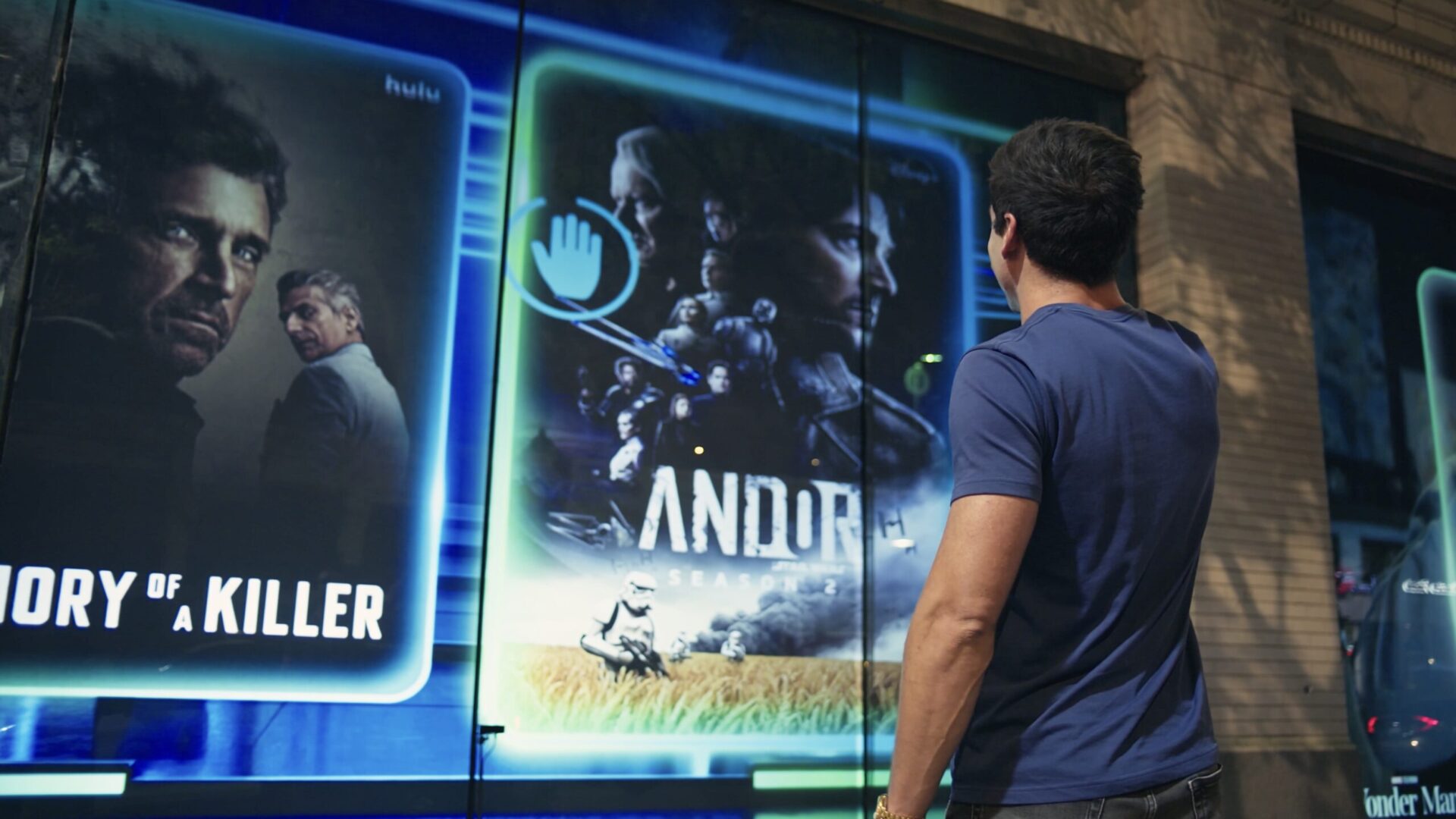
Disney+: Turning Empty Storefronts Into Interactive DooH
Disney+ and Hulu have teamed up with Publicis Media and tech firm Visual Feeder on a bi-coastal out-of-home campaign that turns vacant retail windows into interactive, gesture-controlled display experiences.
The “Drama You Want” activation is running in Manhattan and Santa Monica, using street-level storefronts as digital canvases that invite passersby to engage with streaming content in real time.
The installations use Visual Feeder’s interactive DooH platform to detect hand movements, allowing people on the sidewalk to navigate content by waving and selecting from categories such as thrillers, sci-fi, and procedurals. The experience then delivers a tailored full-screen trailer mapped to the window’s physical dimensions.
Titles featured include The Testaments, Marvel Television’s Daredevil: Born Again, The Rookie, and Grey’s Anatomy, with the creative built around matching viewers to a personalized “drama persona.” See the video below:
The campaign is positioned as a way to extend content discovery beyond mobile and connected TV screens, using high-foot traffic urban locations to create what is effectively a walk-up, public-facing streaming interface.
It also leans into a familiar retail concept – browsing a storefront – while replacing static displays with responsive digital surfaces that shift from passive promos to interactive prompts when someone approaches.
For out-of-home, the project is another example of how digital signage is being pushed toward more experiential formats that blend media, environment, and user input. Instead of simply running loops of video, installations like these are designed to stop pedestrians, invite participation and generate shareable moments.
Using vacant storefronts as the physical layer adds another wrinkle, turning otherwise idle retail space into temporary media assets — something that has been gaining traction in dense urban cores where foot traffic is high but traditional retail occupancy can be uneven.