
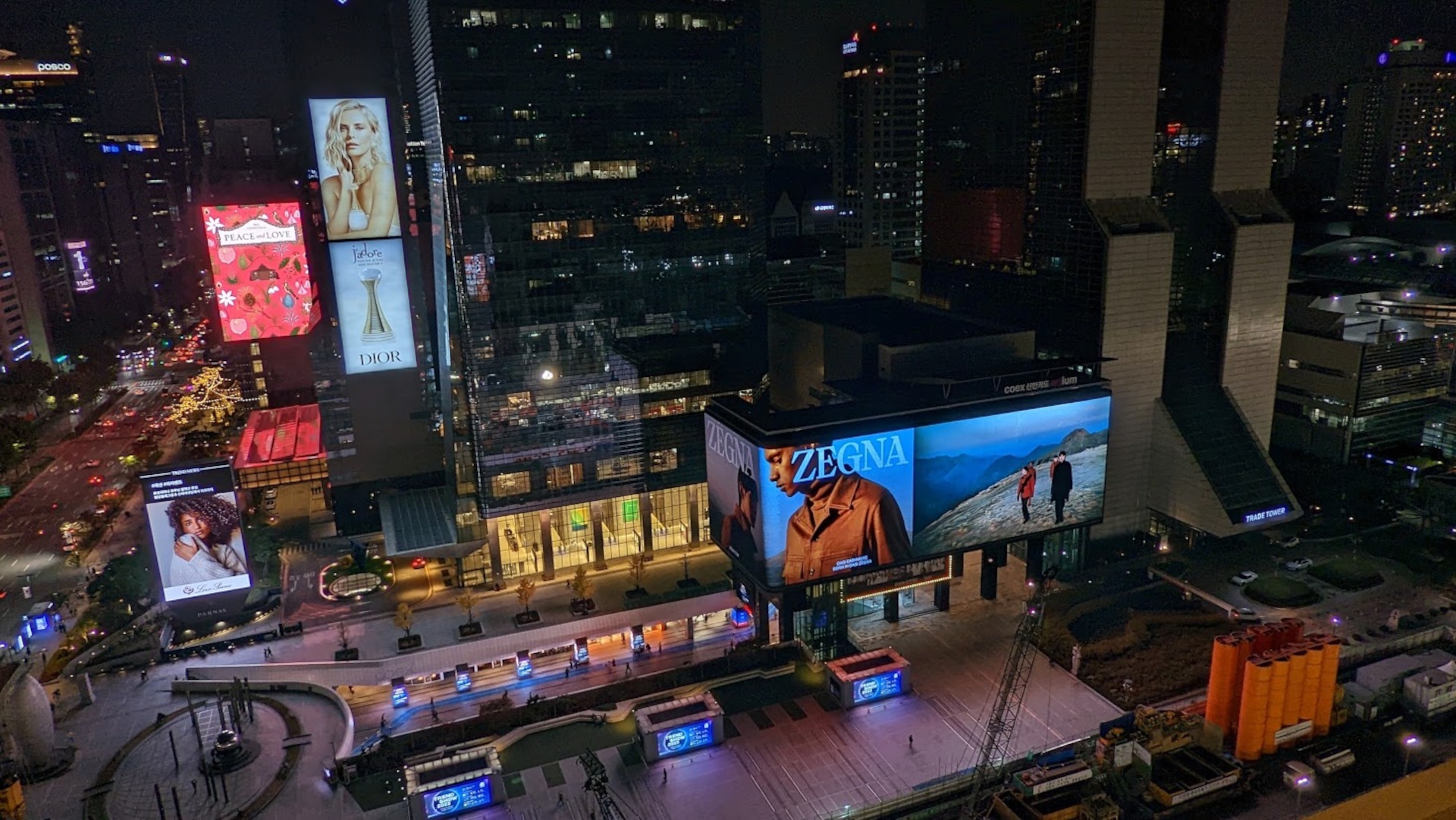
Seoul’s city government has introduced tighter brightness limits for outdoor digital billboards, responding to complaints about glare and growing concerns about the impact of bright screens on drivers, pedestrians, and the nighttime urban environment.
According to local reports, the new rules set a daytime cap of 7,000 nits (cd/m²), which Seoul says is the first daytime brightness limit introduced by a local government in South Korea. At night, the rules become much stricter and vary by both screen size and time of day. Medium-sized displays, defined as 30 to 225 square meters (323 – 2,422 square feet), will be capped at 500 nits from one hour after sunset until midnight, then at 400 nits after midnight. Large-format screens over 225 square meters will be limited to 400 nits before midnight and 350 nits after midnight, both well below the current ceiling of 1,500 nits.
The move follows local reporting in Korea highlighting mounting complaints about light pollution and screen glare, especially in high-profile commercial districts such as Gwanghwamun, Gangnam, and Myeongdong. The city’s updated rules appear to aim to balance visibility for advertisers with the pressure to reduce visual fatigue and improve the urban lighting environment.
The brightness debate in Seoul has also intersected with a broader discussion about energy use. A recent Seoul Economic Daily report estimated that 24 outdoor digital billboards and media facades in the city’s three main free-display zones consume about 1.16 million kWh of electricity per month, or roughly the same as 4,000 households. That has prompted calls for stricter operating standards, including not just luminance limits but closer attention to total power consumption and operating hours.
According to the Seoul Metropolitan Government, the new limits could cut the energy costs to roughly 85 percent on average.