
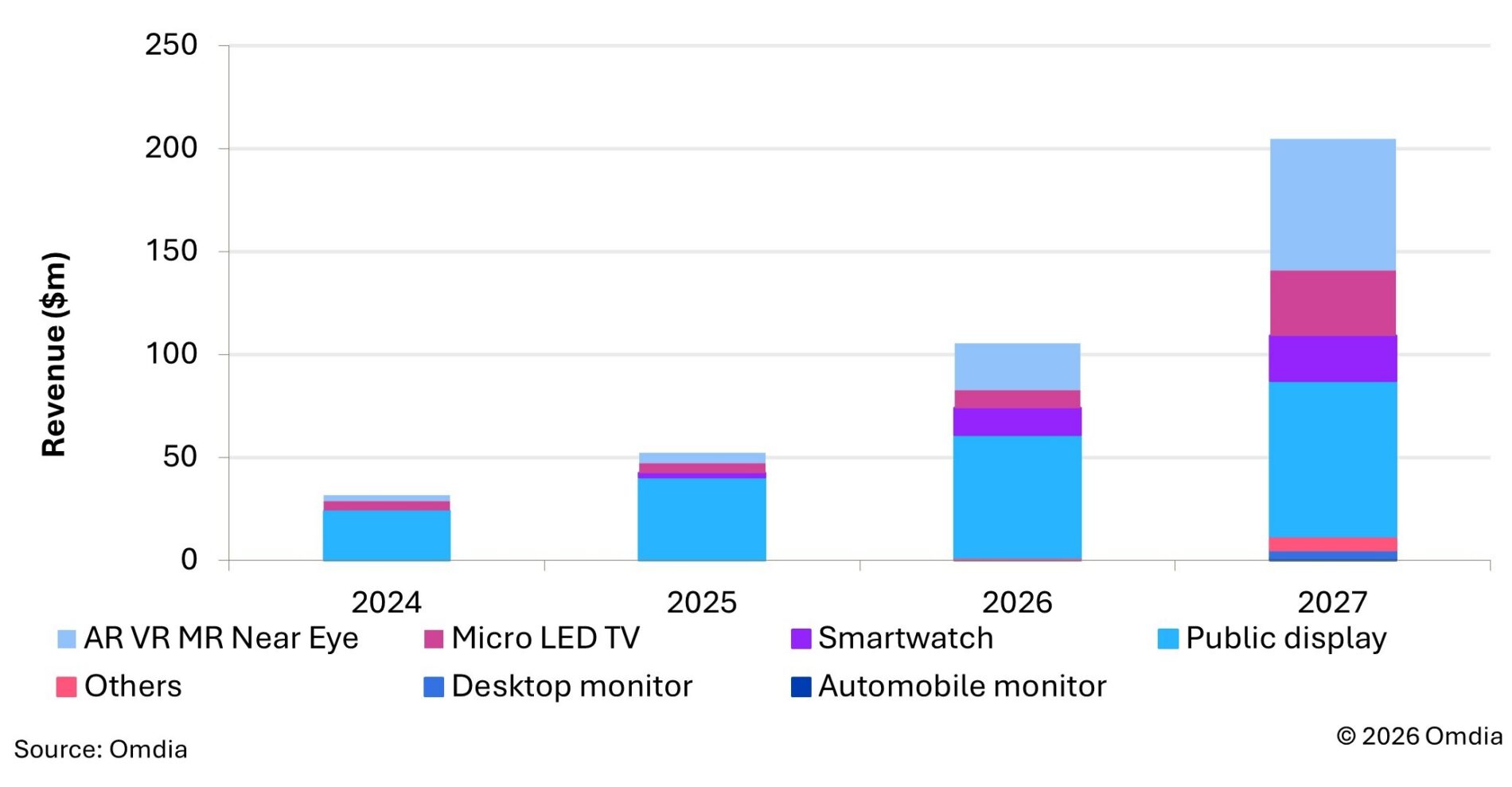
Micro LED display technology is beginning to move beyond early experimentation, with global revenue expected to double in 2026 as manufacturing improves and new applications gain traction.
According to Omdia’s Micro LED Display Market Tracker, revenue is projected to grow from $52.4 million (all figures US$) in 2025 to $105.4 million in 2026. While overall adoption remains limited compared with LCD and OLED, analysts say the technology is gaining momentum in specialized markets where competing display technologies cannot meet performance requirements.
Early growth is expected across public displays, ultra-large TVs, smart watches, and emerging wearable devices. Industry progress addressing longstanding challenges – including mass transfer complexity, backplane yield issues, and high production costs – has enabled manufacturers to begin scaling production in several categories.
Omdia highlights the rapid development of LEDoS (Micro LED on Silicon), which integrates microscopic LED chips onto semiconductor substrates to create ultra-small, high-resolution displays. Typical LEDoS panels measure just 0.1 to 0.2 inches diagonally and deliver pixel densities of 4,000 to 6,000 pixels per inch, making them well-suited for augmented, virtual, and mixed-reality devices as well as AI-powered smart glasses.
Jerry Kang, Practice Leader for OLED, Flexible, Micro LED and Emerging Technologies at Omdia, said Micro LED is likely to grow first in niche applications such as ultra-large displays, near-eye devices, automotive screens requiring high brightness, transparent displays, and stretchable form factors that conform to uneven surfaces.
Looking ahead, Omdia expects Micro LED revenue to reach approximately $6.8 billion by 2032, representing about 4.4 percent of the global flat-panel display market as the technology transitions toward broader commercialization.
(Image: Omdia)