Our new invidis 3D Display Handbook explores why 3D display technology is ready for a comeback. From autostereoscopic displays and light-field solutions to interactive 3D experiences, we cut through the buzzwords and explain what is already possible, what works in real-world deployments, and where the industry is heading next.
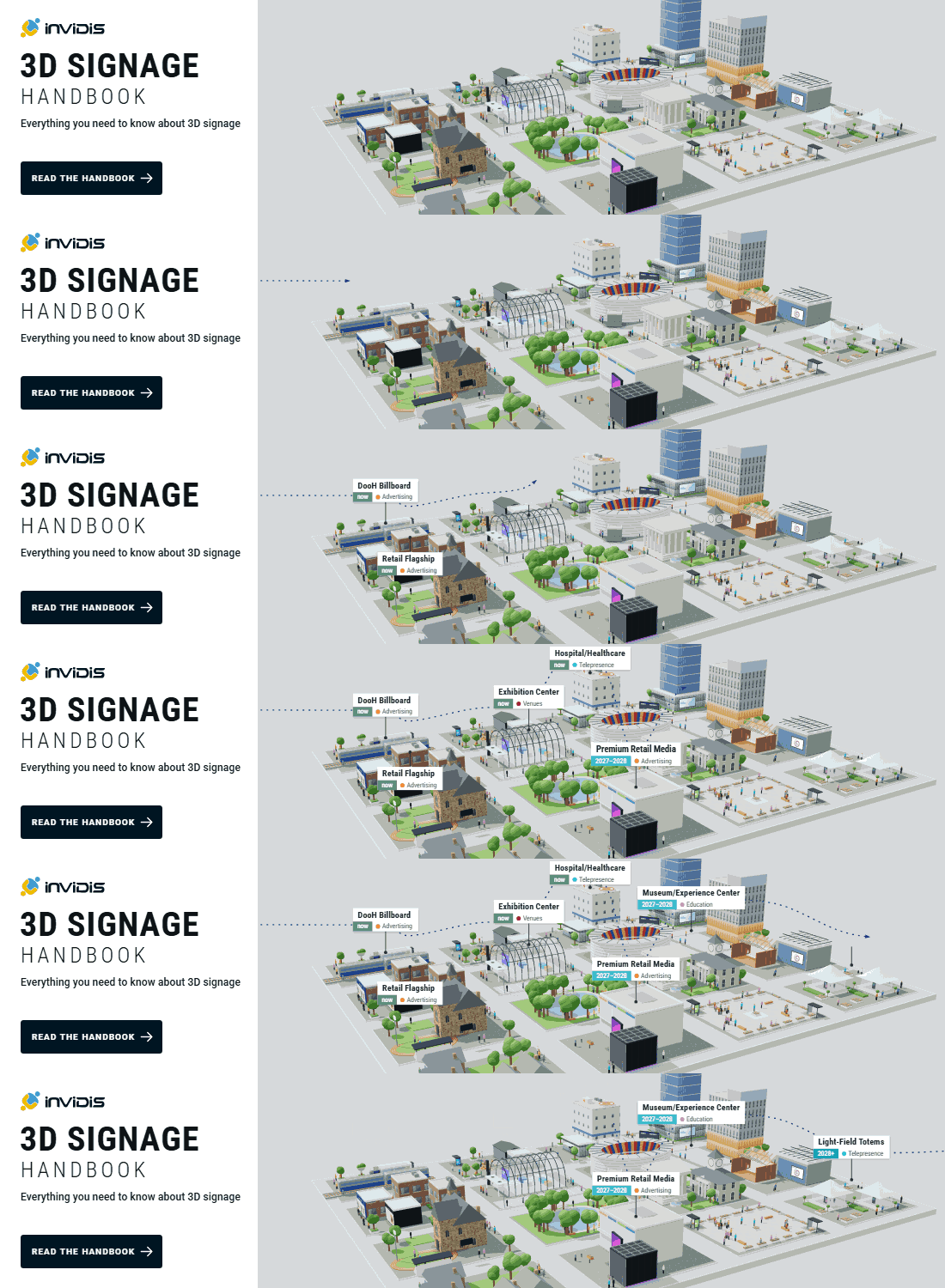
Explore the potential of 3D signage with our interactive 3D Signage City – click the image for full size experience
For years, glasses-free 3D displays have fascinated audiences but struggled to move beyond niche applications. Today, the market is changing. Advances in AI-powered content creation, improving display technologies, and a new generation of manufacturers are creating fresh momentum for 3D signage.
Inside the handbook:
- The evolution of glasses-free 3D display technology
- Anamorphic content, transparent displays and Pepper’s Ghost systems
- LED rotor displays and the reality behind “holograms”
- Multi-view and tracked autostereoscopic displays
- Light-field and volumetric display technologies
- AI-powered 3D content creation and workflows
- Digital humans and interactive spatial experiences
- Telepresence, collaboration and enterprise applications
- Business use cases across retail, DooH, healthcare, education and industry
If you want to understand the opportunities, limitations, and business potential of glasses-free 3D, this handbook is your essential guide.
These 3D display solutions are explained deeper in the yearbook:
- Hypervsn Display
- Proto Display
- Samsung Spatial Signage
- Sony Spatial Display
- HP Dimension with Google Beam
- Ameria Touch-free 3D interaction
FAQ: 3D Signage Handbook
The 3D Signage Handbook answers the following questions:
What is 3D signage?
3D signage refers to digital display technologies that create the perception of depth, volume, or spatial presence without requiring viewers to wear special glasses. The category includes visual illusions, autostereoscopic displays, light-field technologies, volumetric displays, and other emerging spatial display solutions.
What is glasses-free 3D technology?
Glasses-free 3D technology allows viewers to experience depth effects without 3D glasses or VR headsets. Different approaches include lenticular optics, eye tracking, multi-view rendering, light-field technology, and volumetric display systems.
Why is 3D signage gaining popularity?
Advances in display technology, AI-powered content creation, and growing demand for more engaging customer experiences are driving renewed interest in 3D displays across retail, advertising, entertainment, education, and corporate environments.
Is 3D signage the same as a hologram?
No. Most displays marketed as holograms are not true holographic displays. They typically use optical effects, transparent displays, LED rotor systems, or reflections to create a three-dimensional appearance.
What is anamorphic content?
Anamorphic content uses perspective, motion, shadows, and specially designed graphics to create a convincing illusion of depth on conventional 2D LED or LCD displays. It is commonly used on large digital billboards and DooH screens.
What is autostereoscopic 3D?
Autostereoscopic displays generate separate images for each eye, allowing viewers to perceive depth naturally without wearing glasses. This technology is one of the most important foundations of modern glasses-free 3D.
What is the difference between autostereoscopic and light-field displays?
Autostereoscopic displays create depth by directing different images to each eye. Light-field displays reproduce multiple viewing angles simultaneously.
What is a volumetric display?
A volumetric display creates images that occupy real physical space rather than simply appearing to have depth. Unlike conventional displays, volumetric systems generate visible image volumes that can be viewed from multiple angles.
What role does AI play in 3D displays?
AI is helping automate 3D content creation, convert 2D assets into spatial experiences, generate virtual environments, and scale content production. As a result, developing content for 3D displays is becoming faster and more cost-effective.
Which industries are using 3D display technology?
Applications are expanding beyond advertising and include retail, museums, airports, hospitality, healthcare, education, engineering, manufacturing, architecture, corporate communications, telepresence, and Digital-out-of-Home media.
What are digital humans and virtual assistants?
Digital humans are AI-powered virtual people displayed on advanced screens. They can act as customer service agents, information assistants, receptionists, educators, or brand ambassadors in physical locations.
How is 3D technology used for telepresence?
Telepresence solutions use advanced displays to create lifelike remote communication experiences. Participants appear at nearly life-size scale, making interactions more natural than traditional video conferencing.
Who should download this Handbook?
The handbook is designed for professionals working in digital signage, DOOH media, ProAV, retail technology, display manufacturing, workplace experience, architecture, experiential marketing, innovation management and corporate communications.
Why should I download the 3D Signage Handbook?
The 3D Signage Handbook provides a comprehensive overview of glasses-free 3D technologies, holographic display concepts, autostereoscopy, light-field displays, volumetric visualization, AI-powered content creation, digital humans, telepresence, and emerging spatial computing applications. It helps decision-makers, technology professionals, marketers, and digital signage experts understand both the technology landscape and real-world business opportunities.