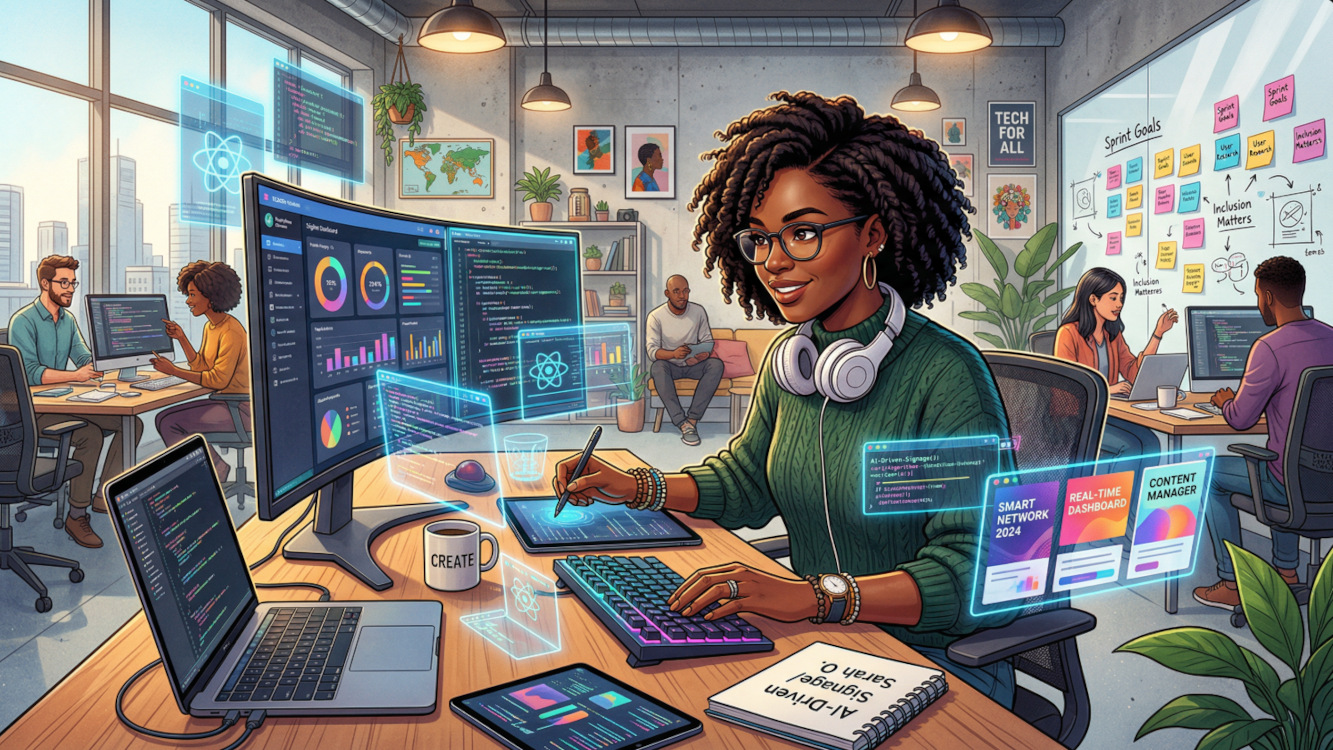
Digital signage software needs more women - an image change would help. (Image: AI generated using Nano Banana)
Women in Software: Coding Was Never Cool – Until It Was
The stereotype of the lone male coder persists. But AI, vibe coding, and a new generation of developers are changing the job’s image – and could make women coders the future pillars of digital signage software.
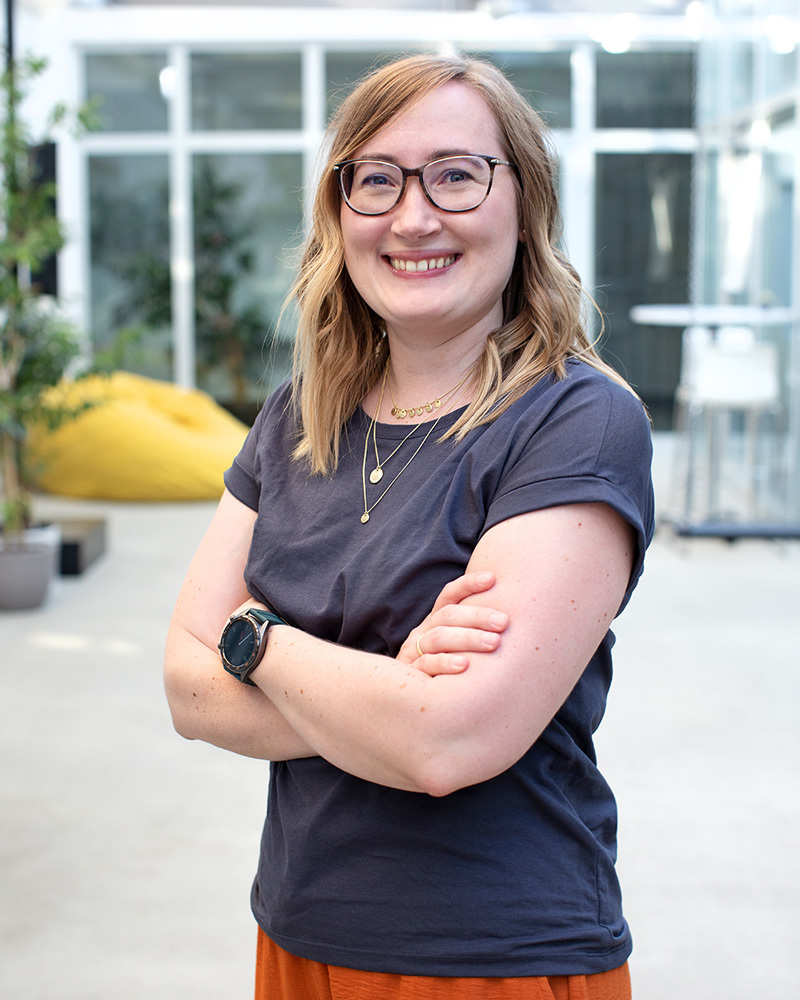
by Antonia Hamberger
I would have never, ever considered a software engineering career for myself. Never. But looking back, the image of the job that I had in my mind isn’t acutally all that accurate. When I speak to women software engineers now and hear the passion they express toward the products they build, I’m thinking: damn, this is cool.
But when I was at that stage in life of choosing a career path, coding was never cool, never sexy, never glamorous. Today, I can’t think of anything cooler than actually building a product people use – not just marketing and selling it.
Not to diminish crucial commercial roles, and not to say I regret the path I took (I’m still fairly sure I’d be a bad coder). But we probably underestimate how fun and rewarding software engineering can be, and how many opportunities that path holds.
Behind the CMS: still mostly male
In digital signage, behind a typical CMS platform the share of women usually sits between 6% and 18%. A remarkable exception is Dise, where the software team consists of 30% women – and the core development team is entirely female. These numbers stem from a small-scale invidis survey of European and US software providers. In the wider tech sector, most statistics point to around 22% to 25% female software engineers – and roughly 35% overall in tech roles.
James Hart, Global Head of Marketing at SignageOS, sees the academic pipeline for women entering developer and engineering roles across Europe as the biggest bottleneck when it comes to increasing the number of female coders. During every stage of his tech career – including leading teams at Blackberry, Jabra, and AVG – he has seen the most robust solutions built by teams that reflect the diverse global markets they serve.
Carolyn Voelkening, Chief Delivery Officer at Appspace, agrees that diversity has a direct impact on product quality and long-term growth. “In product and engineering, small decisions compound. Who we hire influences how we design, prioritize, and test. When women are part of that process, we see broader thinking and fewer blind spots.”
The hiring will is there – the pipeline isn’t
The willingness to hire female developers and product managers is certainly there. Some digital signage companies, such as the German ISV Dimedis, even say they would prioritize women for new roles when candidates have the same level of qualifications as a male applicant.
Quotas for women remain a controversial topic for many – and they are only one of several measures companies can take to attract more women. They also stem from the realization that fostering a working culture compatible with women’s needs has long been neglected.
“Encouraging women into software engineering and coding is a long-term challenge. Historically, we have not done enough as an industry to solve the problem, and we see the effects today in our staffing levels,” says James Keen, EVP Marketing at Uniguest. “Awareness of a problem is only step one; identifying positive action is a responsibility we all share.”
From quotas to Swiftie days
Beyond quotas, companies are introducing a range of initiatives. Appspace, for example, has an internal group called Athena – standing for Advocate, Transform, Humility, Empower, Nurture, and Authenticity. The group aims to create a supportive and empowering space for women across the organization.
Smaller companies are taking their own approaches. Dise, for instance, has hosted a “Swiftie day” in the office when the new Taylor Swift album dropped. Not every developer has to become a Swiftie, of course, but it illustrates how more diverse teams can shape company culture – fostering collaboration, connection, and a sense of belonging.
Enter AI and the era of “vibe coding”
The software engineering role itself is also changing dramatically. A growing part of the development cycle now happens through AI-driven development and “vibe coding” – generating code through conversational prompts. This shift requires a somewhat different skill set than traditional manual coding.
According to SignageOS, technical roles are increasingly reliant on high-level multitasking and cross-functional coordination – areas where women have historically excelled. The company sees strong potential in encouraging female team members to lead these transformation initiatives and provides specialized training in AI-enabled management and advanced motion graphics.
Maybe coding was sexy all along
Call me superficial, but vibe coding and AI coding agents make software engineering sound a hell of a lot sexier than it ever did before. Every university graduate wants to be as AI-savvy as possible – preferably working with the technology rather than being replaced by it. If these developments help bring more women into software, all the better.
What I know now that I didn’t know back then: the job is cool, and far better than its image suggests. The digital signage industry needs more young talent – and in return, it offers plenty of opportunities for ambitious achievers, men and women alike.
What makes coding exciting – the women’s perspective
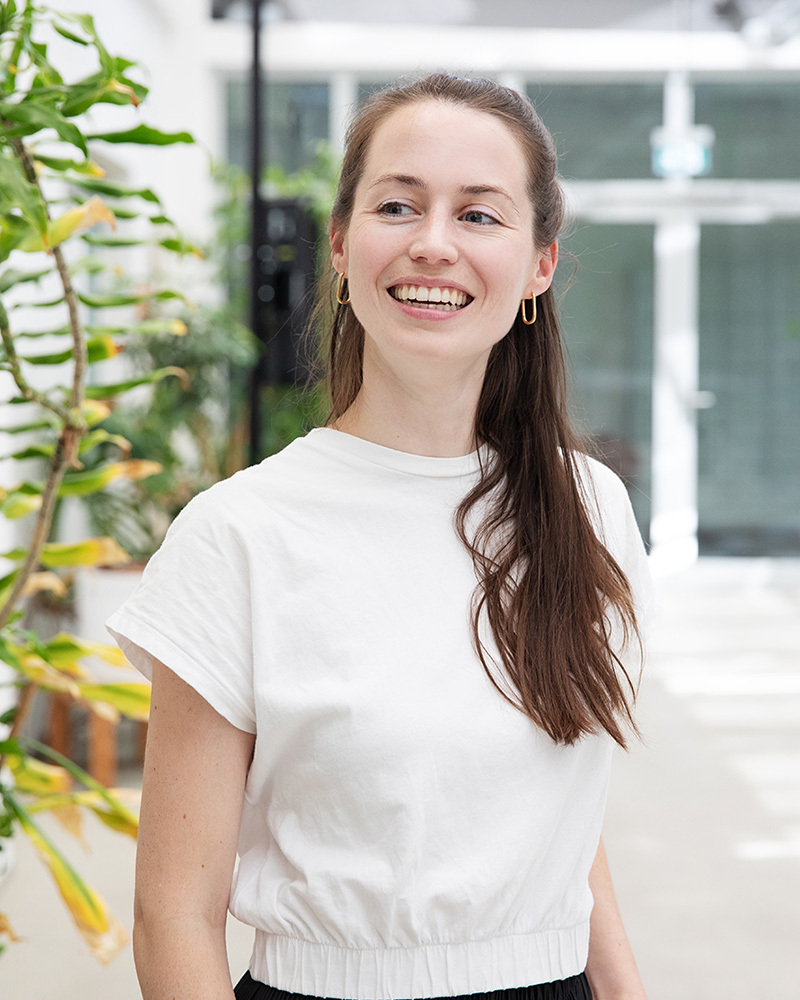
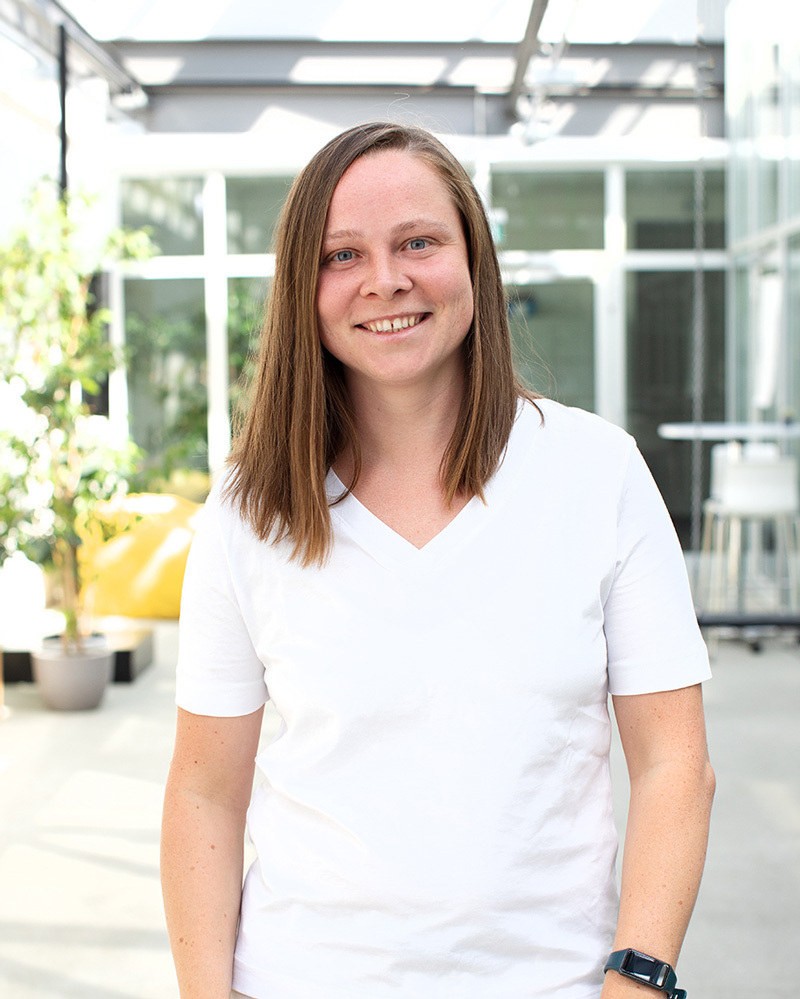
German CMS software provider Dimedis has three women in their development team and they are all super enthusiastic about their job. Here’s what they have to say:
“I’m fascinated by topics like algorithms and the chance to understand exactly why something works. Coding combines this analytical thinking with the ability to explore new approaches and bring ideas to life in a practical way.” – Maike Kahmann, Software Developer at Dimedis
“For me, software development is like a big puzzle. I break complex requirements into small, logical pieces and translate them into code. In the frontend, the results are immediately visible: abstract ideas suddenly turn into something tangible. When a widget ends up doing exactly what the client wanted, it’s genuinely satisfying.” – Inga Fischer, Software Developer at Dimedis
“What excites me about development is diving into complex problems and actively shaping solutions. By asking the right questions, challenging assumptions in a structured way, and bringing in different perspectives, we build a shared understanding that leads to solutions with real impact. The tension between fuzzy ideas and precise execution constantly brings new challenges – and that’s what keeps it exciting.” – Maren Seufert, Process Coach & Product Owner at Dimedis
You are currently viewing a placeholder content from Facebook. To access the actual content, click the button below. Please note that doing so will share data with third-party providers.
You are currently viewing a placeholder content from Instagram. To access the actual content, click the button below. Please note that doing so will share data with third-party providers.
You are currently viewing a placeholder content from X. To access the actual content, click the button below. Please note that doing so will share data with third-party providers.