For more than a decade, Ströer proudly championed its OoH+ strategy. Today, at the analyst conference following the preliminary figures for 2025, AI took center stage as the new force shaping the company’s future.
DooH Germany: Ströer Goes All-in on AI
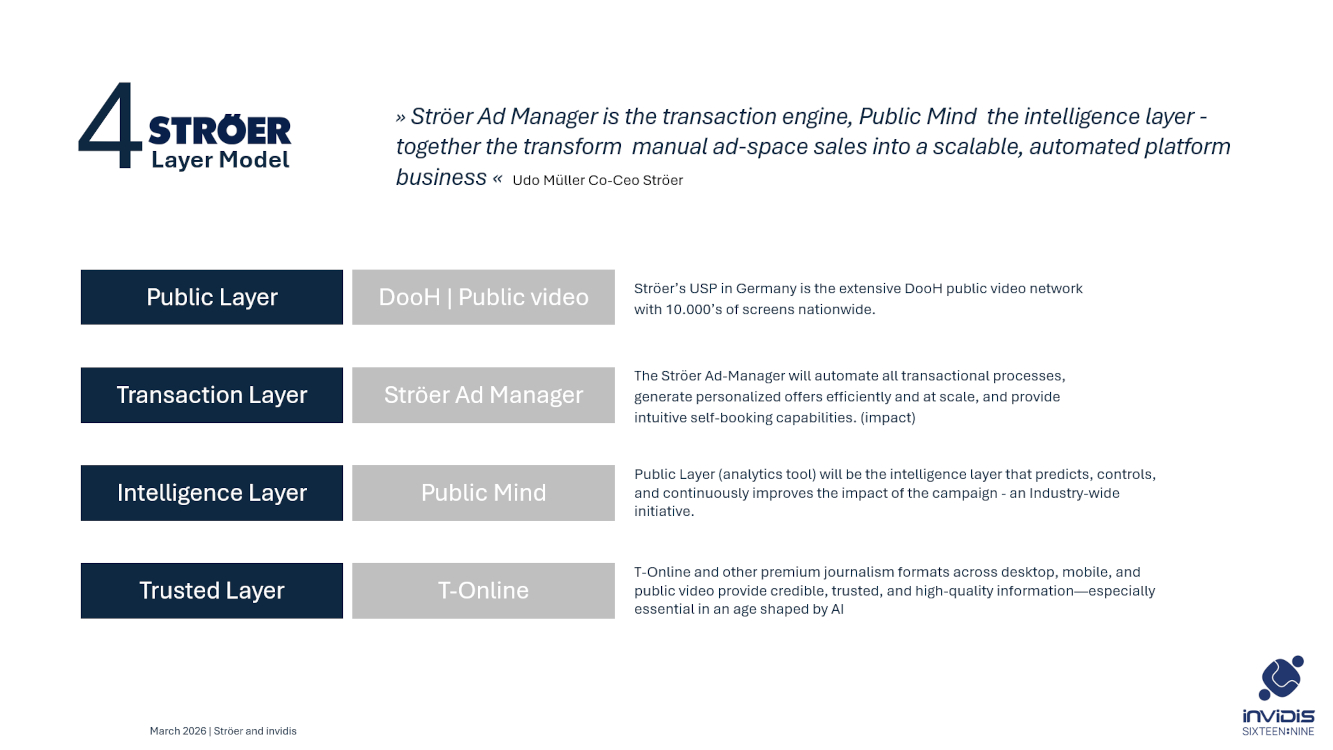
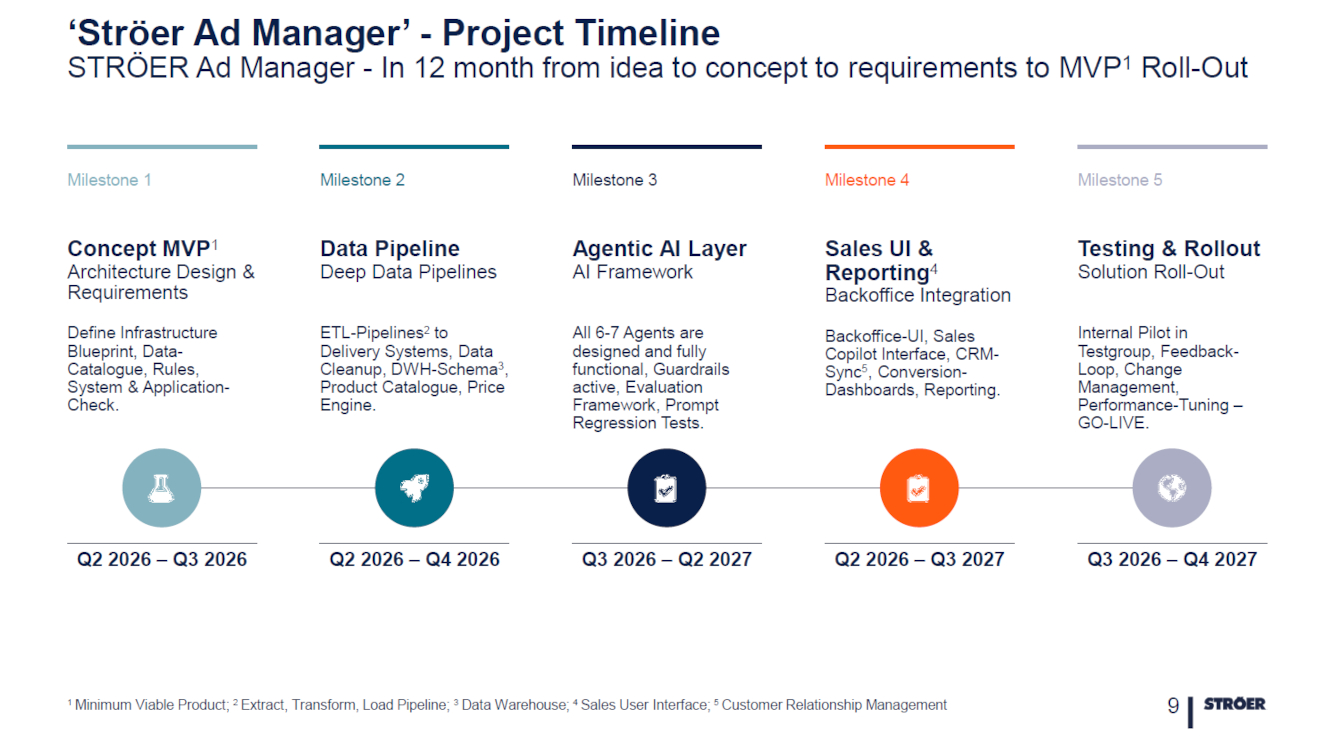
The German OoH market leader, Ströer, is planning a rapid transformation over the next twelve months. Media silos are set to be dismantled, and the in-house developed Ströer Ad Manager will serve as the central platform unifying the company’s offerings across media types. Self-service booking is expected to become the standard. For a traditionally structured OoH business, this represents the most significant disruption since the rise of DooH.
Ströer’s first digital wave arrived more than a decade ago with the large-scale rollout of DooH screens. Now the company is preparing for the second wave: automated, cross-channel, and scalable media buying. Instead of selling predefined packages within separate silos, the future will focus on integrated, algorithmically generated offerings.
Ströer openly compares its plan to the Google Ad Manager – a clear signal of its ambition. Looking ahead, the real competitors will no longer be JC Decaux and other traditional OoH players, but the big US tech platforms like Google and Yahoo. These platforms capture more than €13 billion in digital ad spend annually in Germany, largely through self-service booking and automated interfaces. Ströer now wants to close that gap – and quickly. The goal is that within twelve months, the majority of bookings will be AI-supported self-service or automated.
Early tests with cultural event bookings, conducted via Shopify, have already shown promise. Ströer argues that building an AI-powered booking platform today would cost around €2 million, while buying equivalent off-the-shelf solutions would cost many times more.
This shift also redefines the role of agencies. Their traditional booking margins are coming under pressure from multiple directions, and Ströer acknowledges that “business as usual” will no longer work. However, Müller stresses that Ströer remains a “natural partner” for agencies – far more so than the major US platforms. With 750 sales employees nationwide, including more than 500 in internal sales, the company’s processes are still complex and labour-intensive. In Müller’s view, AI offers the path to simplifying and scaling these operations.
From reach to impact
Perhaps the most fundamental shift is Ströer’s move away from selling reach toward selling impact. Google, Meta, and Amazon built global empires on outcome-based advertising models. Ströer now intends to follow suit and hopes the rest of the German OoH market will follow within months.
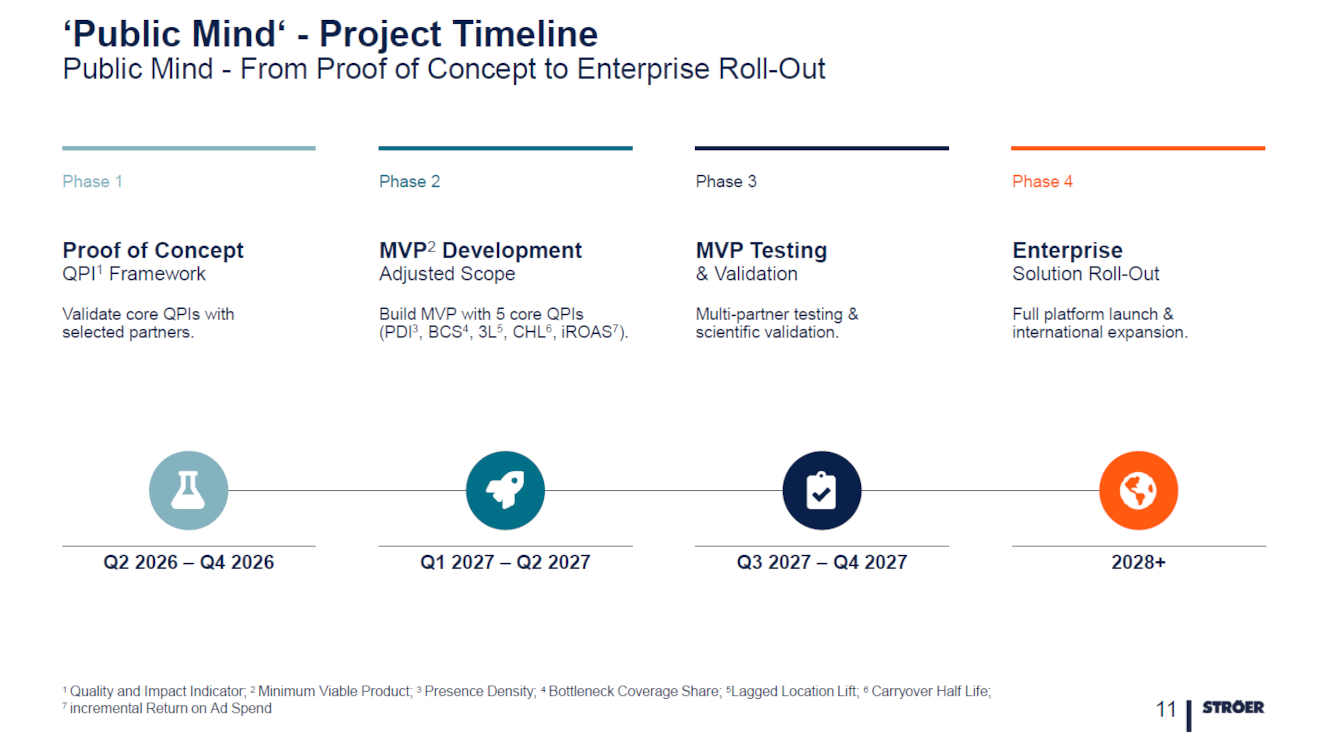
To measure and deliver this, Ströer is co-developing an industry-wide standard known as the Impact Layer “Public Mind.” This new framework aims to forecast and report expected campaign impact based on selected KPIs – reflecting the growing preference among advertisers for measurable outcomes over raw reach.
Even within operations, AI is embedded at scale, with Ströer using machine learning tools to maintain its hundreds of thousands of advertising faces.
Big vision, modest numbers
For a company like Ströer, an AI-first strategy is a logical and perhaps unavoidable step, but it was presented in a surprisingly rough and unpolished way. For a strategy gamechanger, the visuals lacked the professionalism one would expect from Ströer. It is difficult to avoid the impression that this new AI narrative was added quickly to overshadow the rather modest 2025 financials.
And modest they were. Revenues remained broadly stable in a year Ströer openly described as “very challenging” and “not in line with expectations.” Even the market leader could not repeat its double-digit growth of previous years. DooH grew only 8 percent, Programmatic DooH 12 percent, while Capex – despite the high profile launch of The Whale in Hamburg – stayed at prior year levels. “Resilience under extreme market conditions,” Müller said. But for investors, resilience is not growth.
Thanks to the Bundestag election campaign early in 2025 – typically a welcome revenue driver – Ströer maintained previous year performance, but not substantially more. And the first quarter of 2026 will not be an easy one either. The DooH boom has clearly lost momentum, partially because Q1 2025 was inflated by extraordinary effects.
Positive signs down the road
Yet, the company remains positive growth on a three-year average. Müller expects mid to high single digit growth returning from the second half of 2026 and, in the mid term, a return to 10 percent annual OoH growth, driven mainly by AI and continued declines in TV and print spend.
And there were other signs of strength: The company secured new municipal marketing contracts in the cities Bremen, Frankfurt, and Bielefeld, reportedly on more favourable terms than deals signed 15 years ago. Outside the top metropolitan markets, Ströer remains the 800-pound gorilla, while JC Decaux continues to prioritise major cities.
A company in transition
Ströer is tearing down silos, presenting an ambitious new AI-based strategy, and promising to implement it all within twelve months – a very ambitious timeframe, especially in a conservative industry like OoH. But the ad industry around the world feels the pressure to change – and to change fast.
Ströer announced to present a more detailed strategy investor update in April.
invidis opinion – Co-Founder back in control
A chapter is closing at Ströer – and anyone listening to today’s analyst call could sense it immediately. Udo Müller, Co-Founder and Co-CEO, dominated the call and is obviously once again steering the strategic future of Europe’s largest out of home provider almost single handedly.
Co-CEO Christian Schmalzl, long known for translating complex media processes and digital trends into clear language for the investment community, has shifted into a background, almost silent role.
Schmalzl has decided not to renew his contract, which runs until 2028, and will leave the company. Industry insiders would not be surprised if he departs earlier.
His minimal presence during the call – a single comment, nothing more – suggest that this is more than a formal transition. This is also fuelled by insider stories about rumblings in the organisation.
And it was very unusual for Ströer to have a presentation that felt hastily assembled. This all points to a deeper shift inside the organization. The only thing that appears certain: Müller has taken back full control of the wheel.