
Visionect’s black-and-white e-paper displays have always had a great asthetic but catered to a niche in digital signage. Now, the company is uniting with its leading brand, Joan Workplace, to build a complete smart office hub, with e-paper at its core.
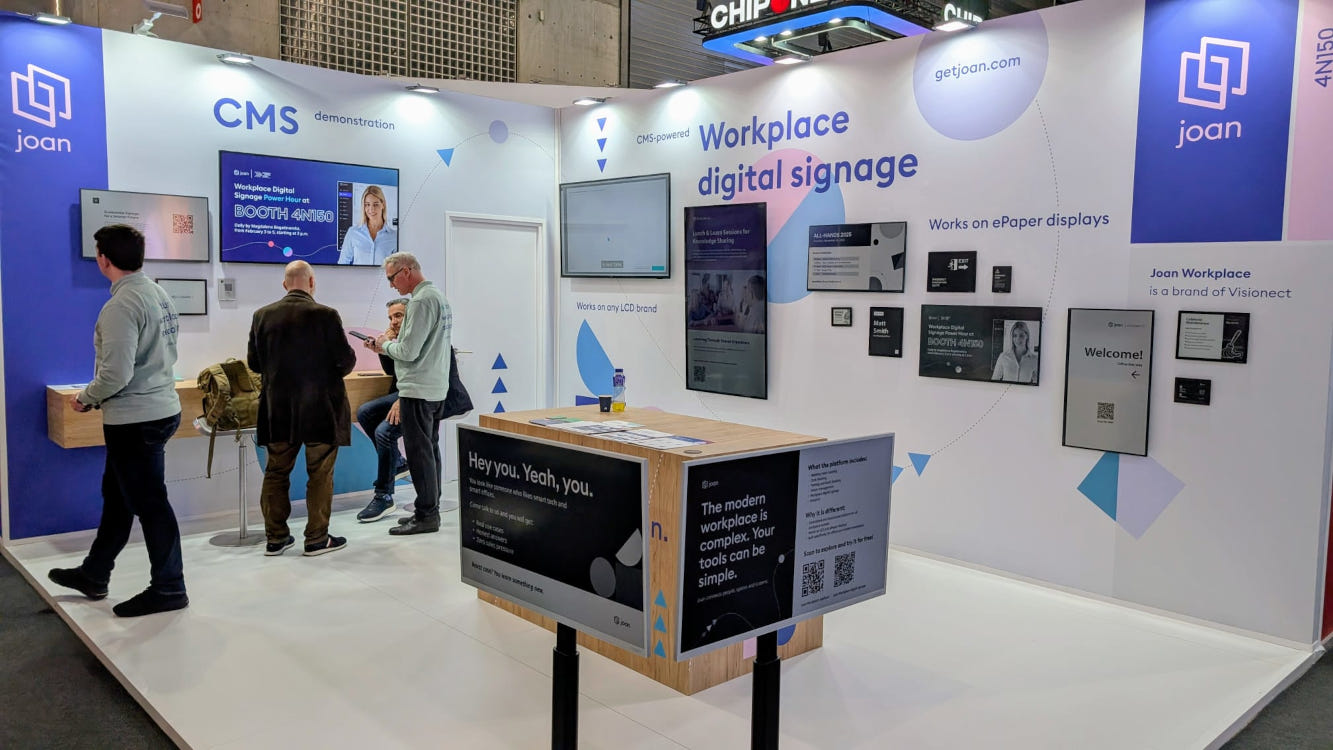
Visionect: E-Paper Pioneer Shifts Focus to Software
Visionect isn’t one of the big names in digital signage but has stood out in recent years for its unapologetically minimalist displays: black-and-white e-paper devices in sleek cases that not only consume very little energy but also look terribly stylish.
Long before e-paper gained broader traction, the Slovenian brand leaned into the technology’s strengths and focused on environments where they play out best. The Place-and-Play devices don’t need to be plugged into an energy source and can be hung on a standard or glass wall with magnetic clips – ideal for museums or offices.
That hardware legacy now sits within a broader strategic narrative. Visionect is the company behind the brand Joan Workplace. While Visionect developed signage hardware and a CMS, Joan built its identity around workspace orchestration – room booking, desk booking, and visitor management solutions.
From single tools and devices to a unified platform
In recent years, workplace needs have evolved: companies are looking for ways to elevate the office experience and make better use of their spaces. This prompted Visionect to expand its offering beyond traditional signage. Under the brand Joan Workplace, the company is now addressing the market with an all-in-one office platform that combines content management, room booking, desk booking, parking and asset reservations, and visitor management.
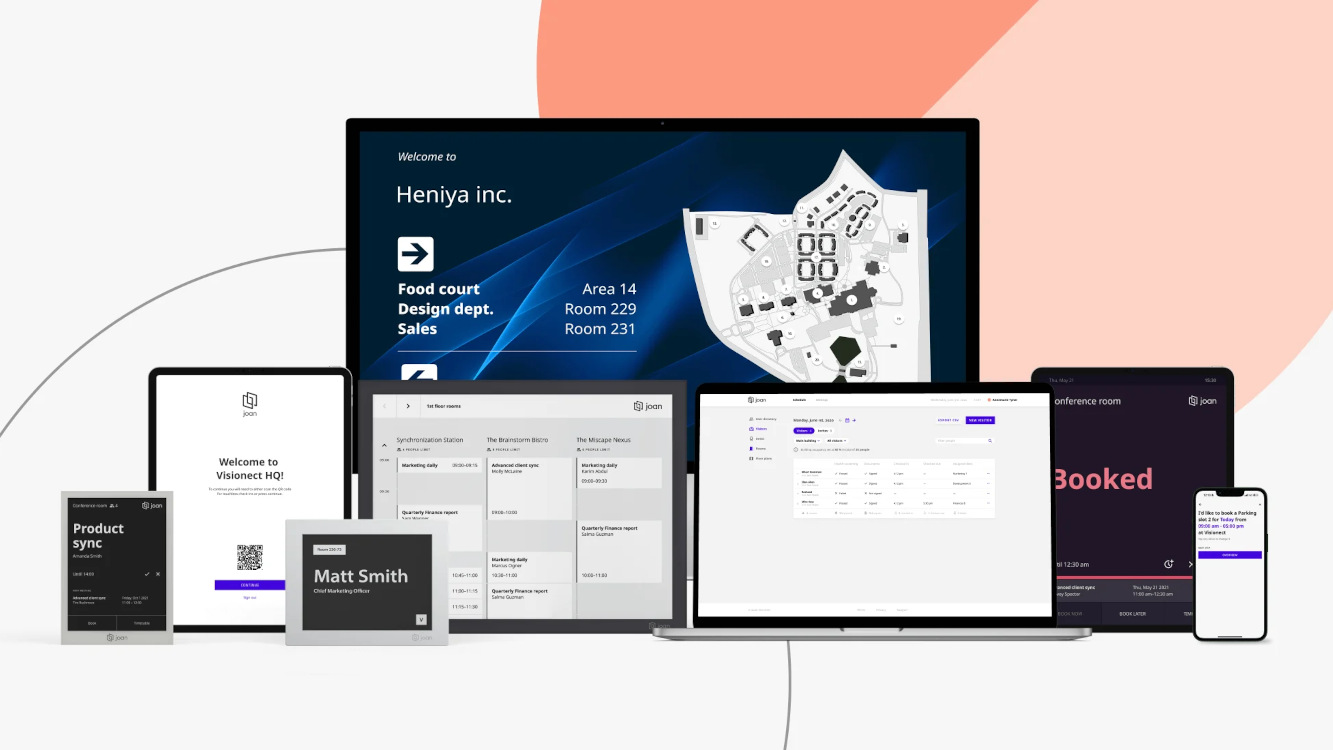
On the hardware front, Visionect’s DNA remains visible. The company continues to double down on its signature monochrome e-paper aesthetic, with new form factors and gadgets on the roadmap – including e-paper visitor badges expected to launch soon. But hardware is no longer the primary story. Like many established vendors across AV and workplace tech, the company is shifting toward a software-centric model.
Compatible with third-party systems
Importantly, the platform is not limited to the company’s own devices. It supports third-party displays, including both LCD and e-paper, and is designed to coexist with external ecosystems such as Crestron deployments.
Following the combined brand launch, the roadmap points toward deeper integrations with third-party systems throughout the year. Another priority is a redesign of the company’s mobile and web applications, with a focus on usability and cleaner workflows for hybrid office users.
And, inevitably, the transition toward a software-first identity includes artificial intelligence. Joan plans to integrate AI capabilities into the platform, aligning with a broader industry shift toward automation and smarter workspace management.
With this strategy shift, Joan is responding to a reality where end-to-end solutions are the answer to not being pushed out of the market by bigger and better ecosystems. Visionect’s early bet on e-paper helped define a niche. Now, under Joan, that legacy is being reframed as part of a larger play: moving from distinctive hardware vendor to workspace platform provider, with displays – e-paper or otherwise – becoming just one piece of a bigger ecosystem.