
In the West, the idealistic quest after the holy "know-it-all" and "will-do-no-wrong" AI is bypassing the reality of consumers. They just want practical, quick, and cheap – they don't need perfect. Something the Asian tech giants have understood. The second edition of Retail Connect by Roi Iglesias, partner at invidis impact.
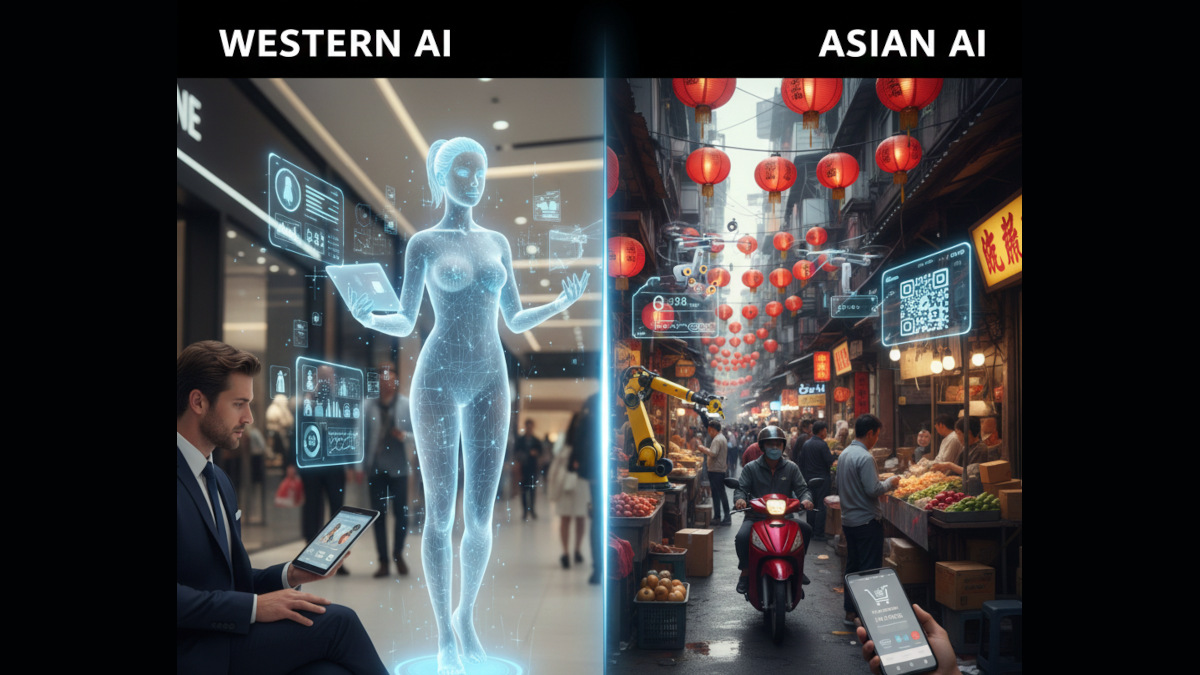
The AI Personalization Myth: Why Western Retail Sells Magic and Asia Sells Results
In the West, we’ve spent years building a vision of hyper-personalized AI that looks flawless on a slide deck. It’s a world of millimeter-perfect recommendations, dynamic pricing, and chatbots that allegedly “understand” your soul before you’ve even finished your morning coffee.
Meanwhile, in Asia, AI is just as omnipresent, but the philosophy is different. There is less talk about the “perfect experience” and more focus on realistic, cheap, and rapid adoption that inegrates into daily life without making a scene.

The irony? Despite the billions poured into massive models and dashboards overflowing with KPIs, the average Western consumer has already figured out the trick: they compare.
When a chatbot offers an “exclusive” deal, the user simply opens another tab, checks a different marketplace, and – if the price doesn’t align – the algorithm is left standing there like a salesperson who just lost their dignity.
Alibaba has recently upped the ante in what can only be described as an ‘agentic arms race.’ The company is pouring roughly $431 million (3 billion yuan) into a massive marketing and incentive blitz to promote Qwen, its AI agent, as the default shopping brain for the masses. Unlike Western players who are focused on modular APIs and technical standards, Alibaba is going for the jugular: integrating Qwen directly into the Taobao and Alipay ecosystems to handle everything – sourcing, booking, and paying – without the user ever leaving the chat.
While Amazon tests ‘Buy For Me’ features and Microsoft scales ‘Copilot Checkout,’ Alibaba’s end-to-end vertical integration remains unmatched. They aren’t just building a tool; they are buying the market’s habits, betting that a seamless, incentivized ecosystem will beat the fragmented, modular approach currently favored in the West.
The west: AI as a work of art, not a tool
In Europe and the U.S., AI in retail and e-commerce is often sold as an all-encompassing system – everything from facial emotion detection to the prediction of subconscious desires.
The narrative is polished: “We are ethical, we respect privacy, we follow the EU AI Act, and we offer the ultimate user experience.”
The problem is that when a user actually lands on the page, they don’t feel a “perfect experience.” They feel a friction-filled flow designed to trap them, feed them “personalized offers,” and, quite frankly, make them feel watched.
When the AI says, “This is your ideal offer,” the most human instinct in the world kicks in: open a new tab. According to recent consumer sentiment reports from Gartner, users are increasingly skeptical of AI-driven interactions, often viewing them as a barrier to the best price rather than a gateway to it. They go straight to Amazon, Ali Express, or a local competitor to verify the truth.
Asia: AI as a price engine, not a fantasy
In China and other Asian markets, AI is less about storytelling and more about optimizing price, inventory, and logistics.
Chinese consumers are notoriously sensitive to discounts. They don’t look for an “intelligent assistant” to talk to; they look for social proof and value. This is why AI in Asia is built into the plumbing of super-apps like WeChat and Taobao, focusing on:
- Hyper-speed logistics
- Instant mobile payments
- Real-time price adjustments
The consumer doesn’t ask if the AI “understands” them. They ask if it saves them time and money. If it doesn’t, they swipe to the next app. There is no romanticism involved.
The consumer as an “AI Detector”
Recent studies on digital shopping habits suggest that consumers are becoming their own “AI Detectors.” They aren’t necessarily afraid of the tech; they just know it isn’t infallible. More importantly, they suspect it’s optimized for the brand’s margin, not their own wallet.
In this context, the Western obsession with “complete, ethical, and curated AI” starts to look a bit naive. While the West debates regulation and bias, the consumer has already moved on to a pragmatic strategy: using AI as a starting point, never the final destination.
Who is winning the realism race?
If I had to choose between “polished but slightly ridiculous” and “pragmatic and somewhat chaotic,” Asian AI adoption wins on realism.
It doesn’t try to sell the illusion of a soul. It accepts that the user will compare, will leave the app, and will demand the lowest price. It adapts to the user’s cynicism instead of trying to “curate” it away.
The West remains determined to build a “perfect system” that the consumer treats as a mere suggestion. It’s the ultimate irony: the most “advanced” AI is being used as a simple tool, and the shoppers knew that long before the executives did.