
As Ramadan reshapes daily life for millions of Muslims in Europe, DooH campaigns are evolving to match its unique cadence. A campaign developed for McDonald’s Germany leads the way with a time‑based execution that swaps tempting visuals for thoughtful restraint until sunset.
Ramadan: DooH Aligned With the Sun
Ramadan is not only a major cultural moment in the Arab world; its influence increasingly shapes advertising strategies across Europe as well. In countries such as the UK and Germany, where large Muslim communities observe the month of fasting, brands are embracing more sensitive and context‑aware Digital Out‑of‑Home communication.
One of the most notable recent examples is the “Happy Ramadan” campaign created by Scholz & Friends for McDonald’s Germany, a project that demonstrates how DooH can adapt to cultural rituals with both creativity and respect.
In Germany alone, around six million Muslims celebrate Ramadan each year. During fasting hours, many find themselves surrounded by traditional outdoor advertising filled with images of food – visuals that can feel intrusive or stressful throughout the day. The challenge for advertisers and creative agency is how to acknowledge these sensitivities while still reaching audiences at relevant moments.
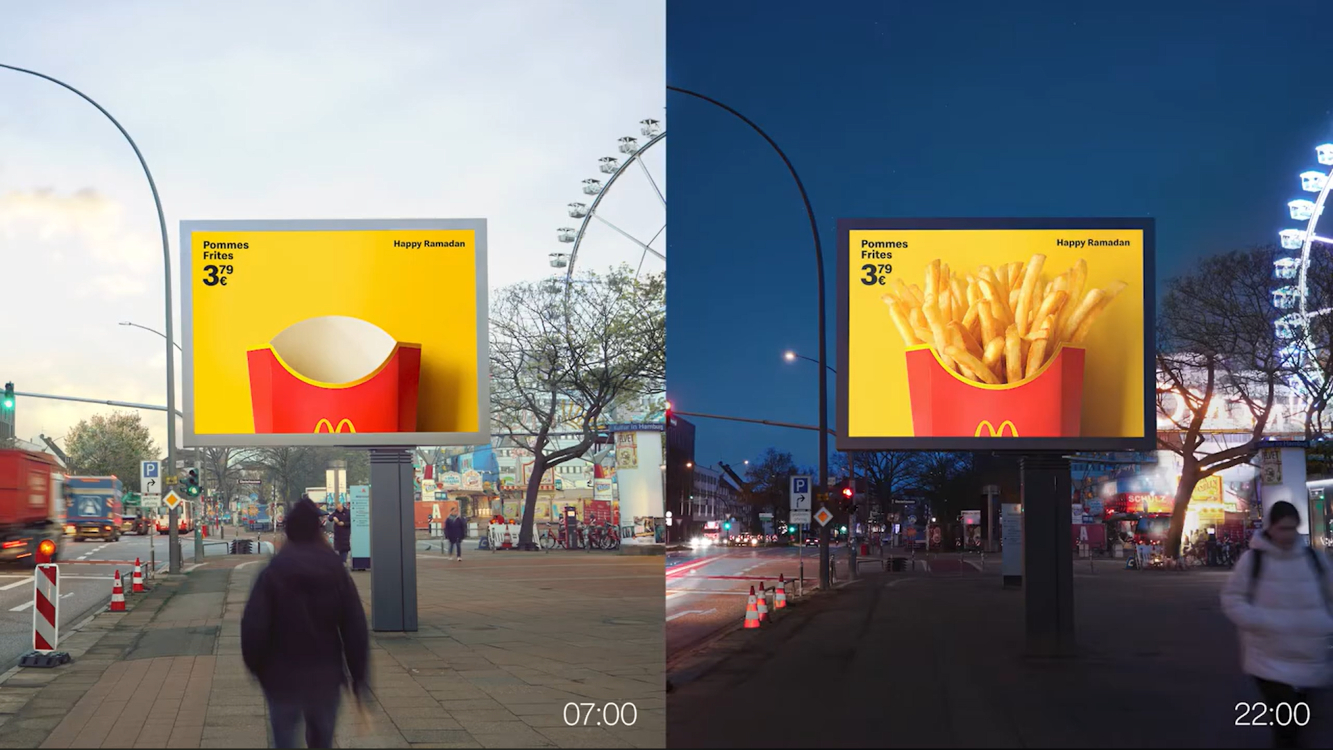
Scholz & Friends developed in 2023 a dynamic, time‑based DooH activation that removed all food imagery during daylight hours. The campaign precisely synchronized with the sun’s daily path. When the sun rose, DooH screens would show only neutral McDonald’s brand motifs free of any tempting dishes. Once the sun set and Iftar begins, the visuals transform automatically, revealing the full range of McDonald’s meals and creating a warm, appetizing moment timed to when the audience can finally enjoy food again.
The “Happy Ramadan” concept works because it treats DooH not as a static channel but as a living, reactive medium that can adapt to the rhythm of society. The campaign recognizes the values of respect, empathy and community that define the holy month. For McDonald’s, the payoff is a stronger emotional relevance; for the wider industry, the campaign demonstrats how sensitivity can elevate creativity.
Beyond the Arab world, Ramadan has become a defining period for context‑aware advertising in Western markets. As more brands embrace dynamic content and smarter scheduling, DooH is increasingly able to reflect cultural nuance in real time.
The “Happy Ramadan” underscores a broader trend. As cities grow more diverse and audiences more segmented, culturally intelligent DooH will play an essential role in making public communication more inclusive. Ramadan, with its clear daily structure and community‑oriented values, offers an ideal use case for brands willing to think beyond traditional advertising patterns and embrace the contextual strengths of digital outdoor media.
invidis Comment by Florian Rotberg
There is a risk that culturally sensitive campaigns – like S+F McDonald’s award‑winning Ramadan concept from 2023 – are increasingly misinterpreted through today’s polarized political lens. What was until recently celebrated as considerate, clever and inclusive now carries a different weight in a Europe where cultural debates have become weaponised and right‑wing parties continue to gain ground. In this climate, many brands hesitate to engage with cultural contexts at all, fearing backlash from vocal segments of a minor part of the public who quickly frame such efforts as “woke” rather than as smart, respectful communication.
This shift is unfortunate, because in the Muslim world Ramadan marketing remains a major pillar of the advertising calendar – even if the creative bar is often far lower than what European agencies have shown is possible. The McDonald’s campaign demonstrated that cultural relevance doesn’t have to be political; it can simply be thoughtful, empathetic and rooted in an understanding of audience needs. As brands grow more cautious, the industry risks losing some of its most meaningful and innovative work precisely at a moment when culturally intelligent communication could bridge divides rather than deepen them.