
Barcelona | As global trade tensions rise and AI reshapes risk, the digital signage industry must rethink where its technology comes from. At ISE 2026, resilience and digital sovereignty emerge as the defining forces for the future ProAV supply chain.
ISE 2026: In Signage, Origin Starts To Matter
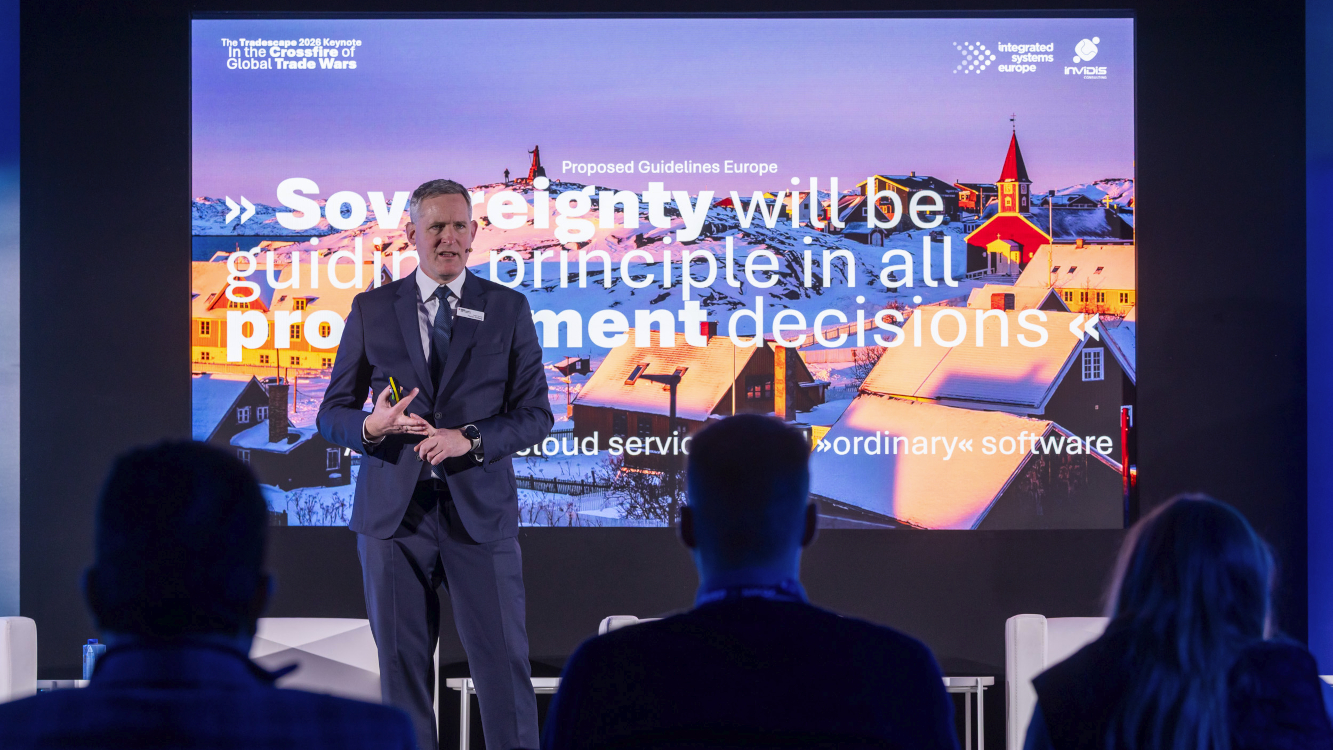
The ProAV industry has found itself caught in the middle of global trade conflicts – directly through rapidly shifting tariffs in the US market, and indirectly in Europe through a wave of products rerouted from the US. Yet the long‑term impact goes far beyond short‑term pricing turbulence, as invidis outlined in a keynote at the ISE Tradescape Conference. At the core of this shift lies a fundamental change: origin matters again.
From global convenience to geopolitical sensitivity
For years, the provenance of hardware or the headquarters of a software company played little role in digital signage procurement. Solutions, features, and price were the decisive criteria. Displays could be manufactured in China, Vietnam, Malaysia, Mexico, or even inside the EU – whichever factory a brand selected for a particular batch. Customers rarely asked for more than technical specifications.
The same applied to digital signage software and hosting. US‑based or European cloud environments were equally acceptable, as long as providers weren’t linked to Russia or China. The digital signage supply chain was global, convenient, and predictable.
A new reality: Instability and AI‑driven threats
But the past twelve months have changed the equation. Geopolitical instability, security concerns, and the rapid evolution of AI‑driven threats have fundamentally altered how enterprises evaluate technology partners. The comfortable assumption that the digital signage stack is politically neutral no longer holds.
Origin is becoming a procurement factor again, increasingly driven by cautious enterprise buyers and new legal frameworks. The shift is subtle but unmistakable.
Manufacturing moves – but only partially
Brands are already reconfiguring manufacturing networks. Production of sensitive hardware components is increasingly relocated from China to politically less exposed countries such as Vietnam or India. Assembly capacities inside the EU are being strengthened to provide customers with at least partial local production options.
Still, the industry accepts a practical reality: The majority of components will continue to be made in China – and both vendors and customers will continue to work with that.
The new challenge: “Made in the US”
While “Made in China” is familiar and manageable, a new complexity is emerging: the growing sensitivity around US‑made technology.
A recent WEF study highlighted that 80% of all enterprise solutions in Europe run on US‑based cloud hyperscalers. AWS, Azure, and Google Cloud dominate the market – and the entire AI ecosystem is built on top of them.
This dependence is starting to carry political weight. For the first time, US‑based LED manufacturers are encountering resistance when entering European government and high‑security tenders. Trust, not technology, is becoming the barrier.
Resilience through dual technology stacks
Replacing US hyperscalers or leading AI models with non‑US alternatives is technically and economically complex – in many cases nearly impossible. European or Asian equivalents exist but lack scale, ecosystem maturity, or the development speed of their American competitors.
As a result, the emerging strategy is not replacement, but complementation: building a second, sovereign tech stack alongside US‑based solutions. This approach mirrors trends in cloud, cybersecurity, and AI across multiple industries and is now entering digital signage and ProAV.
The road ahead: Sovereignty becomes a design criterion
For the digital signage industry, this marks the beginning of a structural transformation. Procurement will increasingly weigh resilience, sovereignty, and long‑term risk exposure alongside features and pricing. Enterprises will expect transparency regarding manufacturing locations, software hosting, AI model origin, and supply‑chain dependencies.
The message is clear: Resilience and digital sovereignty are emerging as strategic differentiators – and the industry must prepare.