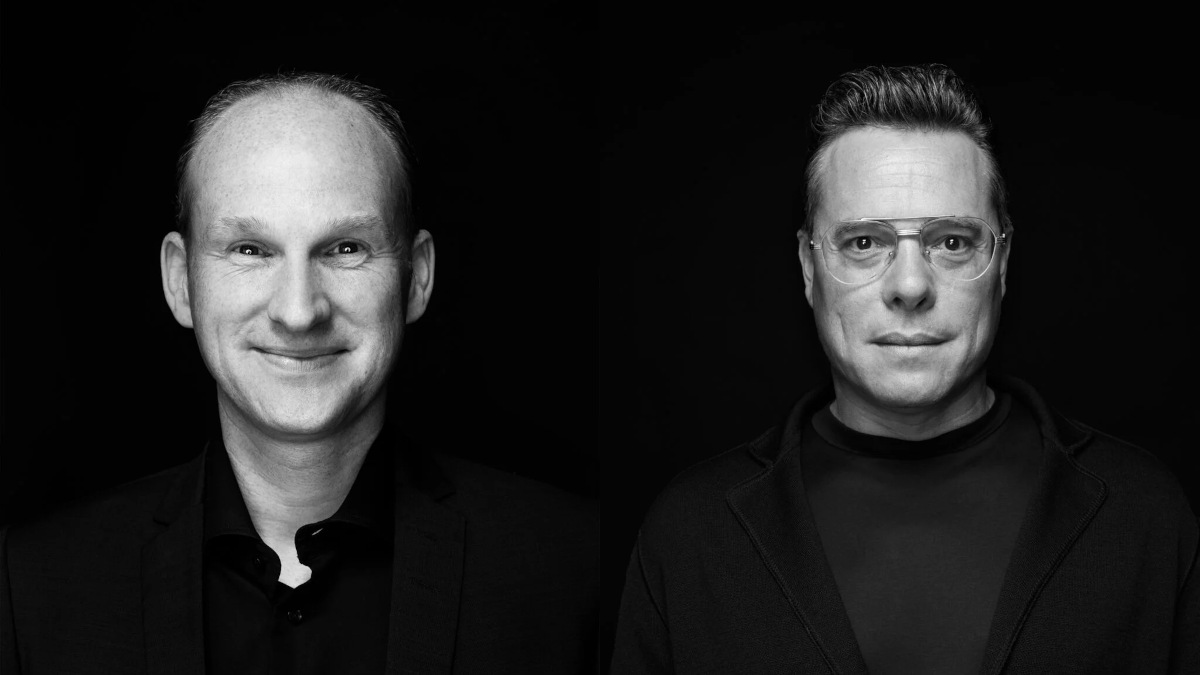
First Impression's mission is to reshape stores as destinations, not just sales points. While in the first half of 2025, many of those projects were postponed, the rest of the year saw an experience-led acceleration. In this Year in Review, CEO Ron Haans and CIO Koen Wouters share their market observations and strategies.
Year in Review 2025/2026: Ron Haans & Koen Wouters | First Impression
Hesitation driven by global uncertainty was clearly felt in the first half of 2025. At First Impression, we saw projects slow down and decisions being postponed. Not out of fear, but realism. When geopolitical tension and economic pressure rise, experience is often the first investment to be questioned.
Yet just before summer, sentiment shifted. Confidence returned. Not as blind optimism, but as a renewed belief in the value of physical spaces. The second half of the year became a period of acceleration. Focused, deliberate and productive. That momentum shaped how we closed 2025.
What stood out most was not a return to old models, but a redefinition of retail itself. Stores did not disappear. They changed role. From points of sale to points of experience. That shift confirmed a direction we had already chosen.
From transactions to presence
For many in the market, efficiency is still the dominant metric. Online excels at that. Physical space should not compete on the same terms. Our perspective is different. Physical locations must justify their existence by creating meaning. Experience is the core function.
Throughout 2025, we saw expectations rise across projects and markets. Time is scarce. Attention is valuable. A store that offers nothing beyond product availability loses relevance to consumers. A store that offers experience gains it. This is not a trend cycle but a structural shift.
Physical locations are becoming destinations. Places where brands are felt, remembered and shared. That belief continues to guide how we design, deploy and support solutions.
Retail media grows up
Retail media matured significantly in 2025, especially in the Dutch market. Partly driven by pressure on traditional marketing budgets. Experience is powerful, but not always immediately measurable. That friction forced the market to become more pragmatic.
In-store networks evolved into strategic assets. They generate revenue, prove value and enable reinvestment into the store environment itself. What was once perceived as a risk to brand image is now widely accepted, even among value-driven retailers.
Our position is clear. Retail media only creates long-term value when it strengthens the experience rather than undermining it. Monetization without meaning is short-lived. Integration is what makes it sustainable.
Flagships as catalysts
In a market focused on scale, we deliberately continue to invest in experience-led flagship projects. Not as showcases, but as catalysts.
High-impact, single-location concepts create clarity. They demonstrate capability. They build trust. Internationally, they often become the starting point for broader rollouts. Not because they are copied one-to-one, but because they define a standard.
Experience leads. Scale follows. Not the other way around.
Building for scale
Behind the scenes, 2025 was defined by long-term choices. The focus was not speed, but structure. We deliberately invested in a fully integrated, all-in-one platform connecting people, projects, partners and assets. Rather than layering new tools on old systems, we chose to rebuild the foundation. The platform will go live mid-2026.
Asset management, deployment data and service intelligence come together in one ecosystem. APIs connect clients, suppliers and partners. AI supports monitoring, prediction and optimization. One system. One source of truth. Built to scale globally.
This is not about technology for technology’s sake. It is about creating control and continuity in increasingly complex international environments.
End-to-end, by design
As brands operate more globally, fragmentation becomes the biggest risk. Different suppliers. Different standards. Different outcomes. Our response is deliberate. An end-to-end approach is a necessity.
From strategy and concept to technology, content, deployment and service. Designed centrally. Executed locally. Managed globally. Smart Deployment ensures every rollout follows one method and one quality standard. Smart Service connects hardware directly to remote monitoring, enabling proactive support and long-term performance.
In a market that often fragments responsibility, we believe ownership matters.
What 2026 demands
Looking ahead, digital signage is no longer a tactical layer. It is the foundation of physical brand experience. LED continues to replace traditional displays. Content becomes more adaptive and context-aware. Image and audio increasingly work together to define atmosphere and energy.
What becomes less relevant are solutions that attempt to replace physical experience altogether. Virtual-only concepts miss what makes physical space powerful. Shared experience. Surprise. Presence.
For First Impression, the challenge is clear. Scale globally without losing local meaning. Be data-driven where necessary. Design-first where it matters.
Because whether it is one location or a thousand, impact only happens when experience comes first.