Coming from the broadcast industry, Mathieu Yerle believes digital signage too closely mirrors the steadily declining world of linear TV. As CEO, he aims to help shape a new era of truly engaging signage. In his Year in Review, he shares his vision of what that future will look like.
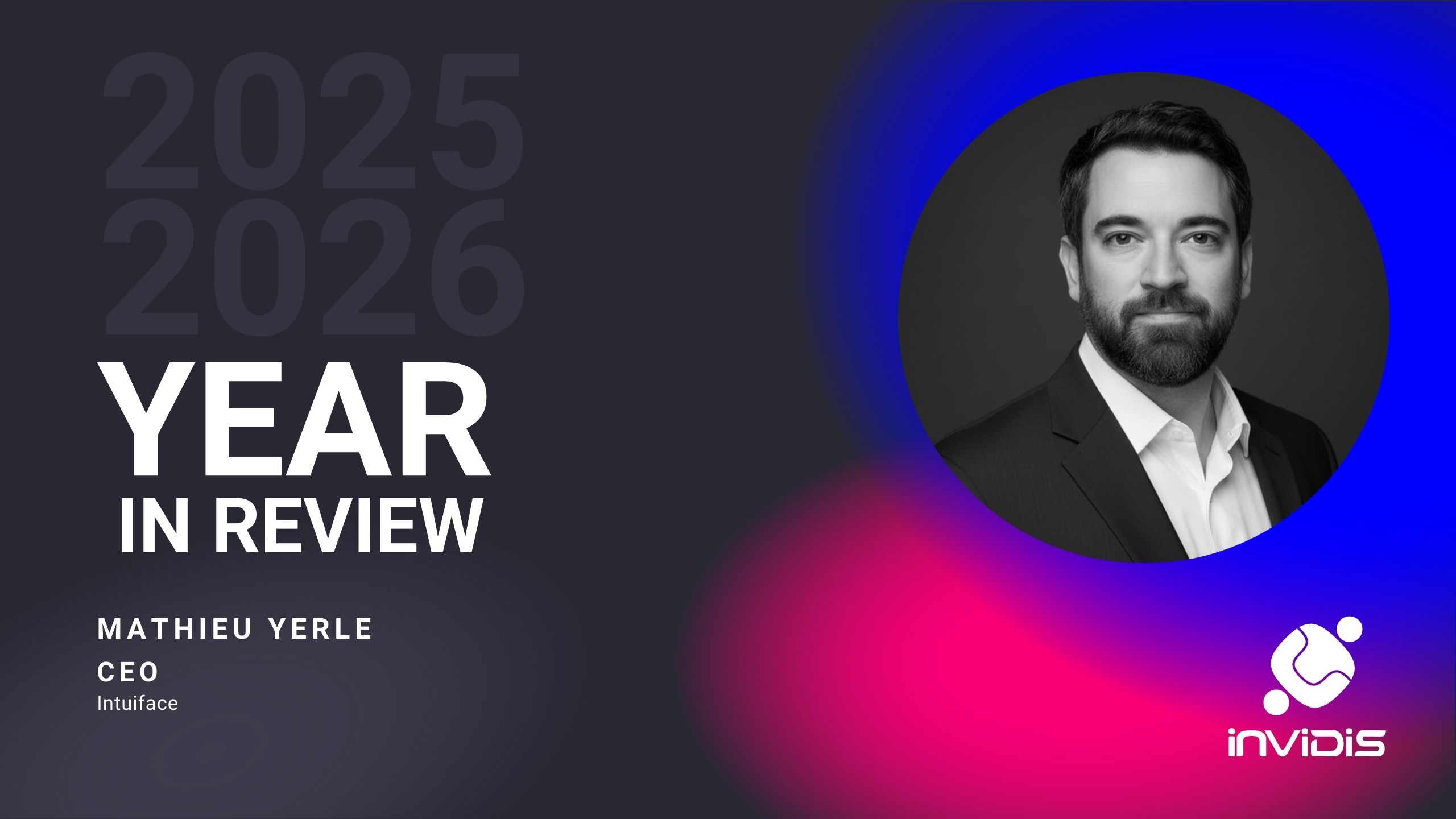
Year in Review 2025/2026: Mathieu Yerle | Intuiface
It has been one year since I officially stepped into the role of CEO at Intuiface. Anniversaries as momentous as this one are a natural time to look back while planning for the year ahead.
When I decided to join this team a year ago, it wasn’t just because I liked the technology (though, admittedly, it’s brilliant). It was because I saw a massive, untapped shift on the horizon of digital communication. I saw an industry standing at the same precipice that media and entertainment faced a decade ago.
The world of digital signage has been comfortable for a long time. It has relied on the safe, predictable model of the playlist: put an image on a screen, schedule it to run from 9 to 5, and hope someone looks up from their phone long enough to notice. But hope is not a strategy, and passive broadcast is no longer enough.
Over the last 12 months, my conviction has only deepened. We are moving away from screens that talk at people, and toward experiences that talk with them.
The “streaming moment” for physical spaces
My background in media (I worked at several leading software vendors in the space for 12+ years) gave me a front-row seat to the death of linear TV. We witnessed audiences abandon the “sit back and receive” model in favor of the “lean forward and choose” model of streaming. Viewers stopped accepting what was programmed for them and started demanding autonomy. They wanted to choose their own path.
When I looked at the digital signage landscape last year, I saw “linear TV” everywhere. Static menu boards, looping corporate messaging, silent video walls. It was a one-way street of pre-programmed messages.
The reason I joined Intuiface – and the driving force behind our strategy for 2025 and beyond – is to bring that “streaming moment” to physical spaces. Today’s audiences are digitally native. They touch, they swipe, they query. They don’t want to be told; they want to engage.
If your digital strategy doesn’t allow for agency, you aren’t just behind the curve; you’re invisible.
Beyond “proof-of-play”: the ROI of interaction
One of the biggest frustrations with traditional digital signage has always been the metrics. Or rather, the lack of them. The industry standard has been “proof-of-play.” Did the content run? Yes. Did anyone care? We have no idea.
This is why the shift to interactivity is not just a creative choice; it’s a financial imperative.
Interactive experiences put the user in control. They explore, they react, they connect. In return, organizations gain something they’ve never truly had before: real engagement metrics. When an audience member interacts with content – whether by touch, voice, attention, or any other mode of interaction – they generate data.
We are moving the industry from “impressions” to “interactions.” We can now measure how, where, and when people engage. This turns digital communication from a cost center into a measurable, iterative discipline where ROI is clear and optimization is constant.
AI as a creative copilot, not a gimmick
This brings me to the most significant investment we’ve made at Intuiface during my first year.
2025 was the year AI became ubiquitous, but it also became noisy. We saw countless tools bolt on a generic “Chat with your PDF” feature or wrap a basic Large Language Model (LLM) in a shiny UI and call it innovation.
At Intuiface, we took a different path. We decided to re-architect the way interactive experiences are created. We are embedding AI as a true creative copilot, focusing on the heavy lifting that slows teams down.
Think of AI not as a content generator that spits out generic marketing copy, but as an “underlord.” It works quietly in the background, orchestrating layout, handling data binding, managing behavior, and ensuring adaptation.
We are integrating AI into the core creative flow to assist with:
- Structure and Logic: organizing complex navigation paths automatically.
- Infrastructure: handling the messy “plumbing” of APIs and data connections.
- Storytelling: suggesting flows that maximize user retention.
By letting AI handle the mechanics, we free up creators to focus on meaning, emotion, and design. This isn’t about replacing human creativity; it’s about removing the friction that stops great ideas from becoming deployed reality.
Looking ahead to 2026
As I look toward my second year and the industry’s future in 2026, our choice is clear. We are going to embrace a future where value is measured by engagement, interaction, and insight.
To guide this transformation, our mission remains to help every organization turn every screen into a living story and every interaction into measurable impact. Because the future of digital communication isn’t about playing content, it’s about starting conversations.
Looking forward to reconnecting with all of you at ISE 2026. Be sure to come by (Hall 4 – Booth 4M600) and check out Experience Generator for yourself!