
New York City | Sustainability may not be a headline topic in today’s U.S. retail market, yet at NRF it appeared in unexpected places. The most innovative green signage solutions were not loudly promoted but quietly embedded in practical, cost‑saving technologies.
NRF 2026: Sustainability Through the Backdoor
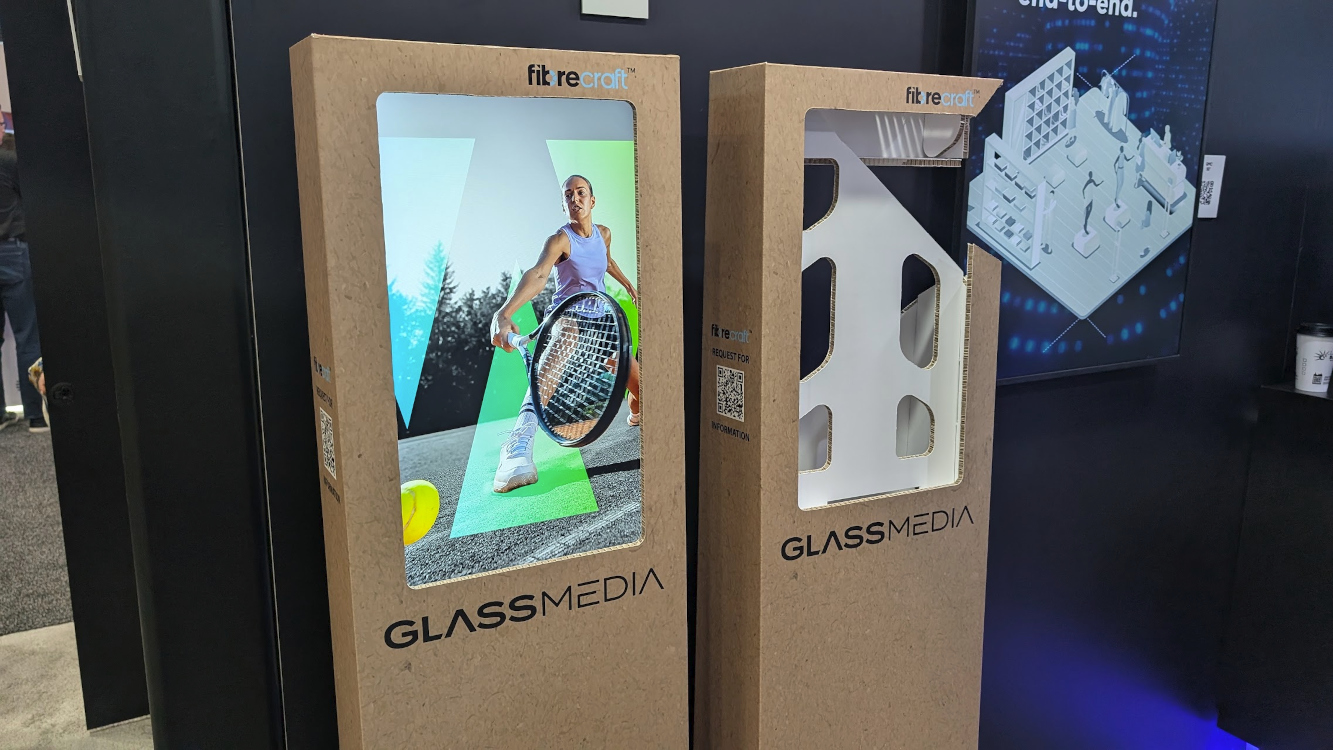
At NRF in New York, sustainability surfaced where few expected it. While AI and LED digital signage displays drew most of the attention, the more meaningful sustainability story played out away from the spotlight. Samsung’s booth, for example, showcased its spatial LCD displays, but the true eye‑opener was found in a corner: cardboard totems by Glass Media and compact e‑paper screens that offered a surprisingly disruptive alternative to traditional digital signage.
Retailers reacted strongly to these modest‑looking solutions because they dramatically reduce logistics, cost, and carbon footprint. The concept is simple: recyclable cardboard structures carry printed branding, while only a small digital component needs to be returned after the campaign. Combined with low‑energy LCD or e‑paper displays, these setups offer a contemporary signage solution that is both highly economical and inherently sustainable – without the need for overt “green” messaging.
Sustainability at NRF also revealed itself in operational efficiency, from advanced Remote Device Management that reduces service visits to new display generations designed for lower energy consumption and longer lifecycles. These developments show how sustainability is entering U.S. retail not through moral positioning but through practical, cost‑driven innovation. Retailers may not ask for green signage directly, but through demands for lower energy bills, lighter logistics, and more resilient networks, sustainability is advancing – quietly, effectively, and very much through the backdoor.
Even in the U.S. – traditionally a market with very low energy prices – electricity costs are climbing at the fastest pace in more than a decade. The main driver behind the double‑digit increase over the past twelve months is the ongoing data‑center boom. Hyperscalers and AI platforms are consuming unprecedented amounts of power: OpenAI alone is estimated to spend more than USD 2 billion per year on electricity, with costs set to rise sharply as additional data centers come online.