
New York City | The retail market has not been waiting for yet another digital platform to sit alongside – and often overlap with – existing ERP, CRM, DXP, and analytics solutions. Nevertheless, former ESL specialist Solum believes the time is right to reposition itself as an “Intelligent Store Management Platform” provider.
NRF 2026: Solum Introduces Store Management Platform
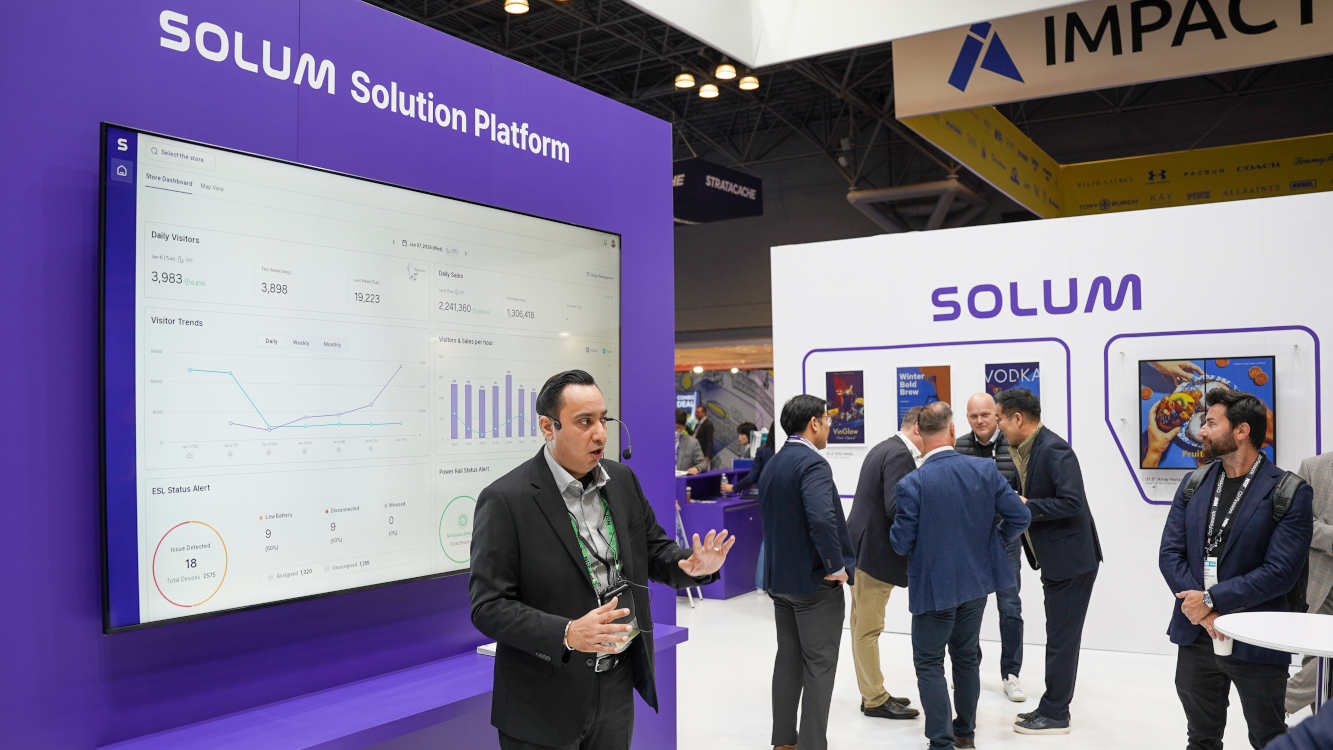
When NRF 2026 opens its doors on Sunday, the Korean retail-tech company Solum aims to place its new positioning firmly in the spotlight. Originally known for its Electronic Shelf Label (ESL) technology, Solum is now moving beyond its historic hardware footprint. The result is a new, integrated offering: the Solum Store Platform (SSP).
From ESL specialist to platform player
Solum’s ambition is clearly platform-driven. The SSP is designed to unify data streams that are typically isolated in today’s stores, including ESLs, AI-powered cameras, digital signage systems, and a variety of in‑store sensors. Rather than treating these technologies as standalone solutions, Solum aims to connect them into what it calls a single, organic data pipeline.
The goal is to give store operators full visibility across operations and enable real-time management of inventory, customer traffic, staffing efficiency and in-store marketing from one centralized dashboard. According to Solum, this holistic view is intended to simplify store management and reduce manual intervention – an increasingly critical requirement as retailers struggle to staff and operate physical locations efficiently.

Expanding from Europe and Asia to North America
As a former Samsung spin-off, Solum is already a well-established technology provider across Europe and Asia, where ESL adoption is comparatively mature. With the SSP, the company is now preparing a broader push into North America, positioning its platform as a fully integrated alternative to the patchwork of systems still common in many U.S. and Canadian stores.
Unlike traditional store setups, where pricing displays, analytics, signage, and operational tools often function independently, Solum’s platform approach is intended to break down these silos. Whether this level of integration can coexist smoothly with retailers’ existing IT stacks remains an open question.
“Retail-in-Sync” experience zones at NRF
To make its software platform strategy tangible, Solum is showcasing four so‑called “Retail‑in‑Sync” experience zones at NRF 2026, each designed to highlight a specific application area of the SSP:
- Customer Experience: a “Smart Beauty” solution where Vision AI analyzes skin data and syncs with ESL location guides to provide personalized product recommendations
- Operational Efficiency: Demonstrates how BLE (Bluetooth Low Energy) cart tracking and ESL integration can drastically reduce order picking times for online fulfillment
- Data Monetization: a Retail Media Network (RMN) model that analyzes foot traffic and ad engagement to measure actual conversion rates
- Sustainability: Showcases an energy-optimized store management system that uses AI sensors to automatically adjust lighting and HVAC based on zone-specific occupancy
$1,6bn order backlog
From a business perspective, Solum enters NRF with a reported US$1.6 billion order backlog and multiple proof-of-concept projects underway with large North American retailers. The company also emphasizes its vertically integrated manufacturing model, with production facilities in Vietnam, Mexico, Brazil, India, and China, positioning this as a hedge against supply chain volatility.
Whether Solum’s Store Management Platform can move from PoC to large-scale rollout will depend less on technology readiness and more on its ability to integrate with existing enterprise systems – and to clearly define where its platform adds value rather than redundancy.
With SSP, Solum joins a growing group of vendors attempting to redefine the store as a data-synchronized, software-driven environment. NRF 2026 will reveal whether retailers see this as the next logical step – or yet another platform competing for attention in an already crowded IT landscape.