
Tariffs and trade tensions are reshaping the ProAV industry. Rising hardware costs, project delays, and strategic pivots toward software and Mexico-based manufacturing are changing the game for integrators and vendors alike. How the ProAV and digital signage channel is adapting.
ISE 2026: Tariffs, Trade Barriers and Supply Chain Shifts
Geopolitical tensions and shifting trade policies are leaving a deep mark on the ProAV industry. Tariffs, retaliatory duties, and unpredictable regulations have created a volatile environment for manufacturers, integrators, and buyers alike. invidis spoke with Michael Sullivan-Trainor, Senior Industry Analyst at Avixa, about the impact on the AV channel and what the future holds.
Strategy Session at ISE 2026
Join invidis’ Florian Rotberg, Avixa’s Michael Sullivan-Trainor and global trade experts at the ISE 2026 Tradescape Forum on Wednesday (4 February) at 16:40 h for a 90min programme discussing the impact of tariffs, trade barriers and supply chain shifts on ProAV and digital signage.
Price Pressure and Project Delays
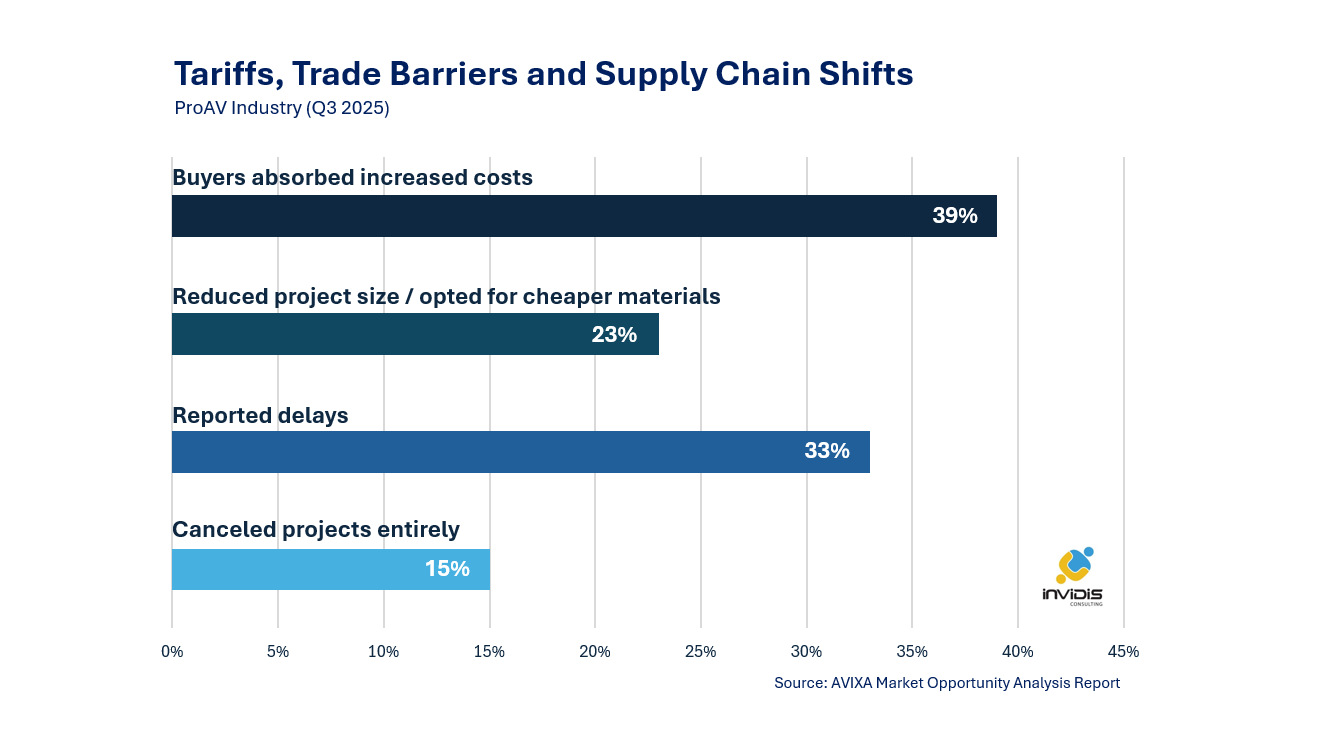
Recent U.S.-driven tariffs – and reciprocal measures – have triggered price hikes across key hardware categories: displays, cameras, lighting, and computing components. “The net effect is clear: higher costs and delayed projects,” Sullivan-Trainor explains. Many buyers have postponed installations due to fluctuating pricing, while others scaled back scope or switched to lower-cost materials. Latest insights are provided by Avixa’s Market Opportunity Analysis Report (Q3 2025)
Impact of Tariffs on ProAV Projects
- 39% of buyers absorbed increased costs
- 23% reduced project size or opted for cheaper materials
- 33% reported delays
- 15% canceled projects entirely.
Cost-Sharing and Stockpiling
To soften the blow, the industry has adopted a cost-sharing approach – manufacturers, integrators, and end users splitting the tariff burden. Some firms stockpiled equipment ahead of tariff deadlines, but inventories are shrinking fast, setting up a challenging 2026.
Catalyst for Change: Software and Mexico
Hardware tariffs are accelerating the shift toward software, cloud services, and SaaS models, which bypass import duties entirely. At the same time, the U.S. tariff landscape is driving a strategic pivot to Mexico as a tariff-free manufacturing hub for North America. Companies with existing Mexican operations are well positioned, while those reliant on China or Vietnam face steep disadvantages.
Europe and Latin America are also feeling the pinch. Retaliatory tariffs on U.S.-made goods and redirected Chinese exports have created short-term supply gluts in Europe, pushing prices down – but only temporarily.
Supply Chain Resilience: Lessons Learned
The pandemic exposed vulnerabilities in AV supply chains, triggering three waves of disruption between 2020 and 2022. Today, availability has largely normalized, but the experience left a lasting impact. Avixa’s 2025 Channel Survey shows:
- Supply chain issues dropped from 40% in 2024 to 29% in 2025 as a top challenge.
- Inventory buffering fell from 30% to 13% year-over-year.
Integrators have adopted permanent changes: diversifying suppliers, ordering earlier, and sourcing locally. “The surge in companies securing their own supply adds robustness to the entire channel,” Sullivan-Trainor notes.
New Markets and Slower Growth
Trade uncertainty isn’t the only driver of change. Avixa forecasts a CAGR of 3.9% for 2025 – 2030, down from 5.35% previously. Slower growth is pushing firms to explore new markets—both geographically (India, Latin America, Middle East, Southeast Asia) and vertically, such as broadcast solutions for corporate clients and AV services for media companies.