
A new market study reveals a mixed outlook for Germany’s advertising industry. While many companies expect stable sales, ad budgets are set to stagnate. If theey can't measure the impact, they're not willing to spend.
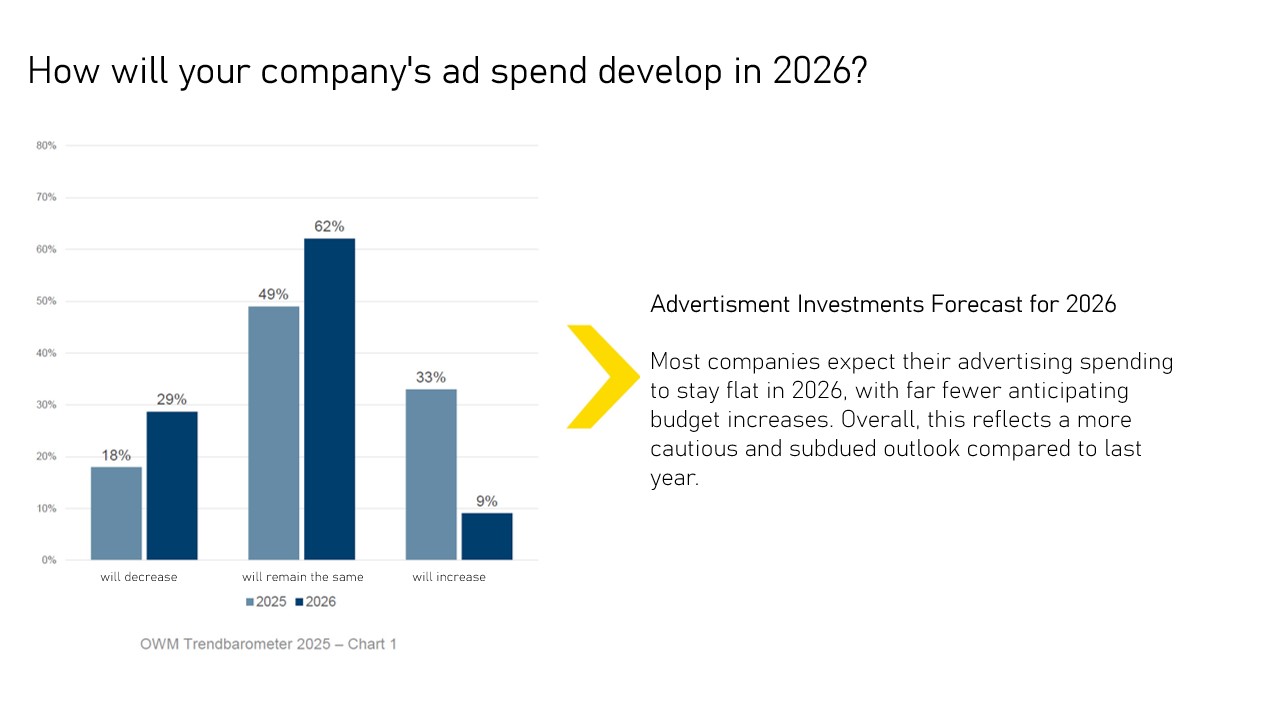
Germany’s Ad Market: Budgets Set to Stay Flat in 2026
The OWM Trend Barometer 2025 reveals a mixed outlook for Germany’s advertising industry. While many companies expect stable sales in the coming year, advertising budgets are set to remain flat in 2026. Key forces shaping the agenda include artificial intelligence, media fragmentation, and the ongoing challenge of measuring advertising impact.
Germany – the world’s fifth-largest advertising market – is experiencing a slow-down in ad spend, while sales seem to be performing better than last year.
According to the latest OWM Trend Barometer, around 70 percent of German member companies surveyed report positive sales growth this year, marking a notable improvement over the previous year. Yet despite the better business performance, advertising investments have declined sharply. The proportion of companies cutting their ad budgets has more than doubled, and most expect advertising spending to stagnate in 2026.
Cautious confidence in the economy
Even amid a weakening advertising market, many companies remain cautiously optimistic about the future. Most anticipate stable or slightly increasing sales in the coming year. Nevertheless, the overall economic outlook continues to be approached with restraint. Persistent uncertainties include consumer sentiment, tariffs, political developments, and the energy supply.
Measuring ad impact: still the biggest hurdle
A striking 92 percent of respondents identify the lack of transparency in advertising impact as their top challenge – a figure that continues to rise. Other major concerns include reaching fragmented target groups (89%) and data quality in programmatic marketing (85%).
Additionally, topics such as artificial intelligence, regulatory requirements, transparency, and talent qualification are gaining significance across the industry.
Doubts about the industry’s future readiness
While many companies are confident in their own future viability, they remain critical of the broader German marketing and media ecosystem. Only a small number believe it is adequately prepared to meet the challenges ahead.
Looking toward 2030, the key drivers of change are expected to be AI and automation, the fragmentation of the media landscape, and the comprehensive measurability of advertising.
Digital channels continue their ascent
Clear shifts are visible in the media mix. Online video, connected TV, social media, influencer marketing, and retail media are all on a strong growth trajectory. Podcasts are also gaining momentum, while search engine advertising shows only moderate growth. In contrast, print and linear TV continue to lose ground.